
Indian Aviation - Price Wars & More
🌐 International Buyers — Pay via PayPal
Details
MKTG029
12
2002
YES
300
Not Applicable
Transport & Logistics
India
Pricing
Abstract
The case examines the marketing strategies adopted by players in commercial aviation industry in India in 2002. It provides details about the industry’s evolution from a single-player monopolistic regime to its intensely competitive multi-player days in 2002. The marketing strategies adopted by the players, in terms of price-reduction, innovative customer service efforts and other promotional activities have also been explored. The case also debates the sustainability of the above strategies in the light of the fact that these were being seen essentially as short-run exercises by industry observers.
Learning Objectives
The case is structured to achieve the following Learning Objectives:
- Changing environment of the Indian aviation industry, intensifying competition.
Contents
“There are no riders and no undercutting involved. It’s all very transparent. We are targeting an entirely new passenger segment through this novel scheme.”
- Uttam Kumar Bose, CEO, Air Sahara, Commenting on the ‘Steal a Seat’ campaign, in August 2002.
The months of July and August 2002 witnessed unprecedented development in the commercial aviation industry in India. For the first time in the history of the industry, efforts were made to make air-travel affordable for a larger section of the population. With air-travel fares being much higher than rail and road travel fares, the average Indian traveler rarely traveled by air. However, in these two months, the companies offering air-travel changed the market dynamics completely. The reason for the above was not very difficult to understand. Though there were only three major players in the Indian aviation market, namely Jet Airways (JA), Air Sahara (Sahara) and the state-owned Indian Airlines (IA), competition was getting fiercer by the day. Thus, when JA launched its promotional campaign 'Everyone Can Fly' that offered special fares on select routes, industry observers commented that such a move was long overdue. Immediately, IA responded by launching its 'U Can Fly' scheme with similar conditions as that of 'Everyone Can Fly.'
Thousands of seats were to be offered by both JA and IA between August 1 and October 31 at rates, which were comparable with rail fares. The special fares could be availed of booking at least three weeks in advance. Though JA claimed that its campaign was a move to commemorate the first flight of 'Wright Brothers' in 1902, there were few takers for this.
In August 2002, Sahara surprised its competitors and customers alike, by announcing the 'Steal a Seat' campaign. Beginning August 26, 2002, customers could bid for 10% of Sahara's unsold seats for as low as Re 1. However, customers would have to plan their journey 25 days in advance. They could bid for their destination online at a leading portal, www.indiatimes.com, or through phone, fax or e-mail. The 'Steal a Seat' scheme followed the already popular 'Sixer', 'Bid 'n' Win' marketing campaigns of the carrier.
As a result of these aggressive marketing strategies, fares continued to decline on a daily basis as compared to the 10% increase per annum in the past and sales increased. Airline companies seemed to be happy, as it was much better to earn lesser revenues than fly planes with empty seats. However, some industry observers felt that companies took this decision out of desperation to increase the stagnating air-travel revenues. It was also being felt that they were nothing but short- term gimmicks as the companies would not be able to financially sustain these for long. Moreover, it would be irrational to expect travelers (especially those from the business class) to plan their travel 21 days in advance.
The history of Indian aviation industry dates back to the early 1930s, when one of the leading Indian business houses, the Tatas set up the Tata Airlines. There was limited activity in the field over the next two decades despite eight more private companies entering the fray. In 1953, the Air Corporations Act 1953 came into force and all the assets of the then existing nine airline companies were transferred to two corporations – Indian Airlines Corp. (IA) and Air India International (Air India). While Air India offered international air services, IA offered domestic services. The Air Corporations Act 1953 prohibited any person or company to operate any scheduled air transport services from, to or across India. Therefore, two corporations enjoyed a monopoly status in the scheduled air transport services market. In 1962, Air India International was renamed Air India Ltd.
In 1986, private airlines were allowed to operate chartered and non-scheduled services under an 'Air Taxi' scheme. The scheme was introduced to boost tourism and augment domestic air services. The carriers were however, not allowed to publish time schedules or issue tickets to passengers. The government's aviation policy was progressively liberalized in the early-1990s. In 1993, the Air Corporations Act 1953 was abolished, which put an end to the monopoly in the scheduled air transport services market. After the abolition of the Cororations Act in 1953, there was a considerable change in the government's aviation policy.
From March 1994, the market was opened to any company that fulfilled the statutory requirements of the scheduled services. The government approved eight private carriers to start domestic operations; Some of them were JA, Sahara, Indian International, Archana, East West, NEPC, Modiluft, and Damania. While Indian International was the first licensee after the open skies policy in 1994, East West was the first scheduled airline to take off the ground. In 1995, the Airports Authority of India (AAI) was formed through the AAI Act merged the National Airports Authority (NAA) and International Airport Authority of India (IAAI), the separate national and international airport authorities. The AAI offered infrastructural facilities to all airlines. At this point of time, there were 449 airports. There were five international airports including Delhi, Mumbai, Kolkata, Chennai and Thiruvanantapuram, for scheduled international operations by Indian and foreign carriers.
However, by late 2000, most of the players disappeared – some with short-time successes and some suffering losses from the very beginning. The reasons were aplenty – lack of experience in the business, lack of proper planning and poor promoter support. According to analysts, none of the private carriers had the staying power or the professional expertise required in the aviation industry. Rasheed Jung, an aviation consultant, said, “All of them, bar none, were riff-raff. All of them were financially extremely weak and almost all of them had extremely poor management.” Damania, established by a poultry-farm owner Parvez Damania from Pune (Maharashtra) was one of the first private airline carriers to close down. The airline was sold to NEPC in September 1995. Since NEPC was already doing well in South India, by acquiring Damania, which was operating in the North India, it could expand its operations throughout the country.
However, NEPC ran into problems after the acquisition when the Securities and Exchange Board of India (SEBI) revealed that the deal was an unfair trade practice. Eventually, NEPC landed in serious financial problems and the company defaulted on payments. East West Airlines was very successful initially with smart looking air hostesses, and courteous and accommodating ground staff, until rumors about East West being funded by the underworld don Dawood Ibrahim surfaced.
The company fought back with an extensive advertisement campaign denying the rumors. The government enquiry also could prove nothing against it. However, the problems were far from over. The company owed $3 million to PLM Equipment as lease rentals. In addition, there was a change in the government regulations and it became mandatory for all airlines operating on Category I routes (the most profitable) to operate on Category II and III routes as well (Refer Exhibit I) which were not as profitable. East West was eventually closed down in August 1996.
Similarly, ModiLuft, a joint venture of the Modi group with Lufthansa of Germany, the world's most expensive airline, was into problems right from the start. Though ModiLuft showed book profits, it defaulted on payments to Lufthansa. And though Lufthansa agreed to invest 40% equity in ModiLuft initially, it did not actually do so. The Modis also complained that Lufthansa did not allow ModiLuft to enter into financial agreements with others and the rates at which it offered its services was quite high. For instance, while a Lufthansa pilot cost $32,000 a month, a Malaysian Airlines pilot cost $6,000. S.K.Modi said, “Our mistake was that we hired the most expensive airline in the world to give us aircraft and services.” In May 1996, Lufthansa announced that the agreement was unilaterally terminated by them.
Analysts felt that most of the private carriers ran into problems because of the government regulations and high costs of operation. All the carriers hired planes at international prices and their maintenance was also undertaken by global companies at international rates. The only 'Indian advantage' was the availability cheap labor. However, the Indian fares were much lower compared to the global fares. For instance, European fares were almost five times higher than in India. Thus, despite the intense marketing efforts of various companies, by mid-2001, only JA and Sahara managed to stay afloat (along with IA) in the Indian market (Refer Table I).
Table I
Market Share: 2000-01
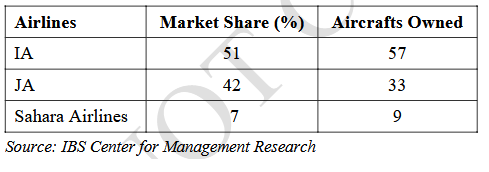 |
Sahara started its operations in December 1993 providing services on the Delhi-Mumbai sector. By 2001, it operated in 12 sectors with a fleet strength of 9, all of which were Boeing Aircrafts. The carrier was successful despite a small fleet and won many awards including Pacific Area Travelers Association Award (1997 & 2001), World Travel Market Global Award (1997), Diamond Award (1999) and International Food Services Association Award (1998). Sahara reported a turnover of Rs 3.5 billion in the fiscal year 2001.
JA was set up in April 1992, as a 100% subsidiary of TailWinds Ltd., a company registered in Cayman Islands (situated in the Northwest Caribbean Sea). Kuwait Airways and Gulf Air had 40% stake in TailWinds Ltd.2 In May 1993, JA started its operations in India with four Boeing 737-300s and based its operations in Mumbai. In 1997, the company's promoter, Naresh Goyal, bought the stake of Kuwait Airways and Gulf Air in TailWinds for an undisclosed sum, and became the sole owner of JA. By 2001, JA had a fleet of 33 Boeing Aircrafts.
JA's success could be mainly attributed to its excellent service. JA always ensured that its service surpassed customer expectations. If a flight was delayed, travelers were phoned and informed in advance. JA primary focus was on the business traveler. To attract and retain business travelers, it offered superior services. On all its flights of more than 20 minutes duration, light refreshments were served and on longer flights passengers were served non-alcoholic drinks, cold towels and a three-course meal. Every new flight attendant was at least put through three months of training in the first year and had to undergo several more hours of in-flight and classroom training thereafter. Because of the above reasons, the company emerged as a major competitor for IA, while Sahara remained the distant 'third rank' player.
As the government owned both AI and IA, the Indian commercial aviation air transport services market was monopolistic in nature. Not surprisingly, the concept of marketing was virtually absent in the aviation industry. The only advertising campaign ever run was AI that of which featured its mascot 'Maharaja', an elegant, plump little man, with a stylish turban and an impressive 'handlebar moustache.'
Advertising and marketing activities started only after the Indian skies were opened for private players. Initially, advertisements by the new players were limited to the print and electronic media. However, with the entry of new players in the 1990s, competition began to intensify. IA also expanded its domestic network and started foraying into international market. All the private airline companies undertook various marketing initiatives and launched aggressive and attractive advertising campaigns. All the advertisements tried to highlight value-added services and offered attractive schemes like festive season off, frequent flyer discounts and free tickets on completion of specified miles of travel.
Despite the aggressive marketing efforts by the companies, none of them was able to garner larger volumes. Companies therefore adopted various innovative marketing strategies like offering discounts, free tickets, and gifts like electronic equipment or kitchen appliances. Though these strategies were beneficial for customers, there was no significant growth in volumes. The downturn in the Indian economy during the late 1990s also affected the travel and tourism industry adversely. In April 1999, to cope with the situation, and take advantage of the potential of the peak summer passenger traffic, Sahara announced discounts of Rs 600 to Rs 1000 on all major routes. It offered Rs 1000 off on the Mumbai-Delhi route and Rs 700 on the New Delhi-Bangalore route. This triggered a price war and IA introduced a 50% off for government employees for its evening flights and also started hourly shuttle services between Mumbai and Delhi without any discounts. Though the flight timings and the far-off airport terminals were uncomfortable in Mumbai and Delhi, IA's volume increased.
Analysts felt that Sahara could not exploit its discount offer completely as it had a small fleet size of four Aircrafts, which was much lesser than that of its rivals. IA on the other hand, introduced hourly shuttles on the Mumbai-Delhi route and thus, offered more seats. As JA had become known and trusted for its superior service, it chose not to offer any discounts. Instead, it formulated a new strategy and intensified the marketing war initiated by Sahara.
In August 1999, JA entered into agreement with leading hotels and announced discounts between 20-50% on room rates for its passengers flying by the economy or business class. It also offered package tours to Goa. The list of hotels included the Taj Group of hotels all over India, the Welcome Group of Hotels in Bangalore, Ooty, Chennai and Hyderabad, Hotel Hindustan International at Kolkata, Le Meridien in New Delhi and Hotel Pride in Pune. Apart from discounts on rooms, passengers were also entitled for a lucky dip, which would give them a free return ticket and a two-nights free stay at the hotel offering the discount. However, analysts felt that such schemes would not last too long as the hotels were already offering huge discounts due to their low occupancy rates. By September 1999, JA had to eventually reduce its rates.
As IA was making some profits due to its lower fares, it decided to continue the discounts. Sahara and JA also seemed determined to carry on with price cuts. As a result of these price wars, fares fell down by 30%. For instance, for the Mumbai-Delhi route, fares fell from Rs 5,110 to Rs 3,800 (JA and IA) and Rs 3,555 (Sahara). The price war continued till October 1999 when the fares were brought back to their original levels in the peak season.
In December 1999, JA re-launched its frequent flier program called 'Jet Privilege' (JP, initially launched in 1994) wherein passengers could earn miles by taking a JP flight. Customers were not required to pay membership fees to become members and did not have to produce boarding cards or other proof of travel. The new program offered three different levels of privileges: JP Blue, JP Silver and JP Gold, depending on the number of miles accrued or the number of flights flown. JP Silver and Gold members could earn bonus miles on all JA flights and enjoyed lounge access, tele check-in benefits. JA also tied up with international carriers like KLM Royal Dutch Airlines and Northwest Airlines, as a result of which, JP members could earn miles on these airline networks as well. They could redeem their miles when they had earned at least 10,000 miles or had flown 10 flights. JA also tied up with Oberoi Hotels and Resorts, and Radisson Worldwide, which enabled its members to earn miles on their stay at any of these hotels.
The price reduction story was repeated in June 2001 with IA announcing price cuts on the Mumbai-Chennai, Goa-Mumbai, Mumbai-Kolkatta, Mumbai-Bangalore and Ahmedabad- Bangalore routes. It also reduced the 'day return fare' on the Mumbai-Delhi route and relaxed the rules by permitting passengers to take any return flight on the same day. IA also introduced 'Specific Flight Fares' on the Delhi-Chennai-Delhi route apart from the existing Delhi-Mumbai- Delhi and Mumbai-Bangalore-Mumbai sectors. It also reduced the 'Round Trip Executive class fare' on the Mumbai-Bangalore-Mumbai route from Rs 10,635 to Rs 9,165.
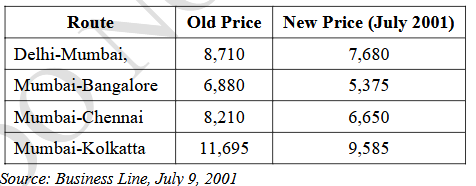
JA followed suit and reduced one-way business class fares in four sectors including Delhi- Mumbai, Mumbai-Bangalore, Mumbai-Chennai and Mumbai-Kolkatta (Refer Table II). It also reduced the economy class fares in five sectors including Delhi-Mumbai-Delhi (Rs 10,280), Mumbai-Bangalore-Mumbai (Rs 8,160), Mumbai-Chennai-Mumbai (Rs 9,000), Mumbai-Indore-Mumbai (Rs 5,480) and Mumbai-Kolkatta-Mumbai (Rs 12,900). Unlike 1999, when the competitors reduced prices in the same sector, in 2001, the reduction was in different sectors, which benefited customers most. However, industry watchers were doubtful whether the price reduction and promotional fares could help the companies in any way.
Table II
JA’ One-way Business Class Fares during July 2001
 |
The fare war in 2002 was the most aggressive ever with innovative offers most of which had been adopted from the global aviation market. It started in June 2002, when IA announced a 3-15% cut in fares for all classes for the western sector and the Delhi-Srinagar, Delhi-Jammu, and Delhi- Khajuraho routes. The next day, JA reduced its prices by Rs 635 for the economy class on the Mumbai-Nagpur route and the Mumbai-Goa route.
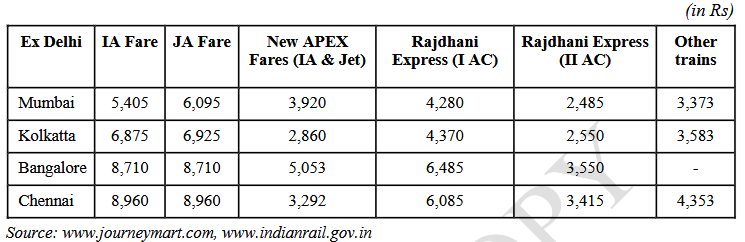
One of the most innovative offers (following the global aviation industry's footsteps) was the Advanced Purchase Excursion (APEX) Fares scheme, under which the passengers had to book their tickets at least three weeks in advance and they would get huge discount on the fares. IA introduced the APEX fares under its 'U Can Fly' scheme and JA under the 'Everyone Can Fly' scheme. (Refer Table III and Exhibit II for APEX fares).
Despite the fact that planning air-travel three weeks in advance was not very convenient, the APEX scheme was very successful for both IA and JA. Anil Goyal, Commercial Director, IA, said, “We have 1,600 passengers flying everyday under the APEX scheme. This means an addition of about 10% to the number of passengers carried during the lean season. Revenue generation and passenger load factor have also increased.” The APEX scheme had another inherent disadvantage – which of high cancellation charges. Passengers had to lose 50% of the ticket price if the ticket was cancelled less than 21 days before the travel date.
Table III
Apex Fares of IA and JA for Ex-Delhi (August 2002)
 |
JA also reported an increase in the number of passengers flying, after the introduction of APEX fares. Saroj Dutta, Executive Director, JA said, “The average number of passengers flying on out advance purchase tickets is around 1,500 per day. That means we are selling most of the 1,850- 2,000 seats offered every day under the concessional window. The response is every encouraging for a new scheme which has been introduced only recently.”
However, Sahara seemed to have adopted an intelligent marketing strategy by offering innovative schemes rather than offering APEX fares. U K Bose, CEO, Sahara said, “While the two rivals fish for railway passengers, let's tap their customer base. Therefore, Air Sahara has advance purchase offers on the Net with high discounts while going all out through the marketing network with its 'Sixer' and 'Super Sixer' schemes which are free of the riders that dog advance purchase fares. For a fixed sum, both schemes offer travel on six sectors, with no need for advance booking or photo-identity which is necessary for APEX concessions.”
In March 2002, Sahara launched a unique 'Wings & Wheels' scheme in the metros – Delhi, Mumbai, Kolkatta and Chennai. The scheme offered complementary air-conditioned coach services to pick up passengers at designated points in the cities and drop them at the airport. The coaches also dropped passengers from the airport to certain locations within the city. The coach also had attendants and offered add-ons like magazines, newspapers, mineral water, soft drinks, and other refreshments.
During July-August, it launched the 'Sixer' offer, a limited offer scheme for all passengers, which enabled the passengers to buy a six-flight coupon ticket and fly any six sectors on the carrier's network for Rs 25,000. The validity of the ticket was till December 2002. U.K. Bose reported that tickets under the Sixer offer sold like 'hot-cakes' and explained, “When it comes to the crunch, passengers will realize that unrestricted travel is more useful even if the tariffs are a bit higher.” Analysts felt that the scheme was successful because of the flexibility it offered. If one planned properly, the tickets would work out less than the APEX fares offered by IA and JA.
On July 21, 2002, Sahara also rolled out a new scheme 'Crickcitement,' with an investment of Rs 250 million. The captain of the Indian Cricket team, Sourav Ganguly was chosen as the brand ambassador for the campaign. The campaign planned to use cricket as a tool to connect people and encourage them to travel by the airline. The campaign was also expected to promote destinations connected by the airline. Under the campaign, a flyer (any class) had the opportunity to win a wide range of gifts (including a luxury car) everyday. U.K.Bose explained, “Realizing the craze for cricket among Indians, we thought it would be appropriate to induce them to travel and get maximum benefits. The Crickcitement is an initiative to promote not only cricket but also tourism coupled with prize-winning schemes, which are simple, as there is no question or slogan to be answered. Hence, passengers can win one million prizes including a Rs 250 million Timber Chalet at Sahara Lake city, Amby valley Lonavala (Mumbai), an E-class Mercedes, Plasma TVs, Pentium 4 computers, fully expense paid tours to watch India play at Sri Lanka, New Zealand and South Africa.”
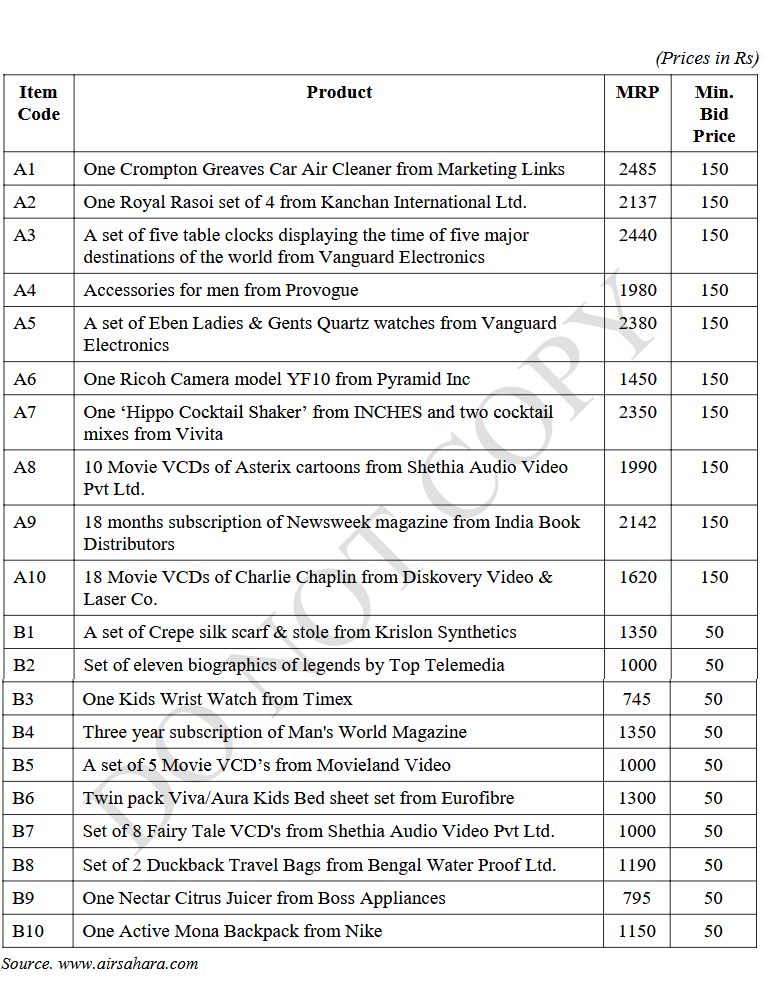
In early August 2002, Sahara launched the 'Bid 'n' Win' scheme, which aimed at making the journey more exciting, interactive and enjoyable. The money generated from the scheme was transferred to the Sahara Welfare Foundation, a fund dedicated to social causes. Passengers on board could bid a wide range of gifts categorized as A and B. The base price for category A and category B items was Rs 150 and Rs 50 respectively (Refer Exhibit III).
However, what shocked industry observers most was Sahara's 'Steal a Seat' online bid scheme in August 2002. Under the scheme, the base price for the tickets was kept at Re 1, and the scheme was open for passengers flying 25 days later. For unsuccessful bidders, there was another scheme called 'Steal Buys' scheme under which they could bid 24-15 days in advance at a reserve price, which could work out much cheaper than the APEX fares offered by IA and JA. Sahara also offered the Delhi-Mumbai ticket for Rs 4,000 if it was bought between 15-19 days in advance, whereas IA and JA charged at Rs 5,535 and Rs 5,405 respectively for the same time period.
On August 15, 2002, IA launched the scheme 'Wings of Freedom,' valid from August 15 to March 31, 2003. This scheme offered unlimited travel on the domestic network for seven days for Rs 15,000 (economy class) and Rs 20,000 (business class). The airline also planned to increase the commission of its agents and offer incentives for the most productive agents. At the same time, it also launched the 'Bharat Darshan (India tour)' which allowed unlimited travel for passengers who bought tickets worth more than Rs 80,000 was also launched. Moreover, while IA and JA were expected to revert to the original prices at the end of the lean season, i.e., October, many of Sahara's schemes would stretch till the year-end.
Industry observers remarked that the most interesting feature of the price war in 2002 was that Sahara, the smallest of the Big Three, was the most aggressive. Apart from launching the novel bid schemes, it also offered the highest agent commissions3 to increase volumes of the tickets sold, while maintaining the lowest fares. Analysts felt that this was because it had the smallest capacity among the three. However, Sahara increased its capacity in late 2001 and planned to lease about 6 additional Boeing 737s towards the end of 2002.
With increasing competition, the government owned IA also decentralized its fare revision policy, i.e., it allowed its regional heads to take their own decisions regarding the fares. Though IA claimed that the number of passengers had increased in 2002, analysts expected that the number would reduce. In 1996-97, the total number of airline passengers was 11.4 million, which fell to 10.5 million in 1998-99. In addition, it seemed doubtful whether the airlines would be able to attract railway passengers for long as the railway fares had come down in 2002.
Though the fare war was not expected to end very soon, analysts remarked that it would affect the financial stability of the private carriers in the long run. While IA owned the Aircrafts and was funded by the government, both the private carriers survived on leased Aircrafts. This lowered their margins and made it difficult for them to sustain these costs in the long run.
Some analysts felt that it was too early to predict the impact of the price war. Though the number of passengers had increased in 2002 as compared to 2001, it was mainly attributed to school holidays and increase in the number of business travelers. JA reported that its load factors remained at a 'sluggish' 65%. A senior official of JA explained, “The decision to lower fares was taken in view of companies cutting back on travel expenses and even CEOs travelling at the back of aircraft.” The official added, “It was too early to draw a comparison on how the downward revision had impacted the airline as the revised fares had come into effect from July 1.”
Meanwhile, IA for a change, seemed to be focusing more on its in-flight customer service initiatives rather than price-cuts to sustain the intensifying competition were taken. In August 2002, the state-owned carrier decided to use superfine bone china crockery to replace the melamine ware for the economy-class passengers and replace the crockery used for the upper class with a new elegant design. Company sources claimed that this was done to improve IA's image amongst its customers. However, since JA had always used bone-china crockery in both economy and upper classes, how far would this move give IA an edge in the air-wars, still remained to be seen.
1. Describe and analyze the evolution and structure of Indian aviation industry over the decades. Also, provide reasons for the failure of several companies in the initial phase of deregulation? What are the factors that have contributed to the industry rivalry?
2. Enumerate the customer service initiatives adopted by JA and Sahara to gain significant market share against a formidable competitor, IA? What strategies should IA adopt to retain its position in the market?
3. Examine the innovative schemes initiated by the three airlines in 2002. Do you think that the promotional programs undertaken by airlines are likely to increase the customer base and contribute to corporate viability? Is the intense rivalry exhibited through price-cutting (by industry participants) undermining their viability in the long run?
4. What strategies would you suggest for an airline company in the Indian aviation industry to enhance market share and increase user base? Which airline, according to you, is better positioned to extend its competitive advantage and enlarge its market share in the near future?
Exhibit I
Classification of Air-Travel Routes
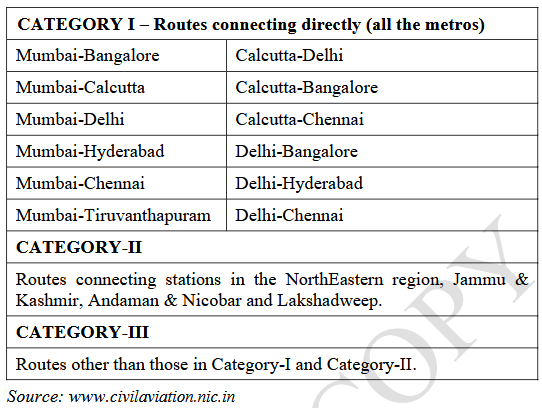 |
Exhibit II
JA Apex Fares
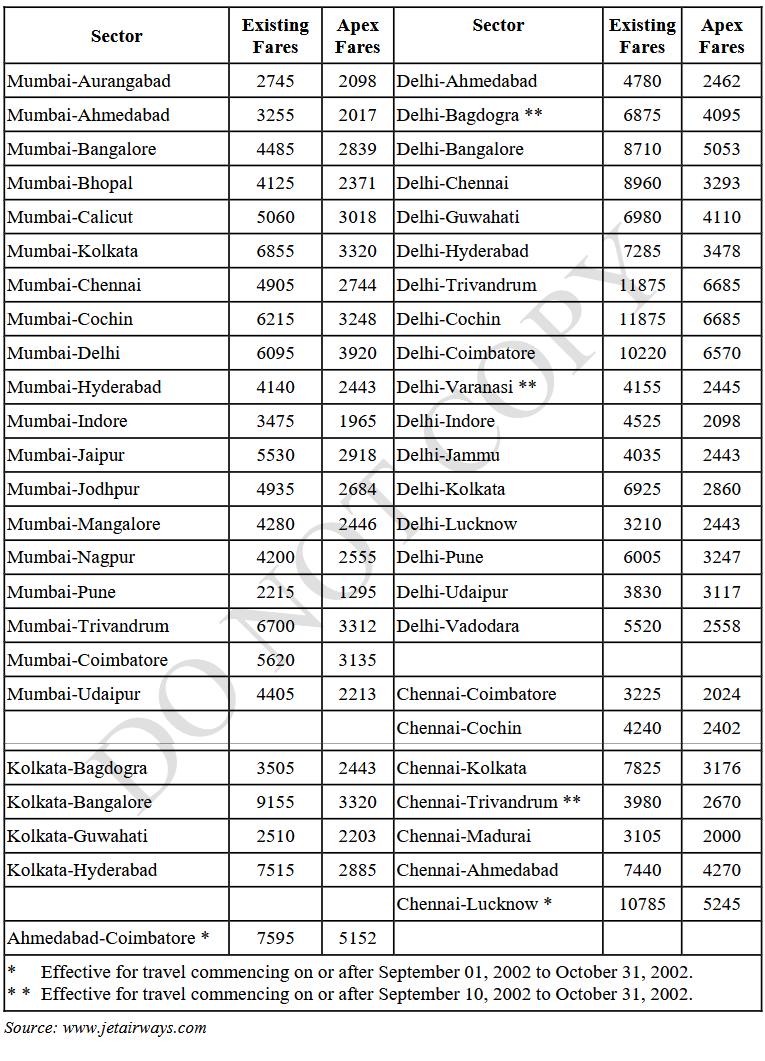 |
Exhibit III
Gifts Offered under Sahara’s ‘Bid ‘N’ Win’ Scheme
 |
Keywords
Marketing strategies, players, commercial aviation, industry, India, 2002, evolution, single-player, monopolistic regime, multi-player days, 2002, price-reduction, innovative customer service efforts, promotional activities , short-run exercises
Related Case Studies
| Case Title | Details | Price | Add to Cart |
|---|---|---|---|
|
Case Title The Nirma StoryCase Code: MKTG008 |
Details | 200 | Add to Cart |
|
Case Title Biscoff in India: The Premium ParadoxCase Code: CLMM170 |
Details | 200 | Add to Cart |
|
Case Title Uber’s Exit from China: A Raw Deal?Case Code: BSTR504 |
Details | 500 | Add to Cart |
|
Case Title Lululemon Athletica: An Ethical Fashion Brand?Case Code: BECG138 |
Details | 600 | Add to Cart |
|
Case Title Ecommerce in India: Will the Advertising Spend Pay Off?Case Code: MKTG341 |
Details | 600 | Add to Cart |