
Reinventing Cadbury
🌐 International Buyers — Pay via PayPal
Details
MKTG030
13
2002
YES
300
Cadbury India Ltd.
Food & Beverage
India; UK
Marketing Strategy,Advertising & Promotion, Brand Strategy
Abstract
The case examines Cadbury India Limited’s (CIL) repositioning strategies for its major brands during 1999-2002. This case provides a detailed account of the company’s growth and strong focus on continual product launches. It also examines CIL’s distribution, promotion and advertising strategies. The problems faced by CIL in the late 1990s and the initiatives taken by the company to retain its market position are examined. The case also discusses the company’s attempts to reinvent its major brands.
Learning Objectives
The case is structured to achieve the following Learning Objectives:
- Marketing strategies adopted by CIL to establish itself as the market leader.
Contents
“Typically, we always talk about chocolates being eaten when everyone is happy. And this is something advertising has always mirrored. But we found that chocolates are eaten under diverse conditions and moods – when people are anxious, when they are sad, when happy – a whole range of emotions. Now if you take a distillation of this thought, chocolate is a true soulmate. Someone who is with you through the ups and downs of life, helping you bounce back. And that's what Cadbury's Dairy Milk (CDM) is – a special friend. This is the thought that we have captured through different human-relationship plots. We are just showing the way CDM features in the consumer's life.”
- Piyush Pandey, Group President & National Creative Director, O&M (CIL’s advertising agency), commenting on CDM commercials, in March 2002.
In March 2002, India's number one chocolate company Cadbury India Ltd. (CIL), launched a new advertisement campaign for its flagship chocolate brand, Cadbury's Dairy Milk (CDM). The campaign featured a television (TV) commercial that was significantly different from the company's earlier commercials for the brand. It featured Cyrus Broacha1 interviewing college students and asking why they liked to eat CDM. This was followed by college students 'singing' their excuses for eating CDM.
Just as the commercial seems all set to end with the students and Cyrus singing the famous CDM theme, 'Khane Walon Ko Khane Ka Bahaana Chaahiye' (those who want to eat, will find excuses), a student comes up and questions Cyrus, 'Kyon Chaahiye?' (Why does one need an excuse to eat CDM)? The advertisement aimed at conveying the idea that no specific occasion is required for consuming CDM. This was a significant departure from CIL's strategy of appealing to adults in India, who sought a rational justification for indulging in chocolate consumption.
A source at CIL's advertising agency, O&M, explained, “The format (excuses campaign) was not giving the brand a chance to explore. And the formatting was having a marginal negative impact, especially among the youth, who still form some 70-80% of CDM's audience. Today, CDM is competing with colas, snacks and burgers. And there is a feeling that perhaps these products are speaking a lingo that is closer to the youth, and that CDM might not be connecting with the youth as well. Hence the change in format.”
Even as company watchers were analyzing this shift, CIL launched another campaign for CDM, which completely did away with the 'Khaanewaalon Ko…' campaign. The TV commercials that were a part of this campaign featured the tagline, 'Saath Rahe Har Pal' (accompany you every moment). Many people in corporate circles wondered why CIL had abandoned its carefully built up and highly successful four-year-old “excuses” campaign.
Few analysts felt that the company had been forced to reposition the CDM brand due to the severe competition from posed by archival Nestle India. Others were commented that CIL was only trying to infuse fresh life into CDM and give it a contemporary image. However, this radical shift was necessitated not by external circumstances but by series of changes that had taken place within the company.
CIL and the Cadbury's brand are synonymous with chocolate in the minds of Indian consumers. A part of the leading US-based global confectionery and beverages major, the Cadbury Schweppes group, CIL has been the leader in the Indian chocolate market for many decades. The company began manufacturing operations in Mumbai in 1946. CIL was initially incorporated as a wholly owned subsidiary of Cadbury Schweppes in 1948 and was called Cadbury Fry (India) Ltd. The first product to be launched in the country was the globally successful brand, CDM.
In the early 1960s, CIL shifted its manufacturing base to a plant in Thane, Maharashtra. The plant, which expanded substantially over the years, manufactured a range of CIL products. The company's R&D and engineering development divisions were also located in Thane. In the 1960s, CIL launched a range of products such as Crackle, 5 Star, Gems, Tiffins, Nutties, Butterscotch and Caramels. Most of these products became instant successes and led to rapid growth in chocolate consumption in India. Following this, the company launched Cadbury's Eclairs in 1972, priced at 25 paise.3 Eclairs, Cadbury chocolate, was a runaway success, despite being priced higher than the available sugar confectioneries in the market at that time.
In 1978, Cadbury Schweppes had to dilute 60% of its equity in Cadbury Fry to comply with FERA guidelines.4 Cadbury Schweppes's stake in CIL was further diluted to 40% in 1979. In 1982, Cadbury Fry was renamed Hindustan Cocoa Products. In 1983, Cadbury Schweppes increased its stake in the company to 51%. In the 1980s, CIL focused on acquiring and applying advanced technology in the production and packaging of CIL products. The company laid emphasis on innovative packaging that would make an impact on customers.
In 1982, the company set up a factory at Induri (Talegaon district, Pune, Maharashtra) to increase the milk-yield (required for Cadbury products' preparation). The factory was engaged in the manufacture of intermediate products such as condensed fresh cream milk and a few brands of chocolates.
Over the next few decades, CIL ventured into various segments of the food industry. In addition to the chocolates and sugar confectionery segment, the company entered the malted foods, cocoa powder, drinking chocolate and malt extract segments. The company brands gained high popularity in most of these segments. During the mid-1980s, CIL launched biscuits under the Cadbury Butter and Glucose brands. However, these products did not do well and the company discontinued them by the late 1980s. In 1986, the company launched the malted food brand, Bournvita, which became a runaway success (Refer Exhibit I for CIL's product/brand profile). In 1989, CIL set up another manufacturing plant at Malanpur (Madhya Pradesh). The company also had third party factories at Warana (Maharashtra), Phalton (Maharashtra) and Hyderabad (Andhra Pradesh).
In 1989, the company was renamed as CIL. The company continued to diversify and ventured into the ice cream segment. It launched brands such as Dollops and Lopstop. However, as the ice cream business did not generate the synergies CIL had planned, it sold its ice-cream business to Brook Bond in 1994.
CIL was present in all major sub-segments of the chocolates segment and many of its brands were market leaders in their respective segments. Since its entry into India, CIL had been the leader in the chocolates segment. Analysts attributed its success to its rigorous marketing efforts, which stayed in line with changing consumer needs, year after year. The company launched various products in different pack sizes, available at various price points. As people generally purchased confectionery products on impulse, the company gave importance to product visibility and availability. CIL introduced Visicoolers, vending machines and jars, and placed them at Star Outlets and amusement parks. The company also introduced 'Sheet Metal Dispensers,' which were placed at the cash counters of thousands of retailing shops for dispensing chocolates. These dispensers attractively displayed the range of CIL's chocolates, thus helping the company position its brands strongly in the minds of Indian consumers.
In 1990, CIL's domination of the Indian chocolates segment was threatened by the entry of Nestle India (Nestle), the Indian subsidiary of global FMCG major, Nestle S.A (Switzerland), into the Indian chocolate segment. Nestle, which entered India in the 1950's, was a leading player in the coffee and milk products segments in India. It entered the chocolate segment in India with the launch of a range of premium chocolates under the Nestle brand name. In 1994, Nestle introduced BarOne (chocolate bar with peanuts) and soon garnered a respectable market share in the chocolate segment.
CIL carried out many successful advertisement campaigns on TV and other media, As a result, CIL brands gained high consumer recognition. During the 1980s, CIL identified children as its target audience and developed campaigns that appealed to this segment. However, by the mid- 1990s, chocolates were being positioned as near-meal substitutes by both Nestle and CIL. This was because the market was moving from being 'children-centric' to encompass adults as an important target segment.6 In 1994, to cope with this change in the composition of the target audiences, CIL decided to target CDM at adults instead of only children.
The result was a new campaign which repositioned CDM. The company brought out a series of advertisements that carried the tagline, 'Kya Swaad Hai Zindagi Mein' (Real Taste of Life –RTOL). These advertisements depicted people from various backgrounds 'celebrating life,' with CDM in the backdrop. One such commercial (called the 'cricket' commercial) reportedly became one of the most popular TV advertisements in the history of Indian advertising. It featured a girl breaking into an impromptu dance on a cricket field after her boyfriend scored the winning run in a highly tense match. Through a few other such commercials, the RTOL campaign succeeded in extending its reach to adults by steering the adults towards self-expression and spontaneity. Subsequently, sales of the entire range of chocolates, 5 Star, Gems, Eclairs, Fruit & Nut, Crackle, Nutties, Butterscotch and Tiffins, grew by 20%.
In 1995, Nestle entered the wafer-chocolate segment by launching its global 'bestselling' wafer chocolate brand KitKat in India. CIL responded quickly by launching its own wafer chocolate brand, Perk, to meet the KitKat challenge. Both the brands were backed by promotional campaigns and decibel advertising. CIL even roped in upcoming Hindi movie actresses Rageshwari and Priety Zinta for its 'Thodi Si Pet Pooja – Kabhi Bhi, Kahin Bhi' (Satisfy hunger – Anytime, Anywhere) campaign.
Even though KitKat's 'Have a Break, Have a KitKat' campaign becoming a huge hit, Nestle's sales lagged far behind CIL's. In 1996, while CIL's market share was 76%, Nestle's was only 10%.
Though CIL continued to be the market leader in the chocolate segment during the late 1990s, it faced problems regarding the market shares of 5 Star and Perk. 5 Star's market share had declined to 15% in 1997 from over 20% in 1995; and Nestle's aggressive marketing of KitKat had placed Perk under threat. CIL's management thus decided to focus on new product launches to stay ahead of the competition and regain market share.
CIL launched a number of new products in 1998, such as Picnic (a chocolate bar with wafer, peanuts, raisins and caramel), Byte (a strawberry flavoured candy), English Toffee (a chewy toffee) and Cadbury Gold (a CDM with a soft center). While Picnic was promoted as a 'solid, filling and ingredient-packed' chocolate, Cadbury Gold was promoted through an 'emotional' appeal.
The advertisement featured a woman by a poolside eating a bar of Cadbury Gold and fantasizing about being in the men's changing room, with the men running desperately to cover themselves. The commercial ended with the woman smiled in a self-chiding but mischievous manner. This advertisement aimed at changing the existing brand image in the consumer's mind (of family values and wholesomeness), by emphasizing self-indulgence and mood-upliftment. Cadbury Gold thus tried to add a new dimension to traditional CIL brand values of family values and wholesomeness.
Much to the company's dismay, these new products failed to click with the consumers, largely because of their taste. During that same period (the late 1990s) Nestle's range of snack-substituting chocolates such as Charge, Nuts, KitKat orange and Crunch, ate into the share of most of CIL's new launches (Picnic and Cadbury Gold were eventually discontinued).
In late 1999, a new two-fold vision was formulated for CIL – one, doubling shareholder value and, two, putting 'a Cadbury in every pocket.' To achieve this, the company planned to increase the depth of chocolate consumption by adding 10 million consumers every year, launching more new and innovative products, relaunching existing major brands, and revampimg the marketing mix, advertising and promotional strategies, and focusing on the gifts segment. To increase the depth of chocolate consumption, CIL strengthened its distribution network to reach 80,000 additional retail outlets every year. It also offered low-priced packs for the masses and launched new products that targeted different age groups.
CIL decided to focus on the availability and affordability of its products to increase chocolate consumption in the country. Small affordably priced packs of all the leading brands were launched to help improve the penetration of CIL's chocolates. CDM was made available at various price points such as Rs 1, Rs 2, Rs 5 (13gms), Rs 1 0 (26gms), Rs 15 (43gms), Rs 50 and even at Rs 100. The high priced packs were positioned as ideal gifts for various festival and family occasions and festivals. 5 Star was also offered at two price points, Rs 5 (14gms) and Rs 10 (33gms).
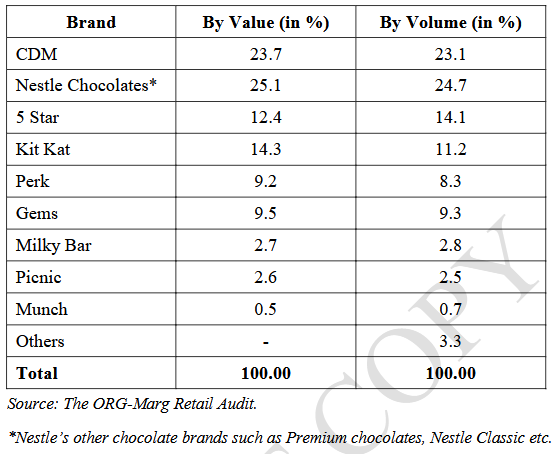
As a result of the above measures, by late 2000, CIL succeeded in adding over 8 million customers to its existing consumer base of 65 million. During the period CDM's market share increased significantly from 23% to 25%. 5 Star's sales also increased from 12% to 14%. In 2000, CIL enjoyed over 70% share of the 22,500 tonnes Indian chocolate market (Refer Table I).
Table I
Market Shares of Brands in the Chocolate Market (1999-2000)
 |
However, CIL realized that the share of chocolates in the total amount spent by consumers on impulse products (mainly chips/wafers, non-core biscuits, ice creams, soft drinks and chocolates) had been declining in the late 1990s. In light of this, the company decided to focus on expanding the share of chocolates in the impulse buying category. This marked the beginning of numerous product launches and relaunches by CIL during 2000-2002.
In 2000, Perk 'Slims' was launched – lighter and crisper than the previous version, its packaging had also been modified. In addition, Perk was introduced in different flavours – strawberry, mango and mint, to satisfy the varying preferences of consumers. A new product, Relish, was launched in the same year.
In July 2000, CIL launched Milk Treat (a white chocolate-coated wafer) targeted at children. The advertisement campaign promoted it as a product that had 'the goodness of milk married to the fun of chocolate.' According to CIL, “Milk Treat is an ideal product for children as it combines food- health and nutritional values of milk with values of excitement and fun that children generally associate with a Cadbury chocolate product.” Milk Treat was launched to compete with Nestle's Milky Bar, a moulded white chocolate. CIL's other launch during the year was Chocobix (a glucose biscuit with chocolate covering).
In February 2001, Mathew Cadbury (Mathew) became CIL's Managing Director. He continued with the policy of placing 'a Cadbury in every pocket. The company therefore went ahead with the launch and relaunch of chocolates. In June 2001, CIL relaunched Eclairs with new packaging that carried the caption 'Kar De Dil Pe Jadu' (Do Magic on the Heart). Eclairs were made available in various pack sizes that ranged from cartons to 90 gm pouches priced at Rs 15. CIL also launched the Eclairs Tub Pack (Rs 25) in the gift segment.
In July 2001, CIL relaunched 5 Star, with a new tagline, 'non-stop energy.' This was an extension of its previous taglines 'an energy bar' and 'reach for the stars.' To reach its core target segment (for 5 Star) – the youth - the company undertook extensive on-ground promotional activities, outdoor advertising and TV campaigns. 5 Star was usually positioned as something that made 'one's dreams come true,' but the new 'Rok sako to rok lo' (Stop if You Can) commercial was strikingly different. It portrayed the inexhaustible energy of a young man who runs up the floors of a skyscraper to plead forgiveness (for his delay) of his girlfriend. The girlfriend keeps shuttling
between the floors in a lift, only to find that her boyfriend has reached the floor before her. The advertisement ends with the girl giving up and forgiving the young man.
On-ground promotional activities for the new 5 Star included two days of road shows that ended with a rain dance and live music performance. CIL also entered into an alliance with youth websites like indya.com, cricinfo.com and hungama.com to communicate the core brand features of 5 Star to young people. Commenting on these innovative promotional activities, a CIL spokesperson said, “Our principle objective is to modernize 5 Star's brand image and enhance youth connect. Through effectively communicating the functional attribute of 5 Star along with the fun elements associated with chocolate, we intend to make the brand the 'top of mind' energy enhancer in the youth's life space.”
In mid-2001, Gems was relaunched. The brand was given a new packaging and the formula was improved. The new Gems were crispier, crunchier and had more chocolate. Targeted at children, it came in a flip top tube and was also offered at low price points, Rs 5 (14gms), and Rs 1 (three Gems), to aid self-purchase (by children). A new commercial was also developed to position Gems as a fun-loving children's product.
In late 2001, CIL launched the 'Temptations' range of chocolates. Temptations was available in five flavors – Old Jamaica, Roast Almond Coffee, Mint Crunch, Honey Apricot and Black Forest. According to company sources, the Temptations range had been specially formulated to remain solid in a tropical climate. The range targeted the premium 'adult' sector between the ages of 25-40 years and was priced at Rs 30 (64 gms).
The Temptations range was promoted through both print and electronic media (TV and FM radio). In addition, visuals were placed at outlets and points of sale of the product. One TV commercial featured a couple playing pranks on each other to avoid sharing their 'Temptations.' As part of the brand's promotional activities, CIL included a card in the 'Temptations' pack that gave a brief history of Cadbury chocolates. The card also provided consumers with a number that enabled them to log on to the company's website and participate in a contest and win prizes (including a trip to Seychelles, a popular tourist destination.
During 2001, CIL also launched a range of gift packs for various festive occasions and celebrations such as Diwali (Diwali Range), Valentine's Day (Sweet Nothings Range), and Rakhi. In addition, CIL offered special chocolates such as Ice Monds (almonds coated with white chocolate) and Kaju Maaza (cashew coated with chocolate) for special festive occasions. Other unique gift packs of CIL included a musical jewellery box; an executive desk set in a multi-functional leather case filled with chocolate coated almonds; a cut glass plate and bowl filled with assorted confectionery and an air tight cookie-jar. These gifts were priced between Rs 85 and Rs 1,500.
In January 2002, CIL launched 'Celebrations,' a selection of assorted chocolates in three flavors aimed at the 'gifting' segment. Priced at Rs 50 (74 gms), Rs 100 (148 gms) and Rs 200 (324 gms), the product was targeted at the premium end of the market. Explaining the rationale behind the launch, Bharat Puri (Puri), Director (Sales & Marketing), CIL, said, “The launch of Celebrations arrives to leverage the inferences of a consumer research conducted by the company that reveals the socio-psychographic leaning of the Indian demography which displays a preference for lending a more contemporary youthful gift on any gifting occasion.”
In order to promote the product as an ideal gift for all occasions, CIL focused on product visibility at retail points. According to Puri, “Celebrations will be available in top-end retail food outlets as well as key gifting outlets. Being a premium gifting product, the emphasis at the retail level will be on ensuring adequate display and visibility for the product as well as the appropriate standards for storage.”
Innovative promotional and advertisement strategies were developed to support all the above launches/relaunches. (The company allocated over 11% of its sales for its advertising and promotional activities in 1999-00 and planned to maintain this figure for a few years.) Many of CIL's advertisement campaigns became very popular and the company bagged various awards for the same, such as 'Advertising Campaign of the Century' (Cadbury Gold), 'Advertiser of the Year' (2000) and the 'Grand Effie' Award for Milk Treat (2000).
To increase the visibility of its products, CIL targeted areas near bus stops, colleges, schools, cafes and places of entertainment like theaters and amusement parks. CIL also launched three company websites, cadburyindia.com, cadburygift.com and bournvita.com. In addition, the company entered into marketing alliances with various portals to offer products (on those portals) that were developed for festive occasions and celebrations such as Valentines Day and Friendship Day.
In 2001, CIL's sales volumes grew by 5.8% (against a targeted volume growth of 10%). This growth was attributed to the launch of small pack variants of the leading brands and the new advertisement campaigns. The company reported that Milk-Treat had garnered 3% of market share, and that Perk and 5 Star had also registered marginal volume growth. CIL was still the market leader in the Indian chocolate business with a 69.2% market share and a consumer base of over 65 million. Sales increased from Rs 2.531 billion in 1995 to more than Rs 6.263 billion in 2001. Net profits also increased from Rs 200.8 million to Rs 574 million during the same period (Refer Exhibit II for CIL's financial performance). When Puri replaced Matthew as the Managing Director in January 2002, there was a radical shift in the company's policies.
Puri changed CIL's vision statement from 'A Cadbury in every pocket' to 'Life full of Cadbury and Cadbury full of life.' As a result, the company shifted its focus from launching new brands to rejuvenating and strengthening the existing brands (CDM, 5-Star, Perk, Gems and Eclairs). In addition, CIL planned to extend its reach to semi-urban and rural markets. Puri said, “Small towns present tremendous opportunities.”
CIL also decided to sell its products through 'non-traditional' outlets like music stores (such as MusicWorld), malls, renowned bookstores and popular apparel outlets (such as Pantaloons and Wills Sport boutiques). The company planned to put chocolate carts (similar to traditional bicycle ice-cream carts) in malls and near college campuses to increase its reach. Commenting on this Puri said, “Making the product available in the right places will always give dividends.”
The March 2002 decision to change the positioning and advertising of CDM was essentially a part of the above shift in strategy. Commenting on the reason discarding the 'excuses' plank for CDM, Roy said, “You don't always need an excuse to do what your heart commands. It's like falling in love.” Despite the numerous measures taken by CIL during 2000-2001, only CDM managed to show positive growth; the market shares of the other brands remained stagnant. According to analysts, for the past few years, the company had failed to achieve the growth volumes it had set for itself. Meanwhile, Nestle managed to take away over 6% of CIL's market share between 2000-2002. According to analysts, of the 6%, 3% of the market share was acquired by Nestle during the first quarter of 2002 alone.
Both Nestle and CIL had launched many products during 2001-2002. Unlike Cadbury's 'new' products Nestle's products differed substantially from its existing range. By providing variety, Nestle was able to increase its share in the chocolates and confectioneries market from 26% in 2000 and 29% in 2001 to 32% in March 2002. Analysts felt that because Cadbury did not launch new products, its product portfolio lacked variety compared to Nestle's. According to them, this was the main reason for the decline in CIL's volume share from 66% in 2001 to 63% in March 2002. However, even when CIL brought out new products – Picnic, Cadbury Gold, Triffle, Relish – many of them were non-starters. Some analysts attributed the failure of many CIL brands to the slump in the confectionery market.
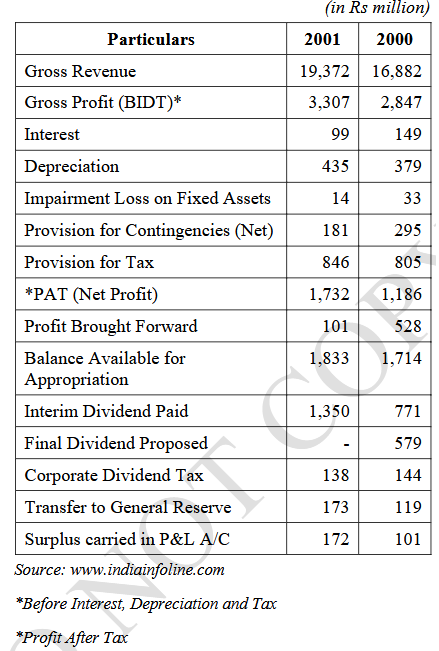
While Nestle derived its revenues from various sectors such as milk products, coffee, culinary products, confectionery and other beverages, CIL was present only in the chocolates, sugar confectionery and malted food segment. Thus, Nestle had the option of diversifying its risks across its vast product portfolio, something CIL could not do (Refer Exhibits III & IV for Nestle's Product Portfolio and Financial Results). In addition, Nestle had 1 million retail outlets, while CIL had only 0.45 million outlets.
In mid-2002, CIL launched 'CDM Chunky' in three variants – plain chocolate, raisins and cashew - priced at Rs 15 (plain chocolate, 42 gms) and Rs 20 (42 gms). The company also launched variants of Perk such as Perk XL and Perk XXL, priced at Rs 10 (15.5gms) and Rs 20 (28gms). The usual advertising and promotional campaigns supported the launches.
In mid-2002, the KitKat/Perk story was repeated when CIL launched a new brand Chocki (a chocolate in liquid/paste form) in response to Nestle's Choco-Stick launched a few months earlier. Choco-Stick, launched in Tamil Nadu (and later in Andhra Pradesh), had become a huge hit with the kids. CIL was thus forced to launch Chocki.
Priced at Rs 2 (8 gms), Chocki began picking up volumes. The fact that Chocki's launch went against Puri's decision not to focus on new product launches was something CIL did not seem to be bothered about – at least for the time being.
1. Discuss the strategies followed by CIL until the early 1990s to establish itself as the market leader in the chocolate segment. Why did CDM change the positioning of its brand in 1994? To what extent did CIL succeed in its attempts to reposition CDM?
2. In light of competition from Nestle, critically discuss the initiatives taken by CIL to achieve its 'Cadbury in Every Pocket' vision, Refer to CIL's product launches and its positioning, distribution, pricing and advertising strategies. Did CIL succeed in achieving its objectives? Discuss.
3. Do you think repositioning CDM in 2002 was a good strategy? Justify your stand. Discuss the future prospects of CIL in light of severe competition from Nestle. What, according to you should CIL do to retain its market position and keep the competition at bay?
Exhibit I
CIL – Product Profile
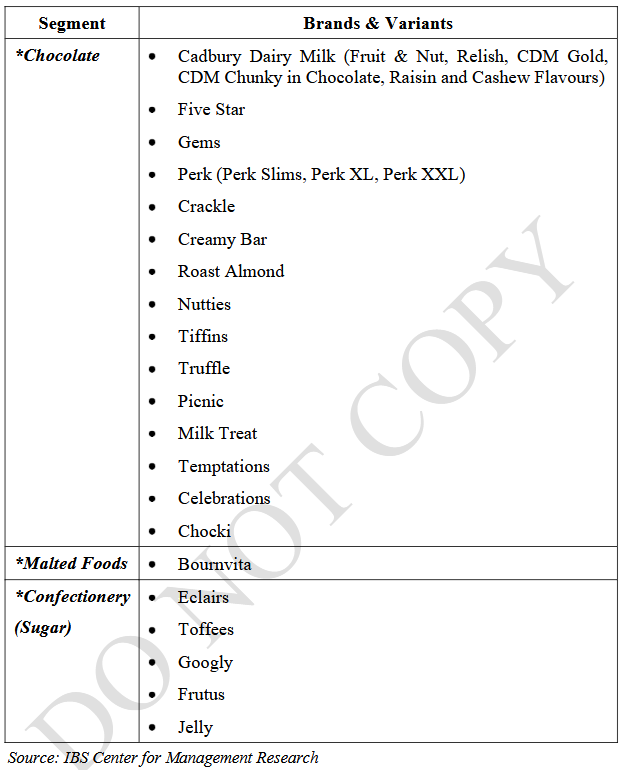 |
Exhibit II
Financial Performance of CIL (1993-2001)
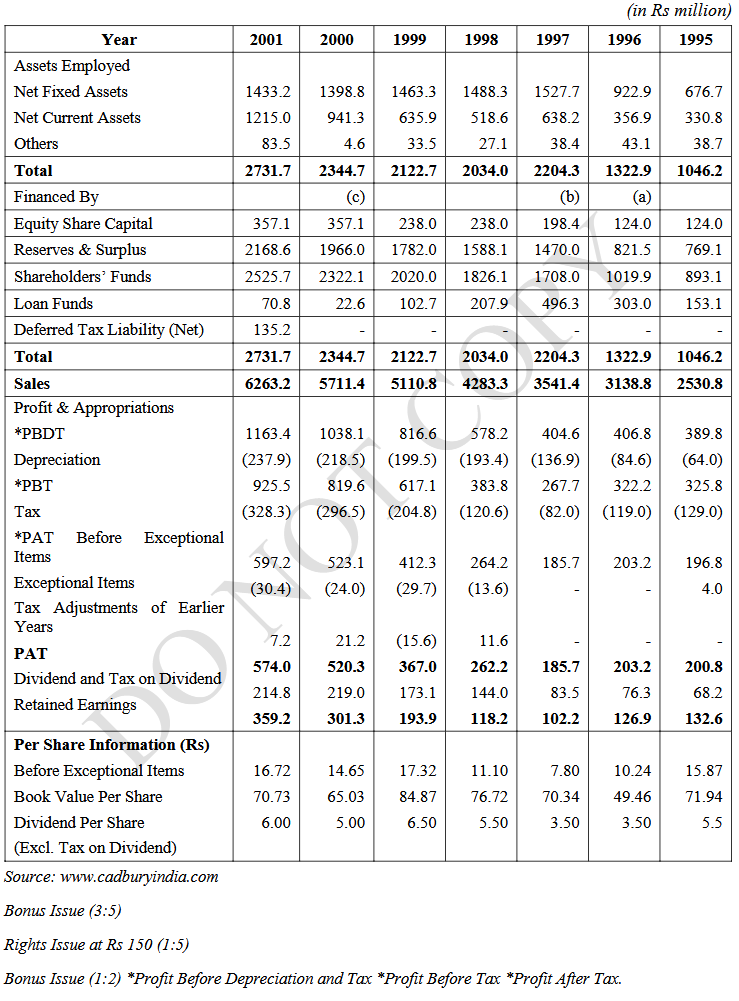 |
Exhibit III
Nestle India – Product Portfolio
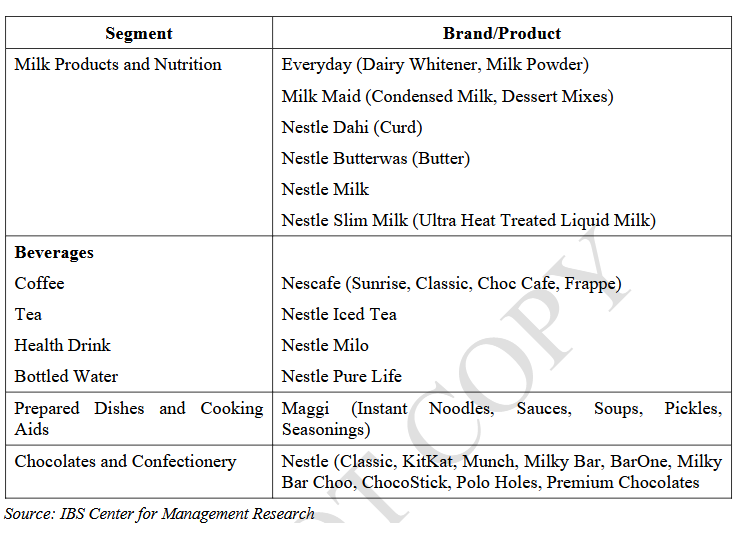 |
Exhibit IV
Nestle India - Financial Results (2000-2001)
 |
Keywords
Cadbury India Limited, CIL, repositioning, strategies, brands, 1999-2002, detailed account, company's growth , continual product launches, distribution, promotion, advertising strategies, 1990, market position
Related Case Studies
| Case Title | Details | Price | Add to Cart |
|---|---|---|---|
|
Case Title Calbee’s Monochrome Packaging: Crisis Management Response or Marketing Strategy?Case Code: MKTG497 |
Details | 500 | Add to Cart |
|
Case Title Coca Cola’s Christmas AI-ad campaigns: Appeal with Algorithms or Emotions?Case Code: MKTG495 |
Details | 400 | Add to Cart |
|
Case Title Reliance Jio’s Next Act: Monetizing a Mass Brand without Breaking TrustCase Code: MKTG494 |
Details | 500 | Add to Cart |
|
Case Title Hulken Bags: Can the Premium Viral Product Achieve Mass-Retail Success?Case Code: LDEN242 |
Details | 400 | Add to Cart |
|
Case Title The Nirma StoryCase Code: MKTG008 |
Details | 200 | Add to Cart |