
Allen Solly - Entering the Indian Women’s Western Wear Market
🌐 International Buyers — Pay via PayPal
Details
MKTG042
11
2003
NO
300
Madura Garments Lifestyle Retail Company Limited
Textiles & Apparel
India
Marketing Strategy,Marketing Research, Market Segmentation
Abstract
The case examines the changing dynamics of the women’s wear market in India during the 1990s and early-2000s. Changes in India’s cultural values and social system, and the impact of these changes on the dressing styles of Indian women are explored in detail. Madura Garment’s decision to enter the readymade women’s Western wear segment is examined in detail in light of the above changes. The case discusses the strategies adopted by the company in terms of marketing research, product design, retailing and promotion. The case also provides information about other players in the women’s Western wear market in India and takes a look at the market’s future prospects.
Learning Objectives
The case is structured to achieve the following Learning Objectives:
- Increased activity in the branded women’s westernwear market in India.
Contents
“Women have too many different kinds of clothing. They want exclusive outfits and would not buy mass produced garments. They just want the look and do not care about the label. It is too risky. It is a headache. It just would not work.”
- Excerpt from a news article on www.BharatTextile.com, January 11, 2002.
“We feel there is a definite potential to expand the market by offering a range of western women's wear, properly styled and cut according to body types, under the Allen Solly brand name. That will complete the whole lifestyle package – we will have both Allen Solly Men's and Women's wear, and have a strong retail line-up for both.”
- Vikram Rao, Director, Indian Rayon, in October 2002.
In September 2002, leading Indian apparel company, Madura Garments (Madura, Refer Exhibit I for a brief profile of the company) launched a line of readymade women's western wear under the brand name 'Allen Solly Women's Wear.' The launch was backed by advertisements in the national print and outdoor media. The move attracted attention for two reasons. First, this was the first-ever nationwide exercise by any company to offer readymade Western wear for women in India on this large a scale. Second, Madura seemed to have taken a risk by trying to extend its hitherto 'exclusively for men' brand, Allen Solly, to the women's segment.
The nationwide launch was undertaken following the brand's impressive performance during the test-marketing phase in the city of Bangalore (Karnataka) in December 2001. Through Allen Solly Women's Wear, Madura formally extended the concept of Friday Dressing1 to women all over the country. The scope of operations and marketing support was what set Allen Solly apart from the earlier entrants in the branded women's wear segment, Indus League and Raymond's. Indus League had launched women's wear under the 'Scullers' range, while Raymond's had entered the segment with its designer range 'Be.' By late-2002, many other brands, such as Benetton, Mango, Wills Sports and Blackberrys, had either launched (or were planning to launch) exclusive women's wear in the country.
This rush to enter the segment was not difficult to understand, considering the fact that the market was almost completely in the hands of the unorganized sector and had very few branded players. Most of the national level branded players were present only in the men's wear segment. In 2001, the women's wear industry was estimated to be around Rs 161 billion with a growth rate of 9%, of which the women's western wear market was estimated to be growing at 15-20% per annum, according to a study conducted by KSA-Technopak.
Some analysts felt that these figures did not justify the pace at which companies were entering the market. And, more importantly, many analysts felt that the business did not hold too much promise, because Indian women would not be comfortable giving up their traditional attire. Around 95% of working women in India wore salwar suits (Refer Exhibit II) to work, and perhaps not many of them would be willing to shift to Western corporate wear.
Madura, however, justified its move, citing studies, which revealed that though Indian women liked to experiment with Western wear, they did not have access to styles that suited them. The company was confident that it would be able to make a success of the venture despite the increasing number of players and the threat of much cheaper unorganized sector products.
The Indian apparel industry was dominated by the unorganized sector, with market share of over 97%. The industry was divided into two segments, ready-to-wear and tailormade. The industry was also divided on demographic (men, women and kids) and geographic (each state having its own dressing style) parameters. Over the decades, the developments in men's and women's wear segments showed markedly different trends. While traditionally Indian men preferred to get their clothes stitched by their trusted tailors, by the early-1990s, ready-to-wear clothes had become extremely popular. However, most Indian women traditionally wore sarees and other ethnic wear (Refer Exhibit II).
Though Western wear entered the country through Hindi movies in the 1950s itself, it remained limited only to teenage girls even by the early 1980s. This was so because after marriage Indian women were generally expected to wear sarees. Though the saree segment was also almost entirely in the hands of small, localized players, there were a few national brands as well. Garden (from the house of Bombay Dyeing) was one of the first popular brands. Over the years, many other brands such as Vimal, Kunwar Ajay, Roop Milan and Parag emerged. Saree prices ranged from as low as Rs 50 to as high as a few million rupees.
As society became more liberal and the number of working women increased, there was a growing need for attire that was more 'work-friendly' than the saree. Consequently, salwar-suits, which were convenient and easy to wear, became popular among women. This trend brought in a marked change in the way women bought clothes. While sarees were almost always bought readymade, women preferred getting their salwar suits tailored. This was because while sarees were a 'one- size-fits-all' kind of a garment, salwar-suits needed to be tailored according to the individual's requirements.
Gradually, salwar suits became popular all over the country, and women from many states replaced their traditional attire with salwar suits. Interestingly, the salwar suit segment had no national level branded players even at the beginning of the 21st century. In the salwar suit segment 'local' salwar suits were available for as low as Rs 150, while designer label (purchased from high-end boutiques) salwar suits cost Rs 50,000 or more. Despite the growing popularity of salwar-suits, the saree remained the most favored and the highest selling product in the country (a KSA-Technopak study revealed that around 197 million women purchased roughly 315 million sarees in 2001).
Gradually, ethnic wear (gagra choli and Lehangas), as a segment became a niche segment as ethnic clothes were worn only on special occasions such as festivals and marriages. However, the category's growth was higher than that of salwar suits. With many designer boutiques and exclusive showrooms entering the business, the salwar suit segment saw some efforts towards branding, though primarily on a local scale (in 2001, around 103 million customers bought 145 million ethnic wear sets, out of which 48 million were ready-to-wear and 97 million were tailormade).
By the late 1990s, the Indian economy (and Indian society) showed clear trends of becoming increasingly westernized in terms of lifestyles, education and vocation, especially in urban areas. The growing number of career-oriented women resulted in a major shift in the way certain products and services were marketed in India. The emergence of products such as ready-to-eat/serve food, fast food joints, take-away meals, branded jewellery and branded sarees/salwar suits was a direct result of the above developments. The introduction of corporate, formal, western wear for women was another step in this direction.
With cultural changes sweeping Indian society, many companies viewed branded women's western wear as a segment that had tremendous potential. According to a KSA-Technopak study, of the total Indian women's wear business valued at Rs 161 billion, the readymade segment comprised 78% (Refer Table I).
Table I
The Indian Apparel Market (2001-02)
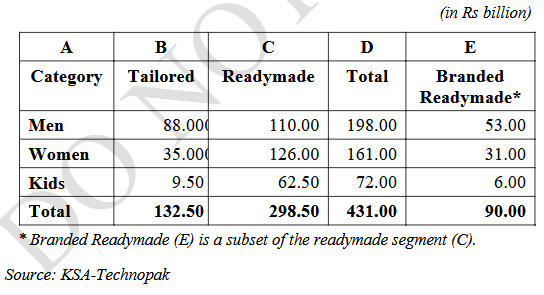 |
In the women's branded readymade segment, while the premium segment (Rs 1000 and above) grew by 18% in 2001, the medium segment (Rs 500 – 1000) grew by 15% and the lower segment (Rs 200-500) grew by around 12%. These growth figures were expected to remain more or less constant in the future. As the table indicates, there exists a difference of Rs 22 million between the market for men's and women's branded readymades. Perhaps this is why there was a plethora of national level brands in the men's segment.
Since competition in the men's segment was intense and demand was reportedly inching towards saturation levels, the future growth was projected to come from the women's and kid's wear segments. Of the Rs 31 billion branded readymade women's wear market, about Rs 6 billion was from women's Western wear, and this market was projected to grow at 25% in the future.
Indus League was the first company to enter the branded women's wear segment in the country. In 2000, the company launched a women's range named 'Scullers Woman' as an extension of its popular men's wear brand 'Scullers.' Promoted as 'smart casuals for work and after,' the Scullers women's range was launched in three basic lines, Essentials, Manhattan and Chromium. Essentials offered basic knitted cotton blouses, flat front trousers, skirts and capris; Manhattan offered party and evening wear; and Chromium offered formal wear and evening wear (Refer Exhibit III). The company also launched a silk apparel collection named Geometric, which offered short tops, shirts and sarong sets. Scullers was marketed through exclusive 'Scullers Club Stores' located in major cities across the country. The range was also made available at major retail stores such as Shoppers Stop, Globus, Pantaloons and Lifestyle. Since it was the pioneer in the market, Scullers Woman received an enthusiastic response.
The next major brand to enter the market was 'Be,' launched by Raymond's in July 2001. While Scullers products were marketed through existing stores (both company-owned and multi-brand stores), Raymond's Be brand was sold through exclusive stores. Commenting on Raymond's entry into women's wear, Gautam Singhania (Singhania), the company's Chairman & Managing Director, said, “After much thought, we have decided to take the plunge. The launch of the Be range is an initiative aimed at corporatizing the designer range of clothing. Be will provide a platform for designers to showcase their talents for larger number of consumers.” The first exclusive Be showrooms were opened in Delhi and Mumbai. Leading fashion designers (such as Rohit Bal, Rajesh Pratap Singh, Raghavendra Rathore and Manish Arora) created outfits for the Be range. Priced between Rs 800 and Rs 7000, Be offered ethnic and fusion wear as well as Western wear. Taking the cue from Scullers Woman and Be, Madura decided to enter this segment. The decision was also inspired by the company's discovery that women purchased Allen Solly men's trousers in 26 and 28-inch waist sizes.
Madura employed leading market research agency Indian Market Research Bureau (IMRB) to conduct a market study on the Indian work culture and the requirements of women regarding Western readymades. The study revealed that while Indian women loved ethnic clothes, they were not comfortable in them while working. Factors such as increased number of women in the workplace and challenging jobs that required a lot of traveling indicated a growing need for Western wear. The study also revealed that though Western wear was available in the market, their international styling was unsuitable for Indian women. Equipped with these findings, the company decided to focus primarily on the comfort and styling aspects of its proposed brand. The first task was to make the product suit the needs and body proportions of Indian women. According to IMRB's research findings, the body types of Indian women could be divided into four broad categories: comfort – for a body small on top, wider on the hips; straight – equal on top, waist and hips; trim – equal on top and bottom with narrow waist; and regular – wide shouldered and narrow at waist and hips.
To offer specialized and modern styling, the company recruited Stephen King, a renowned UK-based designer, to create designs suitable for all four body types. And to cater to the requirements of women who were on the heavier side, Allen Solly trousers were offered in waist size as high as 36 inches. The company also planned to launch a 38-inch trouser in future.
Besides trousers, the Allen Solly range offered woven and knitted tops, and jackets in cottons and new fabrics like polynosic, lycra tencel, rayon blends and soft acrylic concentrating on the Autumn and Winter seasons (Refer Exhibit III). All garments were designed in line with the findings of market research. The range was available in bright as well as pastel shades, giving customer, a wide variety to mix and match from. The knitted range was priced between Rs 499 and Rs 999, woven tops were priced between Rs 599 and Rs 899, and trousers were priced between Rs 799 and Rs 1099. By September 2002, Madura announced the launch of Allen Solly nationwide, and by October 2002, six exclusive outlets (one each in Chennai, Hyderabad, Mumbai and Kolkata and two in Bangalore) were established. In addition, the company planned to retail the range through leading retail showrooms across the country. Special attention was paid to the designing of exclusive showrooms, keeping in mind the targeted clientele (the Mumbai store was designed by well-known UK-based architect Jean Claude Pannighetti).
The stores were planned in a way that made the shopping experience a unique and pleasant one. Garments were stacked in easy to find, fit-based categories, making it easier for customer to locate garments of the required size. All the stores were given a contemporary look with radiant steel, pleasant whites and Belgian glass providing a bright and open ambience.
The target customer base for Allen Solly women's Western wear was identified as the self assured, office going women in SEC A6 between 22-40 years of age, who wore Western outfits once or twice a week, and had an income of Rs 8,000 and above per month. Commenting on the decision to launch the range, Vasant Kumar, Vice-President (Marketing), Madura, said, “Our target is not women who already wear western clothes; we are pegging on converting the salwar-kameez category. If in the process, we manage to attract the former category, that is just a bonus.” The company reportedly sought to attract women who gave importance to 'sophisticated professionalism' in their lives.
To support the brand, Madura decided to go in for aggressive campaigning and earmarked a total investment of Rs 100 million. Of this, around Rs 60 million was allotted for advertising and the remaining Rs 40 million was allotted for background research, creative team, manufacturing and retailing. Promotional exercises for the brand began with a fashion show organized by the company, which displayed the entire range. The company made extensive use of mailers to reach targeted customers. The mailer contained an inch tape, with a message 'Every body is perfect; you have just got to dress it right.'
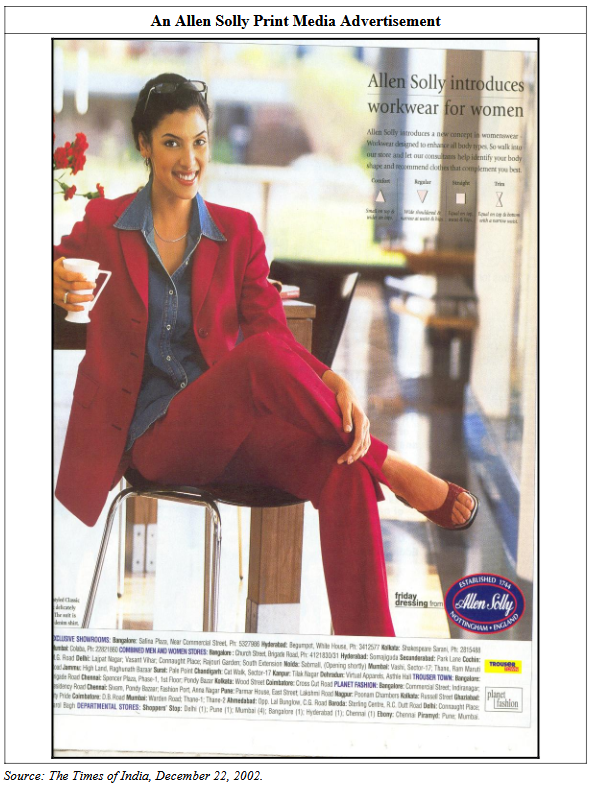
Madura planned to promote the brand mainly through outdoor advertising and print campaigns (refer Exhibit IV for a print advertisement). The campaigns focused on the workplace success of women and how this success was handled with style and flair by the women concerned. The idea was to establish the brand as a true reflection of the attitude of women in the 21st century Indian workplace. Leading magazines and other publications that were read by women from the targeted segment carried the print advertisements, while billboards and hoardings were extensively used at prime locations in all the cities the range was launched in.
The initial response to Allen Solly women's wear was reportedly positive, especially due to the availability of 'comfort fit' trousers. The brand seemed to have gained a significant amount of recognition due to advertisements and media coverage. However, despite this positive response, Madura's decision to launch the range attracted criticism from some industry observers. Doubts were expressed about the logic behind extending a successful, nine-year old men's wear brand to the women's wear segment.
By extending the brand, the company saved a lot of time and money that would have gone in building a new brand. However, such a move may make some men shift to a 'pure men's brand' in future. Though Scullers, ColorPlus and Wills Lifestyle had also similarly extended their brands, none of these brands had a brand image as popular and well entrenched in the country as that of Allen Solly. However, company sources disagreed that men might shift to a pure men's brand and claimed that launching women's wear did not make Allen Solly a unisex brand. Madura Garments' design consultant Stephen King said, “Allen Solly is not a unisex brand for the simple reason that the shapes and sizes of garments vary between men and women.” He also added, “I do not expect men to switch over to other brands just because women's wear is also available under the same brand.”
Madura sources claimed that there was no decline in the demand for the Allen Solly men's range after the launch of the women's range. The company also revealed that, according to its market study findings, many men were pleased with the decision to extend Allen Solly to women's wear. However, some industry players felt that the sales of Allen Solly men's wear could be negatively affected in the long run.
Perhaps to be on the safer side, Madura decided to incorporate some elements in its communication strategy that would help restrict the flight of customers from its men's wear range. For instance, one of the visuals in an advertisement showed an Allen Solly male model welcoming an Allen Solly female model, while the ad line read, 'Allen Solly introduces work wear for women.' The aim was to convey the idea that the women's wear range was a welcome development for both genders as far as the Allen Solly brand was concerned.
Analysts also pointed out that by categorizing women's garments on the basis of body types, Madura risked investments in large inventories for itself as well as its retailers. The issue of inventory assumed greater significance considering the fact that the shelf life of women's wear was reported to be lesser than that of men's wear. Moreover, retailers needed to continually replenish the stocks with new styles and colors to ensure repeat visits.
Despite the apprehensions of some analysts, many players began taking interest in the Western women's wear segment in India. Leading textile company Arvind Mills (the market leader in the Indian denim market with brands such as Lee, Levis and Newport) planned to enter into the women's Western wear segment by early-2003 under its popular premium brand 'Arrow.' Darshan Mehta, President, Arvind Brands, said, “In the US, there is a strong women's line under Arrow, which we plan to launch in India.”
Meanwhile, existing players were also working towards the success of their brands. Raymond's planned to extend its distribution chain to 100 exclusive Be outlets by 2003, mainly through the franchisee route. The company also considered the possibility of integrating Be with the existing Raymond's retail outlet network. Said Singhania, “We already have 250 outlets for Raymond. Going down the line, we will certainly look at integrating Raymond with Be.” Madura announced that it would strengthen its retail network and record a turnover of Rs 500 million during 2002-2005 through the Allen Solly women's wear range.
Even private fashion labels were entering the business, attracted by the changing market dynamics. Many leading fashion designers such as Ritu Beri and Puja Mehra Gupta (Puja) launched their range of women's clothing through exclusive retail outlets. These clothes were not exorbitantly priced like private fashion labels usually were.
Ritu Beri's 'Label' collection offered Western wear, ethnic and party wear while Puja's Bizarre's collection offered only Western wear. With four exclusive showrooms in Delhi, Puja planned to expand to other cities. Puja had split Western women's wear into five categories, daywear, lounge wear, club wear, holiday wear and party wear. Catering to all the above categories, Bizarre garments were priced between Rs 500 to Rs 5000.
Though the projected growth rates were attractive, industry observers felt that there was not enough room for so many players. Moreover, they were of the opinion that companies would find it tough to figure out the perfect fit and offer the best dressing solutions for working women. However, the players seemed to be confident about their prospects as the number of working women was expected to increase in the future. One important question needed to be answered: would the projected growth rates of Western women's wear turn into real figures?
1. Examine the circumstances that prompted Madura to launch women's Western wear in the Indian readymade women's wear industry. Why do you think companies primarily offered only men's wear in the branded readymade apparel segment in the country? What kind of cultural and social changes led to the launch of Allen Solly Women's Wear?
2. Critically analyze the product development, retailing and promotional strategies adopted for Allen Solly women's wear. What are the essential differences between marketing readymade apparel to men and marketing readymade apparel to women in a developing country? How would your answer differ if the target customer base belonged to a developed country?
3. 'Madura has taken a major risk by extending a 'pure men's brand' to the women's wear segment.' Comment on this statement in light of observation that men might switch over to a pure male brand in the future. Do you think Madura's move could erode Allen Solly's brand equity?
4. With many players entering the women's Western wear segment, do you think Allen Solly would be able to grow as planned? As part of a team responsible for managing the brand, help the company design a marketing strategy plan to attain leadership position in the women's western wear segment.
Exhibit I
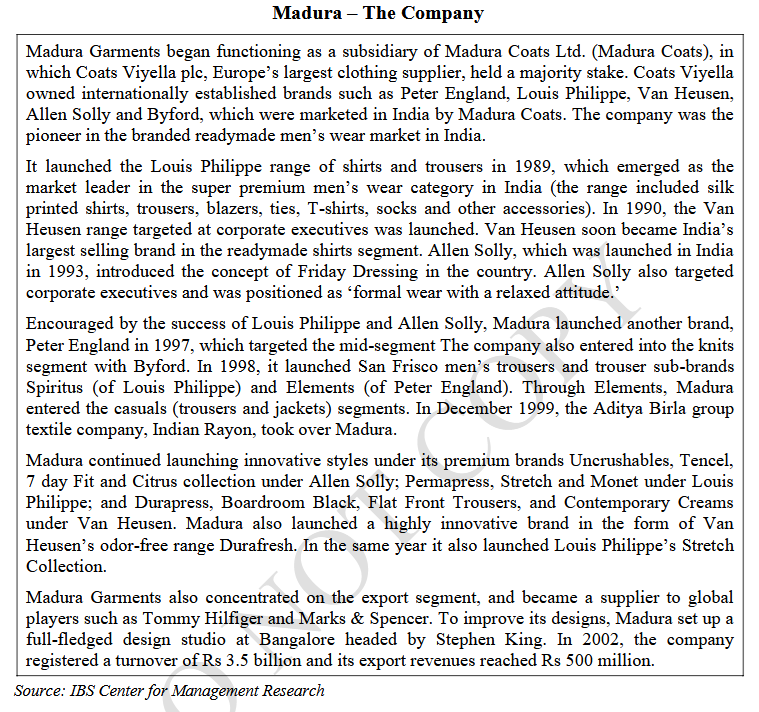 |
Exhibit II
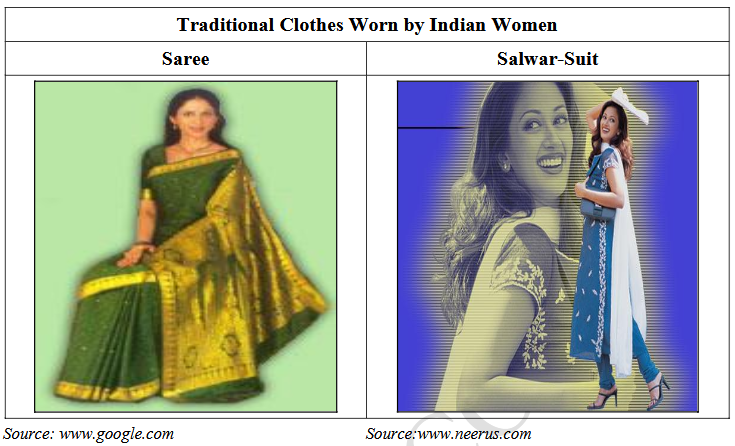 |
Exhibit III
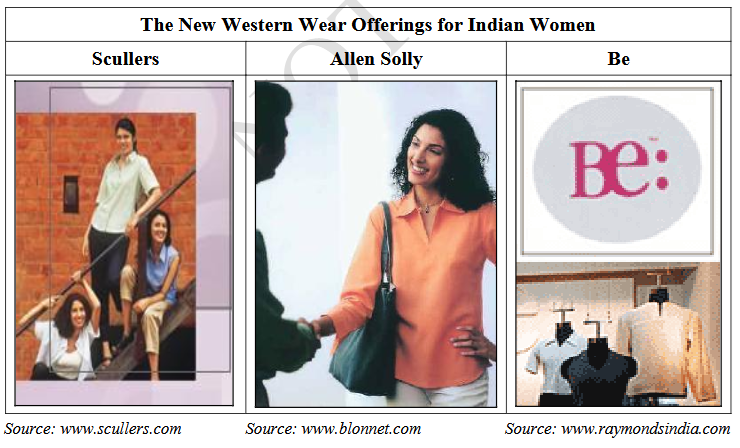 |
Exhibit IV
 |
Keywords
Changing dynamics, women, wear market, India, 1990, 2000, cultural values, social system, dressing styles, Indian women, Madura Garment, readymade women, Western wear, marketing research, product design, retailing, promotion, future prospects
Related Case Studies
| Case Title | Details | Price | Add to Cart |
|---|---|---|---|
|
Case Title Reliance Jio’s Next Act: Monetizing a Mass Brand without Breaking TrustCase Code: MKTG494 |
Details | 500 | Add to Cart |
|
Case Title The Nirma StoryCase Code: MKTG008 |
Details | 200 | Add to Cart |
|
Case Title IKEA’s ‘Punch’ Moment: Using Reactive Marketing to Build Brand ConnectionCase Code: MKTG493 |
Details | 300 | Add to Cart |
|
Case Title Amul and the D2C Dairy Challenge in IndiaCase Code: MKTG492 |
Details | 400 | Add to Cart |
|
Case Title Ulta Beauty under CEO Kecia Steelman: Unleashing Growth in a Slowdown?Case Code: BSTR713 |
Details | 500 | Add to Cart |