
Bumrungrad’s Global Services Marketing Strategy
🌐 International Buyers — Pay via PayPal
Details
MKTG091
18
2004
YES
500
Bumrungrad International Hospital
Healthcare and Services
Global
Marketing Strategy,Service Operations
Abstract
This Case is also available in Portuguese Language. For more details refere to OPMKTG091 in “Part - B”. The case discusses the healthcare services marketing strategy of Thailand-based Bumrungrad Hospital Public Company Limited (Bumrungrad), the largest privately managed hospital in Southeast Asia. From a significantly adverse financial situation in mid-1997 due to the Southeast Asian currency crisis, Bumrungrad has emerged as a market leader in the healthcare industry in Southeast Asia. The case discusses how Bumrungrad was able to overcome its problems by promoting its healthcare services globally. It covers in length the service experience provided to Bumrungrad’s customers. Finally, the case describes the new initiatives taken by Bumrungrad to expand its healthcare services operations and the challenges ahead of it in early 2004.
Learning Objectives
The case is structured to achieve the following Learning Objectives:
- Bumrungrad’s healthcare services marketing strategy.
Contents
“It was just like staying at the Ritz- Carlton in Boston. The only thing that reminds you that it’s a hospital is the medical people coming in and out – and the bed.”
- Rosemary Shea, a patient treated at Bumrungrad.
“We offer a complete package – very high medical and service standards, a five-star facility and very competitive prices. Where else can you walk in without an appointment, see a US Board Certified specialist in under 15 minutes, pay US $15 for the consult and have a Starbuck’s cappuccino on your way out? That’s really quite unique.”
- Ruben Toral, Director of International Programs, Bumrungrad Hospital.
“There are people coming from Holland that have never been to Bangkok before, for total hip replacements. It is like any other product. If you can do something better, faster and cheaper than your competitor than you will sell your product. Thailand now probably represents the best possible health care anywhere in the world.”
- Curtis Schroeder, CEO of Bumrungrad Hospital.
In early 2004, Bumrungrad Hospital Public Company Limited (Bumrungrad) in Bangkok (Thailand) was named the „Best Small Cap Company,' by the Singapore-based magazine Asiamoney. The award was given on the basis of a 2003 poll conducted on more than 3000 fund managers, chief investment officers and heads of research at fund management firms, insurance companies and brokerage houses in the Southeast Asian region. Bumrungrad (market capitalization of under US$500 mn) was selected from over 180 companies considered for the award.
On Bumrungrad's remarkable achievements, Philip Owens, the Managing Director and Publisher of Asiamoney said, “This represents the first time that this award has been made to a hospital company in the twelve-year history of the poll. One glance at our best-managed companies on our 2003 poll reveals that they have one talent in common – the ability to recover fast. Bumrungrad Hospital in Thailand certainly fits this description with its remarkable success story.” On receiving this honor, Curtis Schroeder (Schroeder), CEO of Bumrungrad said, “We're very happy to be recognized in this year's poll. Bumrungrad has made a remarkable recovery from the dark days of the Asian economic crisis through an effective restructuring and has emerged as the dominant regional player in the Southeast Asian healthcare care market for cost-effective international medical care. This award is a wonderful capstone to the efforts of our management and employees.”
Believed to be Southeast Asia's largest privately managed hospital, the 554-bed Bumrungrad Hospital treats both Thai nationals and foreign patients. The hospital is becoming increasingly popular with foreign patients. In 2002, out of the 850,000 patients treated in Bumrungrad, there were 250,000 foreign patients, coming from over 130 countries across the world.
Since the mid-1990s, Bumrungrad has come a long way to emerge as a leading healthcare brand in the world. In 1997, when Thailand was hit by the Southeast Asian currency crisis5, Bumrungrad was among the several healthcare companies in Thailand that were severely affected. A vast majority of Thai patients moved away from private hospitals to government-run ones. However, Bumrungrad perceived this adverse situation as an opportunity for growth and followed an aggressive marketing strategy that targeted foreign patients to the hospital.
Though Bumrungrad has been largely successful through its focus on foreign patients since mid- 1997, the hospital faces a few important challenges in early 2004. Bumrungrad faces fierce competition from leading hospitals in Thailand and other neighboring countries like Singapore and India, which are targeting the same clients by offering similar world-class healthcare facilities. Bumrungrad, therefore, has to discover new ways and means to differentiate its healthcare services from those of its competitors.
Established in September 1980, Bumrungrad6 was initially a 200-bed facility. The initial investment for setting up the hospital was Thai Baht7 90 mn. The hospital was jointly owned by Bangkok Bank and the Sophonpanich family, one of Thailand's leading business families. In 1989, Bumrungrad went public and its shares were listed on the Thai Stock Exchange. Over the next decade, Bumrungrad adopted several innovative practices to emerge as the best privately managed hospital in Thailand. The significant increase in the number of domestic patients in its care over the years led to many fold increase in its revenues.
In January 1997, Bumrungrad shifted to its new facility located at the centre of Bangkok. Constructed at an estimated cost of $110 mn ($60 mn raised through offshore loans), the 12-floor building had 554 beds and 21 operation theatres. The hospital was equipped with the most modern medical equipment and had 600 physicians, nearly half of whom had been trained in the US, and drawn from different parts of the world. Some of the physicians served as consultants and were not on the hospital rolls.
Bumrungrad hired an international management team led by American professionals. Its CEO, Curtis Schroeder had prior experience of running a hospital in California. However, in July 1997 Bumrungrad faced tough situation when Thailand was severely hit by economic recession. The Southeast Asian currency crisis led the value of Thai Baht dip sharply. The crisis had its fall-out on the middle class Thai population from which Bumrungrad derived most of its revenues. They started shifting to government hospitals where healthcare was available free or at lower cost.
In this adverse situation, Bumrungrad decided to change its strategy by drawing in foreign patients, including expatriates in Thailand and nearby countries, as well as tapping patients in developed countries in Europe and the US, as its clientele. Describing the situation, Schroeder said, “We basically had two alternatives at that time. We could shut down the place and lay off employees, cut costs and turn off the lights and try to weather the storm, or we could aggressively use it as an opportunity to build market share. We went with the General Electric approach, the Jack Welch approach, which is that where you make your biggest market share is during down markets.” Bumrungrad began an aggressive marketing effort to project itself as a global hospital complying with all international standards. The hospital had already applied and received the ISO 9002 quality certifications for all its departments and systems in March 1997. In 1999, the ISO certified Bumrungrad as a Comprehensive Tertiary Acute Medical Centre. With this, it became the first healthcare company in the world to receive such certification. Schroeder said, “It's not a magic cure, but whether you're selling cement, steel or healthcare, without third party validation, it's difficult to get international recognition.”
Bumrungrad also decided to use the Internet as an information and marketing medium to promote its healthcare services to foreign patients. It launched its website – www.bumrungrad.com in 1997. The website had several user-friendly features to provide the healthcare information that visitors to the site were looking for. Visitors could find out about the medical facilities and the range of treatments available at the hospital. One of the main features of the website was the 'Find a Doctor' section. Using this feature, patients could choose between 600 doctors and book an appointment online, on the basis of their preferences and requirements. Thus, the patient's preferences for the kind of treatment, the nationality of the doctor and so on were taken care of at the first instance. Appointments were confirmed within two hours. By mid-1999, the website was drawing 800 hits a day. According to estimates in 2001, nearly 150 appointments were booked every day through the site. The customers could also view their medical records through the website.
In the late 1990s, Bumrungrad participated in an international road show organized by the export promotion department of Thailand commerce ministry. It was around this time that Thailand began promoting medical tourism as an 'export' product – one which could earn valuable foreign currency for the country (Refer Exhibit I for the medical tourism industry scenario in Thailand). Soon, Bumrungrad opened representative offices in Ho Chi Minh City (Vietnam), Yangon (Burma), Dhaka (Bangladesh) and Laos (Cambodia). The offices provided assistance to foreigners, helping them to procure visas and make travel arrangements, and providing cost estimates to patients intending to get treated. They even coordinated arrangements for picking up and dropping off patients at Bangkok airport with the Bumrungrad hospital staff Sales representatives were sent to other Asian countries to create awareness and promote Bumrungrad. The promotional exercise helped Bumrungrad attract foreigners who had to undergo surgery from those countries where quality healthcare was either not available or was too expensive. Bumrungrad also started targeting foreigners coming in for routine health checkups - one of its main business segments. Initially the main customers targeted for routine health checkups were the Japanese. For this, it tied-up with a travel agency in Thailand catering mainly to the Japanese visitors and recruited a Thai doctor who could speak Japanese. Over the next couple of years, Bumrungrad opened representative offices in Sri Lanka, Nepal, the Maldives, UK and the Netherlands.
In April 2000, Bumrungrad tied up with Thai Airways International, the government owned international airlines, to run healthcare package trips to Thailand. Thai Airways marketed a medical package at Bumrungrad, alongside its traditional tourism and other relaxation packages. Advertisements and catalog information on Bumrungrad appeared in the magazines of Thai Airways and their Royal Orchid Holiday brochures. The tourists could choose from two options – the 'Health Examination for Women or Men' and the 'Executive Physical.' (Refer Exhibit II). In late 2000, Bumrungrad launched a campaign aimed at attracting patients in the UK. The
company tied up with a UK-based company called UK Healthcare Enterprises to promote its services. The hospital offered an 'instant and affordable' full package of healthcare services. The package was inclusive of airfare, medical charges, accommodation and the entire cost was a mere one-third of that in a hospital in the UK.
Bumrungrad employed similar aggressive marketing tactics to tap other European countries, where people had to wait for a long time for getting treatment in their countries' National Health Schemes, while the other option of private hospitals was very expensive. Describing the strategy, Schroeder said, “We are targeting countries where healthcare costs are high and insurance net is low.” Apart from Europe, Bumrungrad also targeted countries like Japan and the US by offering services which were not covered under medical insurance including cosmetic surgery, laser surgery, skin resurfacing, skin and dental treatment and comprehensive checkups.
Following the September 11, 2001 attacks in the US, many people from the Middle East and other Islamic countries were uncertain of going to the US and Europe for medical treatment, as they feared that they would not be treated well. Bumrungrad was quick to realize this as an opportunity to boost revenues from Islamic countries and serve patients from that region. The entire staff of 1300 people was given sensitivity training on the fundamentals of Islam. The staff greeted Islamic patients in traditional style. For the first time in Thailand, a Halal kitchen was opened in the hospital, which served religiously acceptable halal food for Muslims. The kitchen was certified by the Islamic committee of Bangkok. The hospital also opened an Islamic prayer room and had seven Arabic interpreters on board to communicate with the patients. Each room had a prayer rug and a sign pointing towards the holy city of Mecca. All these initiatives were aimed at recognizing and fulfilling the specific cultural needs of Muslim patients, apart from their healthcare needs. These measures enabled Bumrungrad to attract 10,000 patients from the Middle East in 2001.
In early 2002, Bumrungrad launched an advertising campaign in Arabic newspapers. It also tied up with Middle East travel agents to promote its customized services. Bumrungrad's efforts at wooing patients from the Middle East were very fruitful. During January and May 2002, the hospital treated 5,779 patients from the Middle East, a rise of 64% compared to the corresponding period in 2001. In August 2002, the hospital received 2,700 patients from the United Arab Emirates (UAE) alone.
With the increasing influx of foreign patients, Bumrungrad opened an International Patient Centre (IPC) in mid-2002. The IPC provided services to foreign patients, such as procuring visas, language translation, insurance, transport, interaction with a doctor from their country, and even repatriation.
In late 2002, Bumrungrad floated a new subsidiary named as BH International (BHI). The subsidiary offered consultancy services to people/firms, primarily from neighboring countries, interested in establishing hospitals of the standard of Bumrungrad. BHI was given a contract to build a major hospital in Myanmar.
In November 2002, Bumrungrad tied up with Mandara Spa to offer relaxation programs which complemented the medical treatment at the hospital. These programs were targeted primarily at Japanese patients who had a preference for natural treatment. The spa offered a wide range of treatments including facial, aroma therapy massage, Thai traditional body and foot massage, manicure and pedicure services, and a special treatment program for prospective mothers. The treatments were offered by specially trained Spa staff, in consultation with the doctor concerned.
In 2003, Bumrungrad's main clientele comprised patients from Southeast and South Asia, who required specialist medical services, particularly in acute care; patients from the Middle East; and patients from Europe, US and Japan requiring elective surgeries like plastic surgery. Along with its aggressive global marketing initiatives, Bumrungrad also took proactive measures to ensure it provided the right kind of ambience and service experience to foreign patients. This helped the hospital generate tremendous word-of-mouth publicity.
Bumrungrad had a western-style ambience in the hospital to woo foreign patients. The lobby of the hospital resembled a five-star hotel, with a ceiling as high as two floors, teak pillars and plush sofas and armchairs. Attractive oriental carpets covered the marble floors, while flowering trees and shrubs were tastefully arranged around. The hostesses were trained in different foreign languages. One of the main attractions of the hospital was the variety of restaurants in the lobby that catered to people of different nationalities. While big brands like McDonalds and Starbucks attracted significant attention, there were Thai and Japanese restaurants as well. This ambience made the patients feel at home.
On the importance of the in-hospital experience, Schroeder said, “The ambience we try to create here is very international. We want people here to feel comfortable and not be threatened by the hospital. If you come into a hospital and it's stark and cold and smells like a hospital, the first reaction is, 'I don't want to be here.' When you come in and see the lobby and see Starbucks and smell a good cappuccino, there's a different psychological effect. It changes people's attitude to health and the idea of hospital as a place to come not just when you're sick, but when you want a health check. We do 30,000 health screenings a year so it's more of a health destination.” Bumrungrad aimed to provide a great customer experience (Refer Exhibit III for experiences of patients at Bumrungrad). It ensured that its patients were treated in quick time. It had a reputation of utmost efficiency. Bumrungrad offered healthcare services round the clock. It was estimated that the average time for treatment of outpatients16 was just 42 minutes. In April 2001, Bumrungrad installed internet cafés in the hospital, popularly known as BH Cyber Corners. Visitors and patients could browse the Internet round the clock. The cafes were located at the main lobby and at the outpatient center.
In mid-2001, Bumrungrad installed a medical information system called Hospital 2000 at an estimated cost of 170 mn baht. The system facilitated dealings with customers of different nationalities. Customers could register at the website and could choose to communicate in any of 17 languages. When patients checked into the hospital too, they could indicate their language of choice, from among Japanese, Chinese, Thai and English and the system automatically translated all their records, payment particulars, medical bills and pharmacy labels into these languages.
Bumrungrad was famous for its heart centre. It had two cardiac labs, two exclusive cardiovascular operation theatres, a coronary care unit with 14 beds, an exclusive testing lab, and a consultation center. The women's center at Bumrungrad had a wide array of services dedicated to women. The facilities comprised a consultation clinic with private facilities, a health screening program and full obstetrics facilities, including labor rooms, birthing rooms, a nursery, and an intensive care unit for newly born babies.
Bumrungrad's cosmetic surgery center treated a number of foreigners and Thais. It had both American Board and Thai Board certified plastic surgery physicians. The services offerings included forehead lift, facelift, eyelid surgery, rhinoplasty, facial implants, breast lifting, enlargement and reduction, and reconstructive plastic surgery.
Bumrungrad's accommodation facilities for patients included two royal suites, 19 VIP suites, 57 deluxe rooms and 119 'single, semi-private and budget' 4-bed wards. All the deluxe rooms and VIP suites and the two royal suites had PCs with Internet connection. The 554 beds were split into 500 Medical/Surgical/OB/Pediatrics, 26 Adult Intensive Care, 14 Cardiac Care (CCU), 9 Pediatric Intensive Care, 5 Level III Neonatal Intensive Care patients. The outpatient clinics could accommodate around 3000 patients every day. The hospital even had a helicopter to airlift patients in case of extreme emergencies.
Several of the hospital's 600 physicians had international accreditations. The physicians were assisted by technical staff who could operate a complete array of diagnostic and treatment tools including linear accelerators with 3D computer planning, beauty therapy, and radiation simulators, as well as all operations in the out-patient chemotherapy center and cancer consultation center. Appreciating the management practices at Bumrungrad, Schroeder said, “The combination within hospital walls of management practices and top-class medical skills is the key to the success of hospitals like ours. I'm no brain surgeon, and I wouldn't expect any of our physicians to know how to run a hospital. The formula works.”
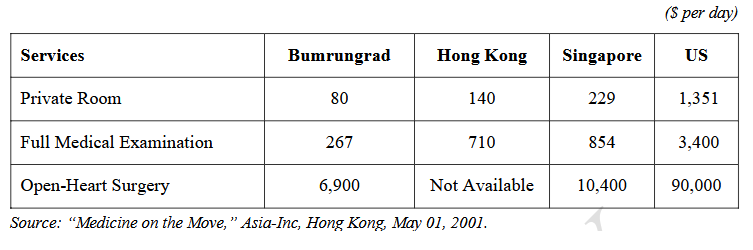
Well-planned pricing was a major contributor to Bumrungrad's success. The healthcare costs at Bumrungrad were significantly cheaper than those at similar medical facilities at Hong Kong, Singapore and the US (Refer Table I). On the importance of pricing, Schroeder said, “If you're flying several thousand miles, the issue is the combination of quality and price. As long as quality is held to be as good or better, price is the most compelling factor.” The room rent included nursing care and general medical services. Low-rent apartments with maid-servants were available near Bumrungrad for families of those being treated at the hospital and for out-patients who needed medical care after being operated.
Though Bumrungrad's healthcare services marketing strategy focused mainly on attracting foreign patients, it did not ignore its Thai clientele. The company launched full -page advertisements in local newspapers to attract local customers. Details regarding the room rates, costs of major surgeries and so on were provided in these advertisements. For instance, in 2000, auspiciously referred to as „the Year of the Dragon,' in the Chinese calendar, Bumrungrad launched the „Dragon Baby' campaign targeted at pregnant women. The package was reasonably priced at Baht 29,900. The campaign attracted a good response particularly from middle class Thai nationals.
Table I
Comparison of Costs at Bumrungrad and Medical Facilities in Other Countries
 |
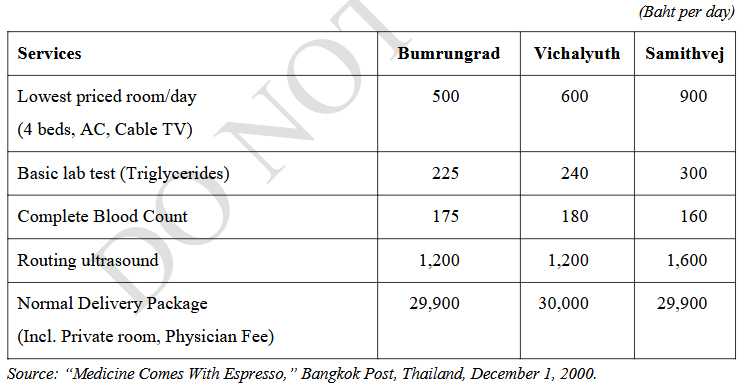
Bumrungrad offered healthcare services to local customers at a competitive price compared to other major hospitals in Bangkok (Refer Table II). Commenting on the affordability aspect, Schroeder said, “It's not just luxury, we have four beds from Baht 900 a day to royal suites at Baht 6000 to Baht 8000 a day. There's always a reputation if you're the premier hospital that you're only a luxury hospital, but in fact we take care of over 600,000 patients and by far the majority of these are simple, middle-class, working people earning a normal Thai wage.”
Table II
Prices at Top Three Private Hospitals in Bangkok
 |
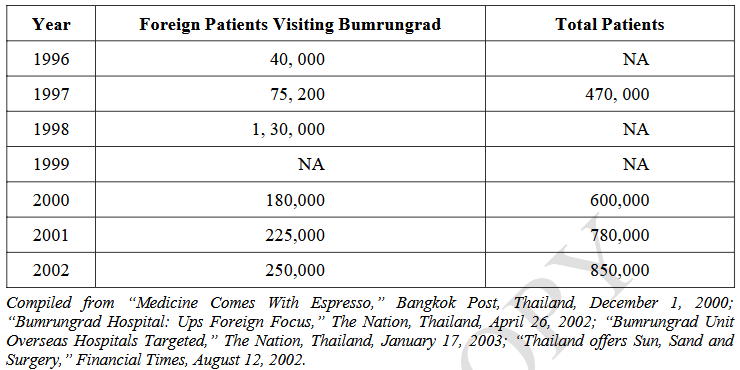
By 2002, Bumrungrad's strategy of wooing foreigners reaped rich dividends with the hospital witnessing more than three-fold growth in the number of foreign patients between 1997 and 2003. (Refer Table III). By 1999, foreign patients accounted for 28% of its total customers compared to 11% before the 1997 crisis. Bumrungrad had also emerged as a market leader in Thailand's healthcare tourism business, with a market share of 90%.
Table III
Foreign Patients Visiting Bumrungrad Hospital
 |
In April 2002, Bumrungrad received accreditation from Joint Commission International (JCI)19, a US-based hospital accreditation agency. Bumrungrad became the only hospital in Asia and one among the 12 top hospitals in the world outside the US to be accredited by JCI. In 2002, Bumrungrad also became the first hospital in Asia to receive ISO 9001:200020 and ISO 1400121 certification. In recognition of its efforts to provide the best healthcare services, Bumrungrad had received several quality certifications and honors (Refer Exhibit IV).
According to September 2002 estimates, each day, Bumrungrad received over 200 e-mails from patients in different parts of the world requesting treatment at the hospital. The management had put five full-time employees in charge of checking and answering e-mails. By the end of 2002, the Bumrungrad had developed a database of 2 mn patients who were treated in the hospital. This database could be accessed by all the doctors.
Bumrungrad?s financial performance had improved significantly by the fiscal 2003 (Refer Exhibit V). Analysts attributed the remarkable growth of Bumrungrad to its global healthcare services marketing strategy.
In February 2003, Bumrungrad opened an outpatient pediatric centre, called Kids' Village. Constructed at an estimated cost of 20 mn Baht, the centre was the largest children's medical care center in Thailand. The center aimed to attract 30,000 children per month compared to the current influx of nearly 10,000 children every month. The centre had 48 qualified pediatricians, representing different pediatric disciplines such as allergy, nephrology, endocrinology, psychiatry and so on. The center offered several medical services in a kid-friendly environment as it was painted with blue skies, clouds, etc. and had colorful treatment rooms and an entrance center, to make kids feel relaxed. It had a Well-Baby center, with a separate entrance and waiting room for kids with immunizations and who were likely to be sick. The 'Kid Zone' had an edutainment center with a mega screen 'BH Theatre' which telecasted children programs round the clock. The center also had a separate breast-feeding lounge and a children's pharmacy. Commenting on these initiatives, Chatree Duangnet, Chief Medical Officer (CMO) of the hospital said, “We spend over 100 mn Baht a year for improving our facilities and services. We make sure that our customers get the best medical quality, intensive service and efficiency in utilization.”
In mid-2003, Bumrungrad added several new features to its website. The new features included a new section called 'International Patients.' Using the various icons in this section, foreign patients could make various requests such as pickup from Bangkok airport, information on the prices of various services, booking a room at the hospital's service apartments, and also keep themselves posted on the recent developments at the Bumrungrad (like new surgeries conducted at the hospital). They could also learn about tour options (the website listed exclusively priced packages). The website also offered some special services to patients and their families. For instance, families of patients being treated at Bumrungrad could send e-greetings to their loved ones from anywhere in the world. The website also introduced Asia's first 'Virtual Nursery,' through which the patients' relatives could view pictures of newborn babies online. The website visitors could also view all the clinics, patient rooms and healthcare departments at Bumrungrad online
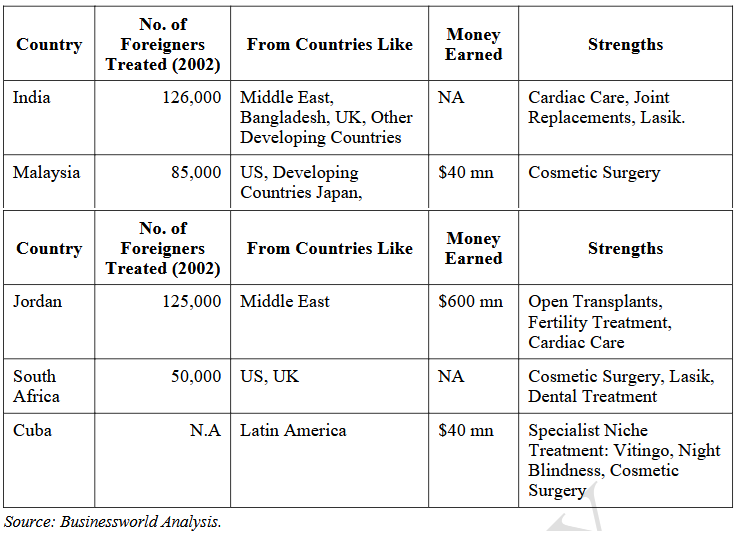
With its state-of-the-art medical and other infrastructural facilities and its world class healthcare services standards, by early 2004, Bumrungrad has emerged as one of the best-managed hospitals in the world. Having achieved this remarkable growth in its business resulting in significantly improved financial performance over the past five years, Bumrungrad's main challenge will be to sustain this growth in future, especially in the light of tough competition from local players in Thailand as well as hospitals from other emerging healthcare destinations in the world (Refer Table IV).
In 2004, Bumrungrad faces tough competition from local players, who are upgrading their services and infrastructural facilities to be on par with those at Bumrungrad. Industry analysts say that it may not be difficult to imitate the unique services offered by Bumrungrad. A few competitors are also offering specialized medical treatment in a five star hotel-like ambience. For instance, Praram 9 Hospital in Thailand is acquiring a reputation for fertility treatment and kidney dialysis. It has internationally certified doctors offering services at very competitive prices. Other competitors like Sanutveh, BNH and Bangkok hospitals have renovated their facilities to reach the standards of Bumrungrad. Hospitals in neighboring countries like Singapore, Malaysia and India are also following the same strategy (Refer Exhibit VI for the snapshot of global medical tourism industry).
Table IV
Emerging Healthcare Destinations in the World
 |
Undeterred by the rising competition, Bumrungrad plans to 'go global' in its pursuit of new avenues of growth. By 2005, Bumrungrad plans to manage a private hospital in Dhaka (Bangladesh). The $40 mn hospital called 'Square Hospital Limited,' is to be managed completely by Bumrungrad. However, Bumrungrad will not be investing its own finances in this venture as it is to be built using finances from private investors in Bangladesh.
1. Bumrungrad has emerged as the leading privately managed hospital in Southeast Asia. Comment on Bumrungrad?s strategy of wooing foreign patients. How did the company promote its services to foreign customers? Explain.
2. In a service business, providing the best customer experience is the key to success. In the light of this statement, identify the distinctive characteristics of the healthcare services offered by Bumrungrad. Study and comment on the services marketing mix of Bumrungrad.
3. Bumrungrad has reportedly improved its financial performance significantly over the past 4-5 years. Explore the relationships between the services marketing variables like customer satisfaction, quality of service and increased productivity, and the overall profitability of Bumrungrad.
4. In early 2004, Bumrungrad faces fierce competition from local as well as foreign healthcare companies from nearby countries. Conduct a SWOT (strengths, weaknesses, opportunities and threats) analysis of Bumrungrad, and comment on its competitive position in 2004. What measures must Bumrungrad take to retain its leadership position in the future?
Exhibit I
Medical Tourism Industry in Thailand
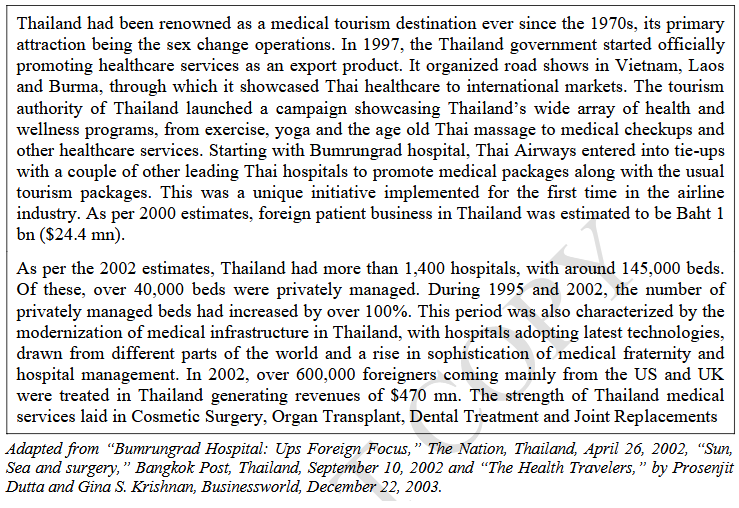 |
Exhibit II
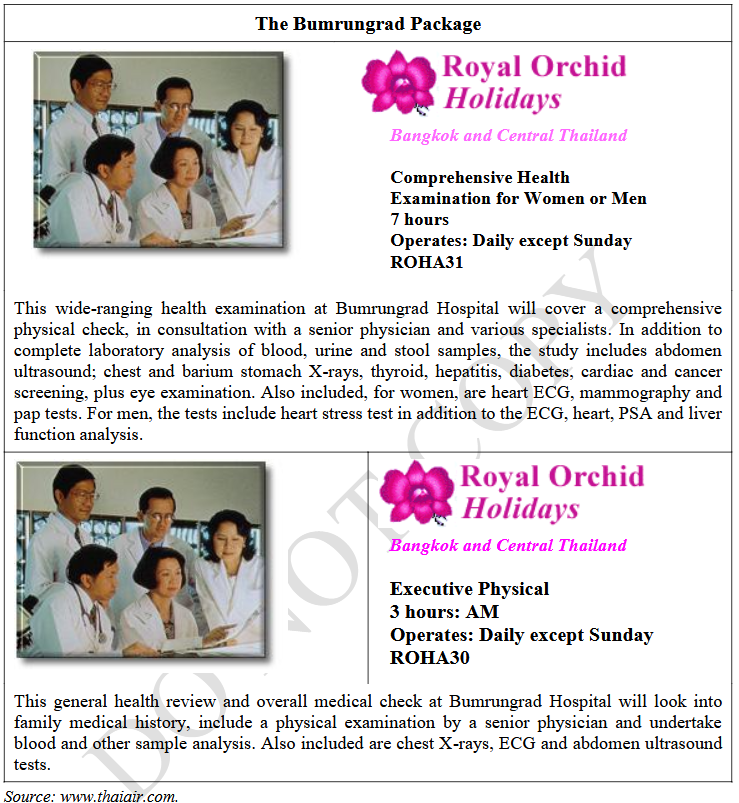 |
Exhibit III
Bumrungrad – Experiences of Foreign Patients
|
Penny Walker (Walker), a New Zealand national was the wife of a Kiwi diplomat posted in Bangkok. She was suffering from some problems such as temporary loss of vision, which she Bumrungrad hospital?s website and its Hospital 2000 information system allowed customers, from countries near and far, to get medical attention in quick time. For instance, Mary Wong (Wong), a A 57-year old US patient who was treated at Bumrungrad said, “This was the best experience in my life.
Thailand is known as the Land of Smiles. I have never seen so many happy smiling people in a hospital in my life. Thanks Bumrungrad!” |
Adapted from “One Fright in Bangkok [Patient story of Neurosurgery Abroad],” The Press, Christchurch, New Zealand, January 2001 and “Inside the Battle for Asia’s Sick Rich,” Asia Week, Hong Kong, November
16, 2001 and “Best Experience in my Life” Grand Imperial Travel, January 05, 2004.
Exhibit IV
Awards and Recognitions for Bumrungrad
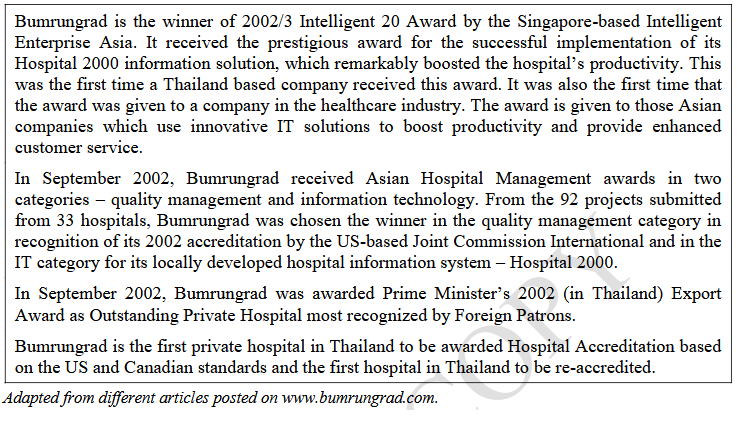 |
Exhibit V
Bumrungrad – Financial Performance (1999-2003)
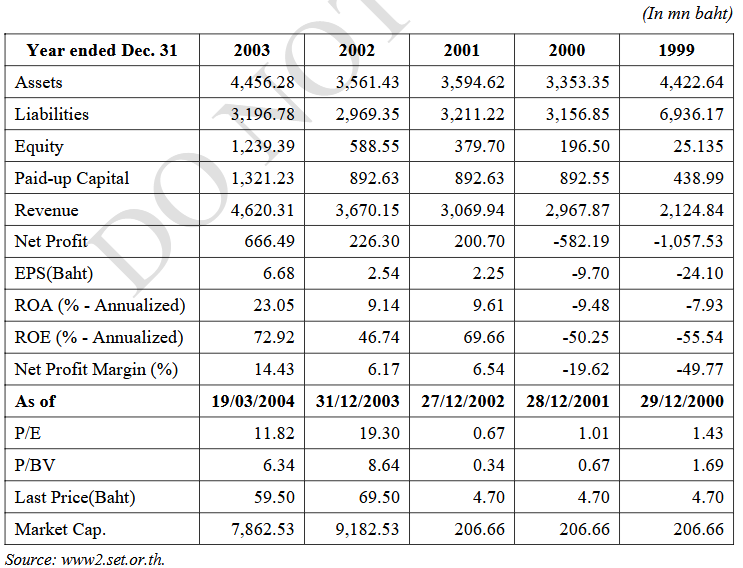 |
Exhibit VI
A Snapshot on the Global Medical Tourism Industry
|
In 2002, more than 1.3 mn tourists visited five countries – Thailand, Singapore, Malaysia, Jordan and India, spending close to $1 bn. In these countries, the spending on medical tourism is Though the practice of traveling to foreign countries for medical treatment had been in vogue since ancient times, the momentum has picked up, as large numbers of people are able and As it is clear that the healthcare systems in developed countries cannot cope with the demand, people from these countries have started looking for alternatives in other countries, particularly Across the world, medical travelers can be classified into four geographical groups, with each group having distinct needs in mind. The first group comprises people from countries like the Globally, the medical tourism market is estimated to be $40 bn, and is growing at more than 20% every year. Countries like India and Thailand are fighting aggressively to tap the market. |
Adapted from “The Health Travelers,” by Prosenjit Dutta and Gina S. Krishnan, Businessworld, December
22, 2003.
Keywords
Healthcare services, marketing strategy, Thailand, Bumrungrad Hospital Public Company Limited, privately managed, Southeast Asia, Southeast Asian, currency crisis, market leader, healthcare industry
Related Case Studies
| Case Title | Details | Price | Add to Cart |
|---|---|---|---|
|
Case Title Taco Bell’s AI Drive-Thru FailureCase Code: ITSY156 |
Details | 300 | Add to Cart |
|
Case Title Reliance Jio’s Next Act: Monetizing a Mass Brand without Breaking TrustCase Code: MKTG494 |
Details | 500 | Add to Cart |
|
Case Title Taco Bell’s AI Drive-Thru FailureCase Code: ITSY156 |
Details | 300 | Add to Cart |
|
Case Title The Nirma StoryCase Code: MKTG008 |
Details | 200 | Add to Cart |
|
Case Title IKEA’s ‘Punch’ Moment: Using Reactive Marketing to Build Brand ConnectionCase Code: MKTG493 |
Details | 300 | Add to Cart |