
Amazon.com’s Inventory Management
🌐 International Buyers — Pay via PayPal
Details
OPER023
13
2004
YES
400
Amazon
Retailing
US
Inventory Management,Channel Strategy & Development, E-business Operations
Abstract
The case provides an overview of Amazon.com’s inventory management. Jeffrey Preston Bezos the founder of Amazon.com launched the company when he realized that Internet provided immense scope for online trading. Although the site was originally launched as an online bookstore it eventually offered several other products to keep abreast of the competition. The case takes a look at the different products and features offered on the site. The case also discusses Amazon’s value propositions and its criteria for choosing strategic partners. It then elaborates on the strategies adopted by Amazon for managing its inventory. It also explains Amazon’s decision to outsource inventory management to distributors. The case takes a look at Amazon’s decision to sell the products of competing retailers on its site. It concludes with a brief note on the future challenges in Amazon’s warehouse management.
Learning Objectives
The case is structured to achieve the following Learning Objectives:
- Facilities offered and the technologies adopted by online shopping sites.
Contents
"In the physical world it's the old saw: location, location, location. The three most important things for us are technology, technology, technology."
-Jeff Bezos, CEO, Amazon.com
"We have seen a very interesting evolution where they insisted on owning every piece of the customer experience and then moved towards an open posture where they are outsourcing more and putting their trust into others."
-Ken Cassar, e-commerce analyst, Jupiter Media Metrix on Amazon.com
Amazon.com (Amazon) was one of the first online shopping sites launched in 1995. Since its inception, it has been consistently ranked as one of the best retail sites on the Internet and is regarded as the universal model for successful Internet retailing. In March 1998, Amazon was ranked among the top 20 Internet sites in almost all the major market surveys. According to an analyst, ?When you think of web shopping, you think of Amazon first.' The Forrester PowerRankings in 2000, ranked Amazon as the best online shopping site.
Amazon owed a large part of its popularity to its excellent customer service, which was due to its exemplary inventory management. Amazon realized that there were a lot of players in the e-tailing industry and therefore it needed to consolidate its position as one of the best online shopping sites. Accordingly, it took several measures. In order to increase its revenue, it added several new products to its site. In 1999, on an average, it added a new product on its site once in every six weeks. It entered into strategic alliances with several companies to increase the range of products available on its site. Later, it strengthened its Customer Fulfillment Network by obtaining products directly from the distributors rather than stocking all the goods in its warehouse. Amazon was popular among its customers for shipping the goods within the estimated time, leading to satisfied customers, improved market share and repeat business.
By the end of 2002, Amazon had 22.3 million registered users on its site. By 2003, Amazon became the biggest book, music and video retailer on the Internet and offered more than 4.7 million books, videos, music CDs, DVDs, computer games and other products. Further, Amazon had the distinction of being the first e-commerce site to use collaborative filtering technology. Amazon's immediate business goal was to 'get big fast' which reflected the driving force behind the company's growth.
In the early 1990s, several entrepreneurs recognized the massive potential of the Internet and decided to cash in on it. One of the first to do so was Jeffrey Preston Bezos (Bezos), a graduate in Electrical Engineering and Computer Science from the Princeton University. After his graduation in 1986, Bezos turned down offers from Bell Labs and Intel and instead took up a job in a startup company run by two professors from the Columbia University. The company built tele- communication networks for Wall Street firms. Bezos left the company in 1988 and joined Banker's Trust where he led the development of computer systems. In early 1990, he became the youngest vice-president of that company but quit the job to work for D.E.Shaw's hedge fund till 1994. At D.E.Shaw, he built technically sophisticated and successful quantitative hedge funds6 and in 1992, at the age of 28, became the firm's youngest senior vice-president. Around that time Bezos came across an article on the impact of the Internet on online shopping. He found out that the Internet was growing at the rate of 2300 percent per month and realized that within a few years many people would be making money by selling over the web. He desperately wanted to start a new venture on the web as early as possible.
As a first step, Bezos conducted a study of the different items that could be sold on the web. He wanted to offer low-priced products that customers would not hesitate to buy online. Said Bezos, "I used a whole bunch of criteria to evaluate the potential of each product, but among the main criteria was the size of the relative markets. Books, I found out, were an $82 billion market worldwide. The price point was another major criterion: I wanted a low-priced product. I reasoned that since this was the first purchase many people would make online, it had to be non-threatening in size. A third criterion was the range of choice: there were 3 million items in the book category and only a tenth of that in CDs, for example. This was important because the wider the choice, the more the organizing and selection capabilities of the computer could be put in good use."
Bezos moved to Seattle and made a humble beginning in his garage. The decision to move from a secure existence in New York City to heading a startup Internet company was hard to make. He decided to start his venture in Seattle since it had many software engineers and was less than 400 miles from Roseburg Ore, the largest book distribution warehouse in the USA. Bezos' vision for his venture was to create a virtual bookstore that could hold more books than any physical book store in the world. He wanted to give a perfect name to his new venture. Said Bezos, "I wanted a name that began with an 'A', one that was memorable and universal." He named his company Amazon.com, after the river Amazon. Bezos' vision was to make his company the Amazon of the book-selling world.
In the initial months, his priorities were to arrange for funds and build the necessary software. So Bezos hired Shel Kaphan, a brilliant programmer, to develop the software. He also finalized a deal with the venture capitalist firm, Kleiner Parkins, to provide funds for his company. Amazon began its operations in July 1995. It invited 300 beta testers8 to spread the word about the new site. In May 1997, Amazon went public. The Initial Public Offer (IPO), which was priced at $18 per share, fetched the company $54 million. In the same year, Amazon tied up with various search engines and portals such as Yahoo, Excite, Alta Vista and Netscape.
Amazon shipped books to 45 different countries in the first month of its operations. Bezos attributed the success of the site to its customers, who recommended the site to others.
Within a few years of its launch, several new e-ventures were introduced which threatened to eat into the market share of Amazon. Bezos told to his staff, ?Don't be afraid of competitors, be afraid of customers. (Competition) is the reason why we have to be smart, why we have to be good at what we do.?9 To survive and out beat the competition Bezos wanted to have the widest range of products on his website. Although Amazon began as a book store, it widened its range of products beyond books. It launched a music store in June 1998 (Refer Exhibit-I for the product range of Amazon). It also launched a video store and a holiday gift store that offered a variety of products including personal electronics and toys. Within a few years, Amazon's range of products not only included physical goods but also services such as banking and travel. Apart from books, Amazon decided to offer music CDs, DVDs, electronic items, magazine subscriptions, free e-cards, industrial and medical supplies, kids items, gifts and registries, camera and photo software, apparel, magazines, office products, kitchen products, computers, video games, cell phones, home furnishings, car parts, travel, banking , restaurants and several other web services to name a few. In September 1999, Amazon launched a feature called 'Zshops.‘ Zshops empowered small merchants and customers to set up online stores for a monthly fee of $10 and a transaction cost of 1-5 percent of the value of the sale. The retailers and third-party sellers registered at the 'Zshops‘ could sell their product on Amazon's site. Whenever a customer placed an order at the Zshop by clicking on the 'buy it!' button, he was asked to fulfill a few formalities such as providing his e-mail address and his valid credit card number. Once he did that, the customer was sent e-mails telling him how to proceed with his transactions.
Amazon built a four-fold value proposition that indicated its priorities in the establishment of the online venture. The four dimensions it focused on were convenience, selection, price, and customer service. The online venture was convenient as it was open for business all the time. The site was so designed as to keep the download time at a minimum. The site also offered its users various facilities such as reviews, e-mail notifications, reference from a previous search and product recommendations. It also provided the users with a wide range of product options, which they could select from. Amazon had an inventory consisting of millions of items which was roughly about 100 times that of a typical physical store.
The site provided book lovers an opportunity to post their reviews on the site, and also read reviews posted by other readers. It also hosted excerpts from books for the benefit of the customers. Customers were given the choice to search for books by author, subject, title or publication. The site offered a lot of incentives to the customers. It offered huge discounts—40 percent on selected feature books, 30 percent on hard covers and 20 percent on paperbacks. The books were shipped to the customers within a week. Upon request, the customers were also sent e- mails announcing the arrival of a new book by a particular author or on a particular subject. When a customer bought an item for the first time on the site, Amazon stored his shipping and credit card information securely so that whenever he logged on in future, he didn't have to provide all this information again. The site also sent e-mails to its customers to let them know the status of their orders. It also launched a facility called GiftClick which let the customers choose a gift and simply type in the recipient's address. Amazon took care of everything else.
Amazon provided its goods at a cheaper rate in comparison to a physical store. In spite of the shipping charges, the customers still got products from Amazon at rates 8-10 percent lower than that of a physical retailer. Moreover the cost savings increased as the number of goods ordered increased. Amazon had earned a great reputation for its excellent customer service. It delivered all the goods within the estimated time, mailed the customers about their latest books of interest and invited customer reviews on the site, thus developing a strong relationship with its customers.(Refer Exhibit-II for Amazon's core values).
In order to expand in a rapid and a cost-effective manner, Amazon decided to partner with other companies. The main criterion used by Amazon for selecting a partner was the customer service provided by the company. During 1998-2000, Amazon acquired ownership stakes ranging from 17 to 49 percent in various online retailers – Greenlight.com, Living.com, Drugstore.com, HomeGrocer.com, Pets.com, Ashford.com, Gear.com, and Della.com. Amazon spent an estimated $160 million on acquiring stakes in these companies. By January 2000, these investments were valued to be between $900 million and $1.5 billion. (Refer exhibit-III for a list of Amazon's partners)
Amazon anticipated three main advantages from these investments. Firstly, it could provide an increased range of products and services to its customers. Secondly, Amazon got increased revenues in the form of marketing fees from its partners. And finally, Amazon's stake in these companies increased its market valuation. Amazon tried to promote each of its partners by sending e-mails to its customers and at times, including their marketing materials in the shipments made to the customers. Amazon often mentioned the products offered by its partners in its catalogs. For example, Amazon's holiday catalog included offerings from Gear.com.
When Bezos started his venture, he aimed at hassle-free operations. He wanted to offer his customers a wide selection of books, but did not want to spend time and money on opening stores and warehouses and in dealing with the inventory. He however realized that the only way to satisfy customers and at the same timer make sure that Amazon enjoyed the benefits of time and cost efficiency was to maintain its own warehouse. Building warehouses and operating them was a very tough decision for Bezos. Each warehouse cost him around $50 million and in order to get the money, Amazon issued $2 billion as bonds.
In 1999, Amazon added six warehouses in Fernley, Nevada; Coffeyville, Kansas; Campbellsville, Kentucky; Lexington, Kentucky; McDonough, Georgia; and Grand Forks, North Dakota. On the whole, Amazon had ten warehouses. Most of these warehouses were set up in states with little or no sales tax. In the same year, Amazon increased its worldwide warehousing capacity from 300,000 square feet to over five million square feet. Since Amazon ordered books and other products from the warehouses only after the customers had agreed to buy them, the return rate was only 0.25 percent compared to the return rate of 30 percent in many segments of the online retail industry.
Amazon's warehouses which were a quarter- mile long and 200 yards wide stored millions of books, CDs, toys and hardware. They were very well maintained and completely computerised. In fact, the number of lines of code used by Amazon's warehouses were the same as the number used by its website. Whenever a customer placed an order, a series of automated events followed which made inventory management easier.
When a customer ordered a book from Amazon, his invoice mentioned the title of the book followed by the barcode. This was a code of numbers such 3-4-5 which indicated the book's location in the warehouse. Computers sent signals to the workers' wireless receivers telling them which items had to be picked off the shelves. The workers decided the order in which the items had to be picked and then verified the weight of each product.
The items taken from the shelves were placed in large green crate which contained the orders from different customers. When the crates got filled, they were placed on conveyer belts and sent to a central point. Here the bar codes were matched with the order numbers to find out who would receive each item. Each customer's orders were placed in a separate cardboard box. Different wrappers were used to cover gift items. Most of the orders were shipped either through the United States Postal Service or through the United States Parcel Service which were located close to Amazon's warehouses. Amazon had developed a proprietary software and had trained some of its personnel to get books which were out-of-print or to get products that were hard-to-find, using the software. The software sent orders (which the company could not cater to) to special orders groups18 for speedy delivery. (Refer Exhibit-IV for the main objectives of Amazon's supply chain
management)
In the holiday season of 1999, Amazon was determined not to disappoint any customer who visited its site for his holiday shopping. Accordingly, Bezos decided to stock the stores with every possible item that customers were likely to buy. Right from the latest novel to the chartbuster movie of the season, he wanted everything to be stored to ensure that none of the customers logged out of the site, disappointed. Although the strategy adopted by him was appreciated, Bezos had to face a lot of problems too while trying to manage his large inventory.
Bezos realized the importance of managing inventory in his company. He knew that a large number of goods piled on the shelves would reduce the profit margins as piled up goods represented unutilized cash which could be used elsewhere in his business. However, if fewer goods were stocked, it meant that some of the customers were bound to be disappointed. In order to overcome this tedious task of inventory management, the company decided to do things differently in the holiday season of 2000.
Amazon managed to reduce the size of its inventories even as the company offered more products on its site. This was made possible by managing the warehouses efficiently. Amazon made careful decisions about which products to buy and where to buy them from. The company then had to decide which of the distribution centres it would send its product to and then know how to receive and track the product once it was in the warehouse. Amazon also decided to buy its books, CDs, videos etc. directly from the publishers instead of buying them from the distributors. Amazon maintained a good relationship with its vendors so that it could extract best deals from them. The company spent huge amounts on its infrastructure and technology between 1997 and 2000.
In order to manage the inventory, Amazon refined its software. The new software helped the company accommodate inventory as per the demand in different regions. For example, Amazon used its information to rearrange its warehouses in Delaware, Kansas, Kentucky, Nevada and North Dakota. It tried to place products, like CDs and CD players which were generally purchased together, at one point. Amazon also tried to reduce its split shipments—the orders for multiple items from different warehouses. This step considerably reduced the inventory levels. Amazon used the software to estimate customer demand at a particular place, which considerably reduced the risk of buying too few or too many goods.
Amazon also tried to cut down its expenses. It decided to outsource some of its routine activities so that it could concentrate better on its core activities. It partnered with other companies for shipping the inventory. So, while the partners shipped the items, Amazon leveraged on its e-commerce expertise. It revamped the layout of its warehouses making it easier for the company to locate and sort customer orders. By doing this, it managed to save all the expenses related to filling and shipping orders.
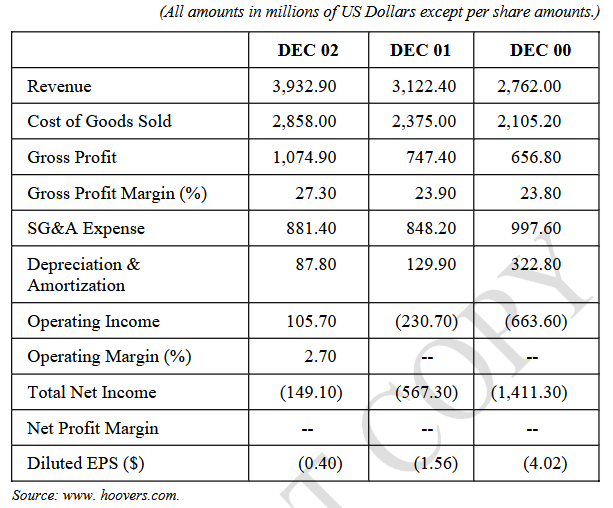
Improved inventory management helped Amazon record its first ever profit in the fourth quarter of 2001. After accumulating a deficit of $2.86 billion in the seven years since its launch in 1995, Amazon recorded a net profit of $5 million in the fourth quarter of 2001.This profit was mainly attributed to its ability to reduce costs in stocking and shipping goods. Amazon had a sales record of $1.1 billion in the fourth quarter of 2001 which was a 15 percent increase over the sales recorded during the same period the previous year ($972 million). In 2002, Amazon recorded sales of $ 3.93 billion which was 26 percent higher than the sales of 2001 ($ 3.12 billion). (Refer Exhibit-V for income statements).
In early 2001, Amazon decided to outsource its inventory management though it knew that it was a huge risk. When Amazon managed its own inventory, it had earned the reputation of providing superior customer service, which was its biggest strength. Now, the company wanted to concentrate on its main activities and outsource inventory management in order to earn more profits. However, Amazon was apprehensive that this move would damage the hard-earned reputation of the company. Nevertheless, it decided to go ahead with the decision to outsource its inventory.
Amazon did not stock every item offered on its site. It stocked only those items that were popular and frequently purchased. If a book that was not too popular was ordered, Amazon requested that item from its distributor who then shipped it to the company. In the company, the items were unpacked and then shipped to the respective customers. So, Amazon basically acted as a trans-shipment centre and ensured that the entire process of shipping from the distributor to the customer was done very efficiently.
Some of the main distributors to Amazon included Ingram Micro19 and Cell Star. Cell Star handled cell phone sales while Ingram Micro, a whole sale distributor, handled computers and books. Amazon had external distributors for most of its products except the bestsellers. In August 2001, Amazon entered into an agreement with Ingram Micro Inc., the largest wholesale dealer of electronic goods and supply chain management services to provide logistics and order-fulfillment services for desktops, laptops and other computer related accessories at the computer store at Amazon.com. Ingram Micro was also the distributor for Amazon's electronic store. Said Carl Gish, vice president of electronics at Amazon.com., "Ingram Micro shares our customer obsession, and they have deep expertise in the highly complex skill of distributing computers and related products. We know they will provide timely and accurate delivery of orders that customers enjoy and expect from Amazon.com." Commented Kevin Murai, president, Ingram Micro U.S., "The customized fulfillment services we are providing to Amazon.com's computer store will minimize the number of touches to the product, while ensuring a seamless shopping experience for Amazon's customers from start to finish." He added that Ingram Micro had the strategic expertise to maximize operating efficiencies, streamline supply chain logistics and reduce inventory costs.
"It's faster to ship to customers this way," Amazon spokesman Bill Curry said. "We also don't have to receive it into the warehouse, put it on a shelf, take it off the shelf, put it in a box, and send it to the customer."
Amazon planned to extend the drop-shipment model to all other categories too. However, there was a major disadvantage with this model. If the customers ordered only a single item at a time, the drop-shipment model was extremely helpful. But if a single order had several items such as a book stocked by Ingram and a game stocked by Amazon, then the following procedure was adopted: Ingram sent the book to Amazon, Amazon added the game and then forwarded the whole box to the customer. This reduced the overall efficiency of the process. Since almost 35 percent of orders placed at Amazon were from different product categories, the drop-shipment model was not very effective.
In early 2001, Bezos came up with the idea of including the products of competing retailers and some used items on their website. Amazon earned almost the same profit selling on commission as it earned selling on retail. An advantage of this feature was that the customers could now verify the prices of Amazon's products vis-à-vis those of other retailers. So the company did not need to advertise its low prices. Said Bezos, "Giving people the choice to buy new and used side by side is good for the customers. Give them the choice. They are not going to hurt themselves with that choice. The data we have tell us that customers who buy used books from us go on to buy more new books than they have ever bought before. They may not want to plunk down $25 for a brand new author they've never tried. This lets them experiment." By 2003, Amazon handled orders for Borders, Target, Circuit City and Toys "R" Us. So while Amazon only handled the net orders, the companies handled the inventory. These services proved to be immensely profitable for Amazon.
By 2003, Amazon's warehouses could handle thrice the volume they used to handle in 1999, while the cost of operating them decreased from 20 percent of Amazon's revenues to less than 10 percent. The efficiency was also seen in its inventory turnover which was 20 times a year while for most other retailers it was below 15. In 2003, Amazon decided to slash its shipping charges. Customers who visited the site were greeted with a pop- up window announcing the company‘s decision to provide free shipping for those who bought two or more items in any combination from the site's books, music, DVDs or video stores. The company also decided to reduce the charges on single item orders and international shipments.
Although an online retailer like Amazon had to spend millions on marketing in order to get new customers compared to a smaller amount required for traditional retailers, it managed to leverage the amount spent because of its lower capital costs. Generally physical bookstores having a wide range of books needed to stock about 160 days worth of inventory. The distributors and publishers had to be paid 45 to 90 days after the books were bought from them. So they had to carry the cost of the books for about 2-3 months. While an online site like Amazon needed to stock only 15 days worth of inventory and was paid for its sales immediately by credit card. So it got a month‘s use of interest free money.
Although online shopping has become popular over the years, Amazon had to struggle to make profits. One of the reasons was the variable costs incurred by multiple delivery attempts and reverse logistics—the return of products by the customers. Multiple delivery attempts cost the company about 20-30 percent of the total costs for home deliveries. This was due to the additional shipping charges which had to be borne by the company. Several incidents of thefts and product damage were reported as the shipped goods were at times left at the customer's doorstep. All these incidents also led to a lot of frustration among customers. The expenses on reverse logistics and multiple delivery attempts ate into Amazon's profits and hence it had to find a solution to this problem.
Amazon tried its best to store its large inventory economically and made improvements in its distribution centres. Consequently, while in the late 1990s, 12 percent of the inventory at Amazon was stored at wrong places leading to delayed orders and lost time, by 2002, this was reduced to 4 percent because of better software and storage facilities. Amazon also tightened its operations to ensure that it did not miss any customer orders. By sorting out all these issues, Amazon reduced the time it took to ship goods out of its warehouses. It also managed to ship out more items using the same number of employees.
Despite all the measures that Amazon took to manage its inventory more efficiently, logistics experts still opined that Amazon's warehouses were working at less than 40 percent capacity. "At this stage it is overly built," said Richard W.Hallal, principal with Clevland Consultant Logistics Development Corp.29 According to the experts, in order to manage its inventory more effectively Amazon should either reduce the number of warehouses or increase its sales. But one thing was for sure, Amazon was "undoubtedly the most quoted example of go-ahead electronic commerce and still the showcase for Internet trading."
1. Managing inventory is one of the most important tasks of a retailing company. If there are not enough goods in stock some of the customers might be disappointed. Stocking too many will reduce the profit margins. Do you think Amazon.com adopted the right strategy while trying to manage its inventory? Was it successful in its task?
2. When it managed its own inventory, Amazon earned the reputation of providing superior customer service. Despite this it decided to outsource inventory management. Do you think Amazon had taken the right decision in outsourcing this key area of its business?
3. In 2001, while Amazon was still struggling to make a profit, it decided to sell the products of competing retailers on its site, along with its own products. Do you think Amazon took the right decision in selling others' products on its site or should it have concentrated on promoting its own products?
Exhibit I
Products and Services offered by Amazon.com
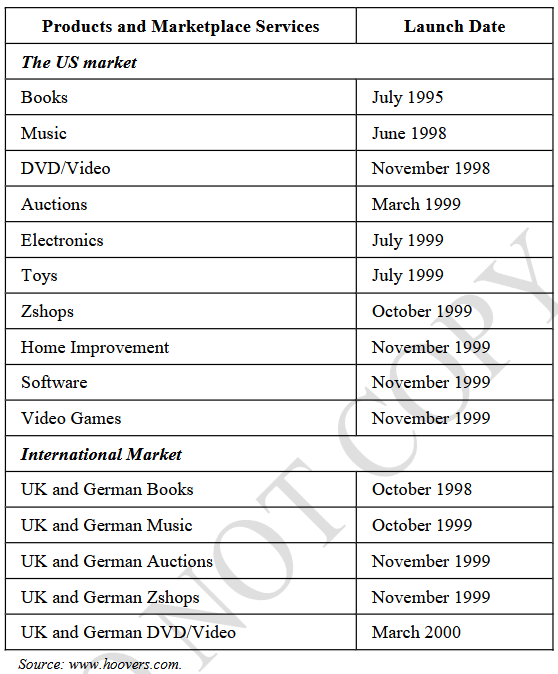 |
Exhibit II
Amazon’s Six Core Values
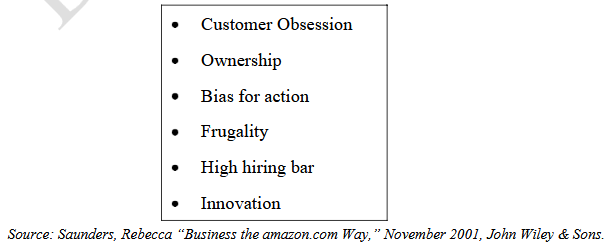 |
Exhibit III
Amazon’s Partners
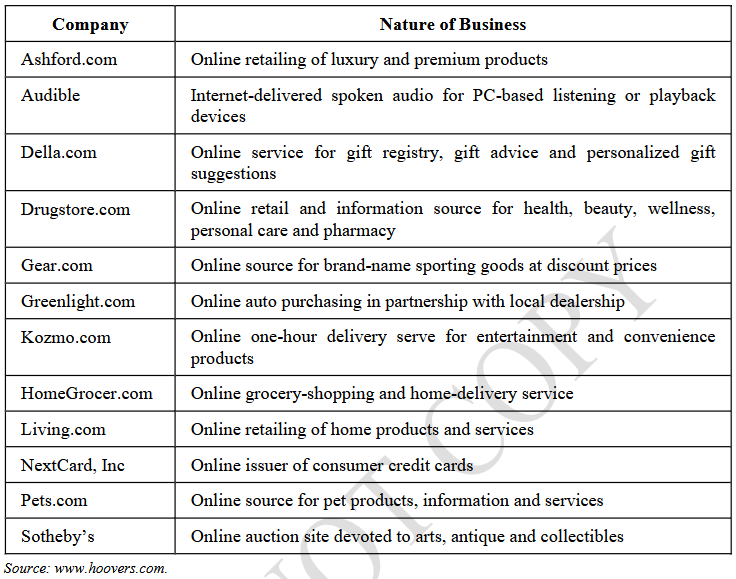 |
Exhibit IV
Amazon’s Supply Chain Management: Key Objectives
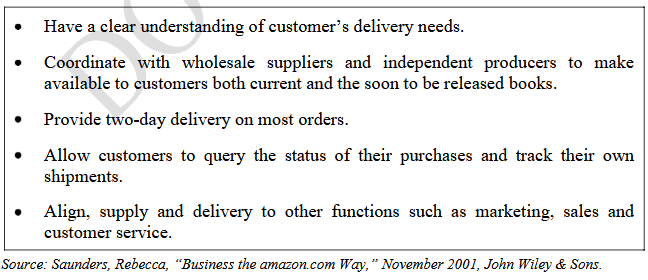 |
Exhibit V
Income Statement
 |
Keywords
Amazon.com, inventory management, Jeffrey Preston Bezos, launched, Internet, scope, online trading, online bookstore, products, features, value propositions, strategic partners, inventory, outsource, inventory management, distributors, Amazon, decision, products, competing retailers, future challenges, warehouse management