
SciQuest.com’s B2B e-marketplace
Details
ITSY008
11
2002
YES
300
JAGGAER (SciQuest.com)
Business & Consumer Services
US
Digital Marketing
Abstract
The case describes the manner in which SciQuest.com’s B2B e-marketplace was developed and the system architecture of this e-marketplace. It also explains how the company implemented an operations fulfillment solution in the marketplace and the benefits derived from it.
Learning Objectives
The case is structured to achieve the following Learning Objectives:
- The development and architecture of a B2B e-marketplace.
Contents
SciQuest.com’s B2B e-Marketplace
“Making scientists more efficient benefits everyone. More research time leads to more scientific break throughs, and more innovative treatments and products for people all around the world.”
- Scott Andrews, co-founder and CEO, SciQuest.com
THE NEED
In the mid 1990s, scientific products industry experts began realizing that the traditional supply chain had not been addressing the needs of scientists, purchasing professionals and suppliers. Scientists had to continuously develop new applications and test new theories. This required forecasting of the quantities of chemicals and other supplies and the kind of equipment they would need. They sometimes had an immediate need for critical items that were highly technical, which they had never purchased before. Most of the time, they had to purchase them from new and different suppliers. This involved going through several catalogs of the size of huge telephone directories.
Purchasing professionals were also frustrated with the traditional paper-based product ordering process that required manual preparation of purchase orders and order tracking. Scientists sent their requisitions to purchasing professionals, who placed their orders with several suppliers by phone, fax and e-mail. This multi-step manual process was highly susceptible to errors. According to a survey, each requisition cost $107 for orders processed manually, while processing an order through an online procurement system cost only $30 in 1999.
Suppliers used two sales channels – traditional distributors and direct sales. While traditional distributors gave suppliers access to a wider market, they kept the suppliers away from the ultimate customer. Most distributors also lacked the ability to provide the technical assistance associated with specialty scientific products and instruments. Direct sales gave suppliers’ greater control and the direct customer contacts that were essential for specialty products. However, this sales channel was often expensive and inefficient. Many suppliers had web sites that were online versions of their catalogs, but these sites didn’t remove the primary cause of inefficiency for buyers – the inability to find products and consolidate orders from different suppliers quickly and easily through a single service. Moreover, small companies could not afford to upgrade the site constantly. To overcome these limitations of the traditional supply chain for scientific products and to meet the information needs of scientists’ e-commerce seemed to offer the best solution. Realizing this, Sciquest.com (SciQuest), a web site offering a wide range of services to scientists and purchasing professionals, launched a business-to-business (B2B) e-marketplace in 1998. The B2B e-marketplace offered scientific and laboratory products used by pharmaceutical, clinical, biotechnology, industrial and educational organizations worldwide.
BACKGROUND NOTE
SciQuest was founded by Peyton Anderson (Anderson), Scott Andrews and Keith Gunter in Research Triangle Park, North Carolina in 1995. Before opening its online store, SciQuest conducted a survey of the audience its web site planned to target. The company first launched an informational web site and product-sourcing service in 1995. The web site allowed users to access a comprehensive online database of scientific products and suppliers with a powerful search engine. SciQuest generated its revenues from scientific vendors who paid an annual subscription fee for inclusion in the database. By 1999, about 25,000 of the 150,000 research laboratories in the
US used SciQuest for research and browsing and 50,000 unique visitors2 logged on to the site every month.
Although the web site was becoming increasingly popular, the founders had much bigger plans for it. All of them were former sales professionals for Baxter Scientific Products, which sold beakers, test tubes and chemicals to scientist, and they were well aware that many companies encouraged their scientists to procure specialized equipment, products and high precision tools, on their own.
Commenting on the 4-6 hours spent by scientists for procuring supplies, Anderson said, “If you multiply that across 100,000 scientists, and we save them five percent of their time, it’s equivalent to having 5,000 more researchers looking for new drugs and new cures. Our role is to be the facilitator of that information-gathering and communications, an honest broker in the middle – we are simply the medium that allows scientists and suppliers to communicate efficiently with one another.” SciQuest wanted to develop an e-commerce web site to make it easy for researchers to find and purchase the equipment they needed. They also wanted to transform the site from being just an information provider to an e-commerce B2B marketplace. Work on this project started in 1997-98. SciQuest entered into technological partnerships with leading software solution providers such as IBM, Oracle, Ariba and Commerce One.
SciQuest decided to begin transforming its website by implementing a robust e-commerce solution that could integrate powerful search capabilities with easy-to-use online shopping functions. The company needed to build the e-marketplace from scratch, including back-end transaction processes such as fulfillment and accounting. The company evaluated many major e-commerce products in the market, finally settling for IBM’s offerings in 1998. David Skowron, vice president of technology at SciQuest said, “Our final decision was based on an evaluation of product scalability, flexibility and price. This decision was reconfirmed when we recently re-evaluated our burgeoning business needs and opted to migrate to WebSphere Commerce Suite, which we believe is the most comprehensive, robust e-marketplace solution today.”
THE TECHNOLOGY
In September 1998, SciQuest implemented the OBI4 compliant Net.commerce solution. The B2B e-marketplace (See Exhibit I) was developed using WebSphere Commerce Suite and DB2 Universal Database for AIX5. A WebSphere Application Server6 was used to develop applications that supported the company’s back-end business processes. According to Andrews, “In our industry, you need the ability to handle a high volume of new information quickly. WebSphere Commerce Suite and DB2 Universal Database enabled us to do just that, making it possible for us to open our doors to millions of potential customers within weeks.”
At the heart of SciQuest’s online catalog was DB2, which consolidated and stored information on more than one million items from approximately 600 vendors. DB2 stored all of SciQuest’s business-critical information, vendor information and customer purchase histories for tracking orders. This enabled SciQuest to eliminate much of its customers’ procurement paperwork and to give the customers a one-stop solution for all of their laboratory supply needs. Rob Fusillo, chief information officer at SciQuest.com said, “From the outset, our goal was to utilize the Web to both reduce transaction costs and increase the value of the average order by allowing customers to purchase from a single vendor.”
To host the e-marketplace, SciQuest used RS/6000 Enterprise Server Model H70 servers and the HTTP7 server. Front-end web queries and transactions were connected to enterprise wide information using Net.Data and Java servlets8. Net.Data macros and JavaServer Pages (JSP) delivered the results to the user’s Web browser. The WebSphere Commerce Suite gave SciQuest the flexibility to employ more advanced technologies, such as JSPs and Enterprise JavaBeans (EJBs), while simultaneously supporting existing technology applications such as those developed using Net.Data. This helped the company to deploy new applications and build more functionality without replacing existing infrastructure.
The WebSphere Commerce Suite solution was connected to SciQuest’s back-office order processing and financial reporting applications using the MQSeries. The MQSeries helped SciQuest to dramatically reduce development time, integrating its internal enterprise-wide applications as well as supplier back-end systems with front-end web transactions. To protect its critical information from unauthorized access over the web, SciQuest used an eNetwork firewall. Once the B2B e-marketplace was fully in place, customers could, by logging on to the site with a user name and password, conduct product searches, compare prices and make purchases (See Exhibit II). Individual purchase orders were made for each vendor, the customer’s credit status was checked and the account history was updated. Soon, SciQuest user sessions increased significantly, reaching more than 100,000 per month in October 1999. As the order management system was not designed to handle this kind of traffic, SciQuest began facing problems in handling the orders.
Explaining the problem, Anthony Francis, VP of global operations at SciQuest said, “Our buyers fill their shopping carts with multiple line items and you have to manage each one of them and know their individual status, whether it’s on back order or consolidated into one shipment. This needs a very robust order management platform, especially when you consider we have no warehouses but have to connect to our suppliers’ warehouses.”
To solve this problem, SciQuest entered into an agreement with Yantra14 in November 1999, to take advantage of its operations fulfillment solution, PureEcommerce. This was a web-enabled application that managed, tracked and executed complex customer transactions across a company’s extended supply chain. It provided comprehensive real-time order management services throughout the transaction lifecycle, from order acceptance, through credit approvals and freight shipping to product delivery.
PureEcommerce enabled SciQuest to effectively manage every single line item even when it was disconnected from its supplier base. PureEcommerce also helped SciQuest to manage customer relationships through reverse logistics, order personalization and tracking capabilities. Customer data was brought forward to the front-end of the business, allowing the consumers to modify and track their orders, print return labels and the like. Now, when SciQuest’s customers filled their shopping cart in the e-marketplace, the orders were routed by PureEcommerce, directly to the concerned supplier. PureEcommerce integrated thousands of suppliers (small, medium and large suppliers), with SciQuest’s marketplace and supported thousands of transactions per day.
SciQuest introduced a training program to help its customer service representatives learn how to use PureEcommerce. Francis said, “For us, the whole PureEcommerce system acts like a pivot in the middle of our operation. We no longer touch an order from the time it comes off our web site as a submitted order until it has passed the various suppliers and is in their hands, via XML, EDI or OrderFax.” The software also had the ability to keep a check on the sale of substances, which could potentially be used to make bombs or drugs. This was made possible by linking PureEcommerce with a CRM application and an e-mail system. The sale of all such substances
was immediately recorded, along with the order-maker’s web site address, for review by SciQuest. The software not only helped SciQuest cut the order-processing costs by 50%, but also significantly reduced the problems the company faced due to the increasing number of customers. The company now began considering introducing various features in the B2B e-marketplace to provide value-added services to its customers.
One such initiative was the launch of an online auction facility in early 2000. The technology for this purpose was supplied by Lotus Domino15 and Lotus Notes16. The auction facility helped customers to submit bids for used and refurbished laboratory equipment. Using Lotus Notes, SciQuest could send, an e-mail response, confirming receipt of a bid by the customer. Items for bid were posted to the web site with the help of Lotus Domino. By the end of 2000, SciQuest shifted the auction functions to WebSphere Commerce Suite, since it supported Java and XML17. Skowron said, “We’ll be able to integrate front-end auction transactions with back-end distribution systems.”
THE FUTURE
SciQuest attempted to position itself as a vendor neutral partner for both buyers and suppliers. It secured over 100 enterprise customers and contracts with 850 suppliers around the world by March 2001. The company had more than 1.5 million stock-keeping units, ranging from reagent and antibodies and latex gloves costing 50 cents, to high-end, $20,000 spectrometers. About 300 transactions were handled through the exchange each day, involving approximately 700 orders to suppliers. SciQuest had the capability to customize its marketplace and integrate it with its customers’ enterprise systems, internal inventory systems and libraries. The company’s catalogue had increased to one million products in 2000 and its services had received the approval of major global product suppliers and research organizations, including Dow Chemicals, Du Pont pharmaceuticals, Glaxo Wellcome, Merck and Monsanto.
SciQuest derived its revenues through commissions from auctions & e-commerce transactions and from advertising and sale of information on its site. The increase in SciQuest’s revenues from $0.48 million in 1998 to $3.88 million in 1999 and $51.7 million in 2000, was largely attributed to the establishment of the e-marketplace, since 90% of the revenues was generated through e-commerce transactions. Though SciQuest benefited from its relationships with large buyers and suppliers through transaction volumes, it found itself working on very thin margins. This was reflected in its bottomline, with the company consistently posting net losses during the 1998-2001 period. While the net loss was $4.22 million in 1998, it increased to $84.35 million in 2000. For 2001, while revenues declined almost 55%, the loss remained almost the same, at $82.84 million (See Exhibit III).
According to analysts, SciQuest’s losses were expected to go up further in the future as spending on sales and marketing, content development, technology and operating infrastructure increased. The global slowdown in the infotech business in the early years of the 21st century, coupled with the fact that SciQuest’s business model was new and unproven, did not augur well for the company.
QUESTIONS FOR DISCUSSION
1. Why did SciQuest decide to set up a B2B e-marketplace? Explain how this decision led to the implementation of the PureEcommerce solution.
2. How is an e-marketplace developed? Briefly comment on the system’s architecture. How did SciQuest benefit from the e-marketplace?
3. What are the benefits of PureEcommerce and how is PureEcommerce implemented? Despite streamlining its operations, SciQuest has not performed well financially. Why?
EXHIBITS
Exhibit I
| SciQuest B2B e-Marketplace |
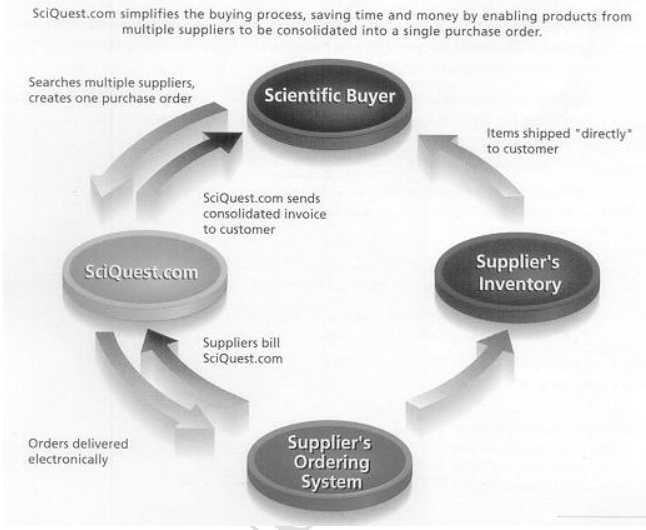 |
Source: Company Annual Report, 1999.
Exhibit II
SciQuest’s Products and Services
|
SciQuest primarily offered marketplace solutions for buyers and suppliers of scientific products. Marketplace Solutions: SciQuest’s electronic purchasing service allowed users to buy Sourcing Guide: SciQuest provided a broad database of product information from more than SciQuest.com Auctions: This service enabled SciQuest’s customers to buy and sell used and SciQuest.com LabDeals: This service was devoted to the sale of surplus scientific products at SciQuest.com Resources: SciQuest offered a broad range of information and reference material Source Book: This was a directory meant for scientists and contained product listings from |
Source: IBS Center for Management Research
Exhibit III
SciQuest’s Consolidated Statements of Operations
| Year ended December 31, | 1998 | 1999 | 2000 | 2001 |
| Net revenues | 477,818 | 3,882,441 | 51,703,556 | 23,265,663 |
| Cost of revenues | 41,880 | 3,426,692 | 46,732,355 | 17,854,289 |
| Gross Profit | 435,938 | 455,749 | 4,971,201 | 5,411,374 |
| Operating expenses | ||||
| Development | 1,191,135 | 9,008,261 | 15,852,648 | 10,896,974 |
| Sales and marketing | 1,706,033 | 10,206,133 | 26,065,994 | 9,088,353 |
| General and administrative | 1,104,010 | 7,075,907 | 20,623,976 | 14,793,619 |
| Stock based non-cash employee compensation |
- | 323,676 | (2,533,103) | 3,185,111 |
| Stock based non-cash customer acquisition costs |
- | 9,107,753 | -- | -- |
| Amortization of goodwill, purchased in-process R&D |
791,102 | - | 34,321,749 | 42,328,008 |
| Total operating expenses | 4,792,280 | 35,721,730 | 62,542,618 | 34,778,946 |
| Net interest income (expense) | 80,041 | 1,869,124 | 7,148,726 | 2,693,586 |
| Income tax benefit | 54,695 | 218,780 | 66,225 | 0 |
| Net Income(loss) | (4,221,606) | (33,178,077) | (84,347,382) | (82,837,105) |
Source: Company Annual Report, 2001.
Keywords
Manner, SciQuest.com, B2B, e-marketplace, system architecture, implemented, operations, fulfillment, solution , marketplace
Related Case Studies
| Case Title | Details |
|---|---|
|
Case Title SMS AdvertisingCase Code: MKTG043 |
Details |
|
Case Title Fabmart’s e - Tailing ModelCase Code: ITSY024 |
Details |
|
Case Title Google.com - The World’s Number One Internet Search EngineCase Code: ITSY019 |
Details |
|
Case Title BEA Weblogic - Personalizing the World Wide WebCase Code: ITSY017 |
Details |
|
Case Title The DoubleClick ControversyCase Code: ITSY014 |
Details |