
BEA Weblogic - Personalizing the World Wide Web
Details
ITSY017
11
2002
YES
300
BEA Systems Inc.
Technology & Communications
US
Digital Marketing
Abstract
The case looks at how BEA Systems’ products/services are playing an important role in personalizing websites. The concept of personalization on the Internet, its benefits and potential problems are explored in detail.
Learning Objectives
The case is structured to achieve the following Learning Objectives:
- Necessity for companies to offer personalized features/services on their websites.
Contents
BEA WebLogic – ‘Personalizing’ the World Wide Web
“BEA WebLogic Personalization Server has gained greater market acceptance because the combination of portal frameworks, personalization and Web application servers are all mandatory for e-businesses.”
- Gail Ennis, Vice President (Marketing), BEA E-Commerce Application Components Division, in May 2001.
CASHING IN ON THE PERSONALIZATION WAVE
By the mid-1990s, the Internet had become an integral part of corporate strategic planning. Companies made a foray into online business, by developing their own websites to portray corporate issues and advertise online-marketing offerings. As the number of companies going online increased, it became necessary for them to offer innovative features on their websites to create and increase user loyalty. This need to keep users glued to one’s website led to the emergence of personalization.
Though in a typical website, customers did not have the power or facility to control data, personalization of websites (like the ‘My’ version of popular search engines and directories) and software products (such as digital art applications and processing software) gave them a certain amount of control. As personalization appealed to the instinct of human beings to ‘gain control,’ the concept became popular amongst companies throughout the world.
A few portals such as Yahoo! Excite, Lycos, and MSN were the first ones to provide personalized services by offering free e-mail, sports scores, horoscopes, stock quotes and news. Buoyed by the success of these portals, many other commerce and content sites began offering personalized services. Amazon.com, one of the major portals began offering purchase related advise to its regular customers, as a part of its personalization initiative.
These websites were aided by personalization solutions offered by many leading technology companies such as IBM, BEA Systems Inc. (BEA), Microsoft and ILOG. Of these, US based BEA had emerged as the leader in the e-business platform market, enabling quick integration of a company’s e-businesses in 2001.
BEA’s products reportedly enabled customers to personalize their solutions and websites effectively. They facilitated faster and efficient delivery of dynamic and reliable personalized services to the customers. The businesses that utilized the e-business products of BEA were found to be highly scalable, reliable and balanced facilitating quick delivery of new services. Following this by the end of 2001, BEA e-business products became de facto standard for over 2100 systems integrators, application service providers and independent software vendors worldwide.
ABOUT PERSONALIZATION
Personalization means providing website users the option to register and set their own preferences. Personalization is a process of collecting user-related data in order to render relevant content and services. Personalization includes dynamically altering content and settings on the websites, in accordance with the personal preferences of the surfer. It could range from a task as simple as a portal allowing users to change the color of the webpage background to a website on stock portfolio management services enabling its customers to customize their portfolio pages. Personalization can either be explicit or implicit (Refer Table I).
Table I
Forms of Personalization
| Explicit Personalization | Implicit Personalization |
|
*Offers an intuitive, browser-based interface enabling end-users to customize content and resources on the site. *Enables users to change the appearance and feel of their user interface by selecting from the various color schemes. * Provides users the option to choose from a range of components that offer interactive tools/services that could be customized. * Helps users select components and set them out on a page according to their preferences and also enables the enterprise staff to lock down the locations of the page bearing mandatory content and components like the navigation bar and corporate logo. *The presentation agent possesses the ability to detect browser abilities, system environment and language of the incoming browser that enables it to display customized content and functionality, automatically. *Does not offer new options if the user’s tastes or preferences change. Hence the need for the model to be simple and easy to update, make additions or deletions. |
*Enables constant creation and updating of user profiles to provide them services as per their preferences. * Based on the previous content utilized by the user, it searches for the content that it perceives to be relevant to the user. Also recommends content and products to users on the basis of the choices made by other users with similar interests. * Offers a vast information base, which is instantly available to facilitate data analysis and personalization. * Offers automatic email notification facility that acts as a good sales promotion channel to the user and helps in administration or marketing for sales follow-up. *Filters irrelevant content or information. *Unpredictable - as the content offered is based on the perceived interests and past record of the users. For Example, a user might click an article out of mere curiosity, which is not actually of any interest to him, and the website based on the article viewed by the user, provides him with many other articles related to the content in the first article. |
Source: www.jcorporate.com
The ability to provide effective personalization services depends mainly on acquiring user attributes, traits, interests, desires and requirements. This is done through one or more of the following techniques:
- Fill-in Profile: The profile is built on the basis of the details provided by the user through online forms. The user indicates his choice, controls the type of content provided and the look and feel of the interface. It usually includes data regarding the user’s interests and preferences.
- Click-Stream Analysis/Web Usage Mining System: This is used to maintain a track of links visited on a website, recording the source of the user, his route through the website and his destination on the existing site. The link analysis also includes observing the links clicked and their related location on screen, the time spent on a specific page and making connections between the links visited and results.
- Collaborative-Filtering Method: The user’s tastes are compared with those of other users in order to build a picture of like-minded individuals. The content delivered to the user is based on the assumption that the user would like the content liked by those, who share similar interests with him. User’s tastes are inferred from their prior actions or by asking them to rate the products.
- Cookies: Cookies are small data packets sent by a website that are stored on the browser’s hard disk. Cookies can be re-used on the server-side of the website to identify the user.
Personalization solutions can be based on the user database available, links provided by clickstream analysis, information collected directly from the user in the course of interface and user profiles stored in the search-engine of the company. The results of personalization are usually estimated by calculating the ROI from the clickstream data that reveals how personalization has changed the consumer behavior3. This reveals the difference between purchases, stickiness, loyalty and the value of data to the customer before and after personalization.
Different portals offer different personalized services to suit the needs of their respective customer base. ‘My Yahoo’ for instance, offers personalized services that facilitate high selectivity of content coverage and a defined application area for its users. GMBuyPower offers personalization features that help in online purchasing, enabling the users to make a detailed one-time purchase. Portals like staples.com support repeat purchases while Amazon.com offers personalized recommendations on products that are offered online.
Many leading companies such as British Airways, Amazon, Adecco BenefitsCorp Equities and WashingtonPost vouch for the robustness of the personalization services offered by BEA. Over 11,000 of the world’s leading companies including many Fortune Global 500 companies are using BEA WebLogic E-business Platform. BEA offered the Web Logic Personalization Server, an advanced architecture that enabled delivery of fast, reliable and scalable personalization.
BEA & THE BEA WEBLOGIC PERSONALIZATION SERVER
BEA, a leading application infrastructure software company, was established in 1995. The company offered integrated, innovative and advanced products/services tailored to transform businesses into e-businesses. BEA’s customer base comprised many Fortune Global 500 companies from various industries such as financial securities, healthcare, network communications, pharmaceutical, airline, computer/office equipment, manufacturing, retail, commercial banking, transportation, telecommunications and government. BEA’s clients included Amazon.com, E-Trade, United Airlines, Federal Express, Qwest, DIRECTV, Kaiser-Permanente and Nokia.
BEA’s 3000 employees were spread across its 90 offices, in more than 30 countries worldwide including Argentina, Austria, Australia, Brazil, Belgium, Canada, the Czech Republic, China, Denmark, France, Finland, Germany, Hong Kong, India, Israel, Ireland, Italy, Japan, Luxembourg, Korea, Mexico, Malaysia, New Zealand, Netherlands, Norway, Portugal, Spain, Singapore, Switzerland, Sweden, Thailand, Taiwan, United States and United Kingdom. The company’s revenues registered a steady growth right from 1995. In 2000, BEA’s annual revenue was around $ 819.8 million (See Table II for Revenues).
BEA offered consulting, knowledge and support services to companies along with its popular BEA WebLogic Enterprise Platform, an application infrastructure foundation that ensured smooth flow of data and reduced application management costs. The various products under the BEA WebLogic Enterprise Platform were: BEA WebLogic Server, BEA WebLogic Portal, BEA WebLogic Integration and BEA WebLogic Framework (an application and deployment framework), WebLogic family of Application Servers, BEA eLink and BEA WebLogic Personalization Server (WLPS).
Table II
BEA Annual Revenues 1996-2000
(In $ million)
| Year | Revenue | % Growth |
| 2000 | 819.8 | 77% |
| 1999 | 464.4 | 61% |
| 1998 | 289.0 | 74% |
| 1997 | 157.2 | 155% |
| 1996 | 61.6 | - |
Source: www.bea.com
The BEA WebLogic Personalization Server (WLPS) offers capabilities that power critical e-business applications. WLPS is principally built on the BEA’s industry leading Web application server that leverages Java 2 Enterprise Edition (J2EE)5 and Web Services APIs6 on a single platform to offer a highly scalable and reliable e-business environment. BEA WebLogic Server offers open standards that are coupled with wide range of integrated development tools, leverage existing skills, simplify development and help in quick deployment of applications.
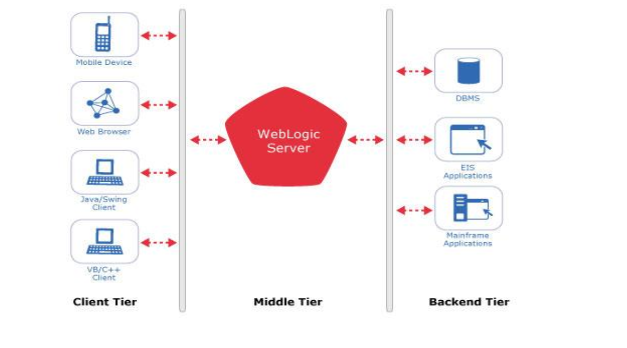
The server supports a range of web browsers, programming clients and wireless devices and delivers load balancing, storing, connection pooling7, virtual machine8, operating system and database communications. WLPS is middleware9 and its architecture is similar to that of the WebLogic server. It supports leading mainframe operating systems, Linux and Unix. On the back-end, the server is integrated with related databases, legacy systems and messages queues. (See Figure I).
The various components of WLPS were: Advisor, Administration, Property Set Management, Rules Management, User Management, Content Management and Portal Management (Refer Exhibit I for component features). WLPS offered a suite of solutions that helped in quick deployment of adaptable and personalized applications, enabling businesses to offer competitive advantage and speed up response time to customer and market demands. It enabled the generation of personalized e-commerce sites with customized content with the help of user profiles and business rules defined by the user. WLPS supported three levels of personalization – portal, group
and user. They were controlled and implemented with the help of various web-based tools. Personalization consisted of web-based forms that helped add and delete portal content, editing content layout, and customizing of portal and content color schemes. Personalization data incorporates user details and general user preferences.
Figure I
| WebLogic's Placement in Enterprise Application Architecture |
 |
Source: www.bea.com
WLPS enabled users to create Java-based Internet pages with robust personalized document features. WLPS enabled users to create an extensive line of portal models ranging from business-to-customer mega portals to business-to-business enterprise portals. WLPS made extensive use of J2EE mechanisms – apart from Java Server Pages (JSP) tags, it used Java Naming Directory Interface (JNDI) and Session & Entity Enterprise Java Beans (EJBs) as well. EJP simplifies and reduces the cost of developing e-business applications.
WLPS had robust, embedded rules engine with a simplified user interface for businesses to generate specific promotions and recommendations to targeted customer segments, groups and individuals in online-marketing. It offered an exhaustive set of pre-built commerce components such as product catalog, order entry, shopping cart and customer care functions, which were quickly assembled and delivered with help of standard e-business application tools. The rules editor worked in conjunction with (JSP) tags to provide a highly responsive and personalized user experience.
BEA addressed the problem of integrating with the existing back-end applications through the BEA eLink tool. This lack of integration often prevented companies from rendering real time, accurate and reliable data stored in their proprietary systems.
WLPS was introduced in April 2000 and was soon adopted by many leading companies including BenefitsCorp, Carrefour-Jardins, Medscape, Akamai technologies and totalmoving.com. WLPS’s success was because of the server’s superior abilities to provide reliable personalized portal services along with speedy application development and integration. By May 2001, the WLPS customer base had reached around 400. According to analysts, WLPS gained quick and high market acceptance on account of the combination of portal framework, personalization and web application server technology packaged into the product.
PERSONALIZATION – THE FUTURE
According to a study conducted by Nielsen/Net ratings, visitors who set up their personal pages on the Netcenter Website of Netscape or My Yahoo site of Yahoo, viewed three to six times more pages and stayed on the sites three to five times longer compared to other visitors to the sites. However, the study also revealed that the number of visitors who created their personal pages was considerably less. My Yahoo amounted to only 10% (2.2 million) of the total Yahoo customer base and the Netcenter site accounted for 12% (1.2 million) of Netscape’s total customer base. This was because all major portals offered personalization features with free e-mail, home pages and online calendars. Analysts commented that there was not much differentiation in the offerings and that all the portals looked the same. With increasing competition among portals, no single portal was able to hold on to a feature advantage for more than two months. Websites were increasingly experiencing a constant shift of users to other websites offering similar services.
At the same time, the very concept of personalization was being countered by users, who claimed that it was breaking into their privacy. Analysts remarked that customers were getting worried concerned about the personal information being collected about them through such services. Personalization was also criticized for restricting the users freedom to explore the dynamic content by providing customized content readily. Another major argument against personalization was that it resulted in increased search costs to the user, as once the user enters the object of the search, there are numerous related links, which lead the user to spend more time in browsing, ultimately increasing the search costs.
Analysts claimed that the above problems could threaten the business of companies like BEA in the long run. However, experts also revealed that personalization offered a wide potential for growth if companies focused their efforts on rendering reasonable personalization without intruding too much on users’ privacy. ersonalization could be a winning strategy for websites only if the designers offered simple and context-sensitive features that satisfied the broader personal goals of the users. (Refer Exhibit II for guidelines for overcoming problems regarding personalization).
QUESTIONS FOR DISCUSSION
1. Discuss the reasons behind the increasing popularity of personalization features by websites. Also explain the forms of personalization and the various techniques of personalization.
2. Explain the functioning of the BEA WebLogic Server along with its components and comment on the reasons behind its popularity.
3. Discuss the various personalization features that can be incorporated by websites and the problems associated with personalization?
EXHIBITS
Exhibit I
Components of the WLPs
| Component | Features |
| Advisor | An EJB accessed via a set of JSP tags, which connects the services and components in the WLPS to provide personalized content, by matching content to the data present in the user profile. |
| Administration Tools | A complete set of functions, which enables easy creation of portal page components and personalization of the portal's content, appearance and layout. |
| Property Set Management | Property sets are applied to six critical areas including user and group profiles, HTTP sessions, HTTP requests, content management, application initialization and catalog custom attributes. |
| Rules Management | Rules are used for the purpose of classifying users as well as for selecting content for display that depends on the user based content management system. The rules service is provided to gain the appropriate inputs for a specific user and return results. A classification rule may be used to identify if the user fits into a specific category on the basis of the user’s and current group’s property values or request properties. The page developer can modify the content displayed on the basis of such classification rule results. WLPS sorts and saves rules in rule sets and each rule set holds a combination of classifiers and content selectors that can be retrieved by using the JSP tags. |
| User Management System | In WLPS, user management is offered with the help of a set of administrative rules or Web Logic Server Realm. WLPS’s user management system uses user and group components (referred to as user and group profiles) to perform tasks such as creating, retrieving and controlling group and user profiles containing property data. Property data is anything that is related to a user or group profile in the context of the client’s personalized application. System users in WLPS are represented by user profiles. A user profile allots an ID for a user and access properties of a user like age, e-mail address, etc. The user profile can be extended and modified to retrieve data from an existing data store. |
| Content Management | A storage location on the disk, which stores content that requires to be queried in a complex manner or modified over time. Content stored in the content management component may be queried directly from JSP, through specialized query tags. It can also be used by other components. |
| Portal Management | Enables website developers, group administrators and end-users to customize, personalize and individualize the appearance, layout and content of the e-commerce site with help of an HTML windowing toolkit that includes a set of JSP tags, EJBs and administration tools. |
Source: IBS Center for Management Research
Exhibit II
Guidelines to Overcome Problems in Personalization
|
*Personalization features and services should be useful, usable and designed to offer tangible benefits to customers. According to analysts, websites should first allow the user to use his natural intelligence to make choices (through wide coverage and simplified options). *The focus of the service should be on who the user is and what his needs are. *As personalization involves exhaustive collection and use of personal data, respect for user privacy and protection of user information is highly called for. The websites should adopt encryption technology i.e. encrypt the passwords and sensitive user information, to guard the information from other sources. The user should also be careful in offering personal or sensitive information. * Using Platform for Privacy Preferences (P3P)16 that offers websites a way to handle user data and also helps users to specify their privacy preferences. *Building relationships with clients or customers is one of the major factors that could ensure the success of websites, as that would help the websites in offering specific solutions, customized to meet the user needs. |
Source: www.ariadne.ac.uk
Keywords
BEA Systems, products/services, personalizing websites, personalization, Internet, benefits, potential, problems
Related Case Studies
| Case Title | Details |
|---|---|
|
Case Title SMS AdvertisingCase Code: MKTG043 |
Details |
|
Case Title Fabmart’s e - Tailing ModelCase Code: ITSY024 |
Details |
|
Case Title Google.com - The World’s Number One Internet Search EngineCase Code: ITSY019 |
Details |
|
Case Title The DoubleClick ControversyCase Code: ITSY014 |
Details |
|
Case Title SciQuest.com’s B2B e-marketplaceCase Code: ITSY008 |
Details |