
A Note on Currency and Index Futures
Details
MISC013
18
2004
NO
300
Not Applicable
Financial Services
Global
Financial Options & Derivatives
Abstract
The note provides some of the basic definitions used in futures contracts. It covers in detail the application of futures as a derivative instrument, and how market participants like hedgers, speculators and arbitrageurs use futures. The note also explains the role of the clearing house and settlement procedures in futures contracts, and why the contracts need to be marked to market. The objective of this note is to make the reader understand better, the use of futures as a tool for the purpose of hedging, speculating and arbitraging particularly, in terms of currency and index futures. The note is intended to provide supporting material for case studies/courseware pertaining to currency and index futures.
Learning Objectives
The case is structured to achieve the following Learning Objectives:
- Currency and Index Futures.
Contents
ABSTRACT
The note provides some of the basic definitions used in futures contracts. It covers in detail the application of futures as a derivative instrument, and how market participants like hedgers, speculators and arbitrageurs use futures. The note also explains the role of the clearing house and settlement procedures in futures contracts, and why the contracts need to be marked to market. The objective of this note is to make the reader understand better, the use of futures as a tool for the purpose of hedging, speculating and arbitraging particularly, in terms of currency and index futures. The note is intended to provide supporting material for case studies/courseware pertaining to currency and index futures.
INTRODUCTION
Futures trading started way back in 1865 on the Chicago Board of Trade (CBOT), but prior to 1972, the underlying asset of futures contracts were agricultural commodities. The futures market met the needs of farmers and merchants. It overcame a few of the drawbacks related to the forwards market (Refer Exhibit I) like non-standardization of contract and credit risk. Trading in financial futures started only after the World War II on the two largest exchanges i.e. the CBOT and the Chicago Mercantile Exchange (CME). Post-1972, there was further development of futures contracts, with the introduction of a range of financial instruments. However, it was only in 1994, that these financial products started to be traded electronically.
DEFINING THE TERMS
A futures contract is an agreement between two parties to buy or sell an asset at a certain time in the future at a certain price. The underlying asset of a futures contract may be an agricultural commodity (such as corn, wheat, soybean, or soybean oils), or a financial instrument (such as treasury bonds, treasury notes and shares). Unlike forward contracts2, futures contracts are standardized (in terms of contract size, expiration month, trading cycle, etc.) and are traded in an organized exchange.
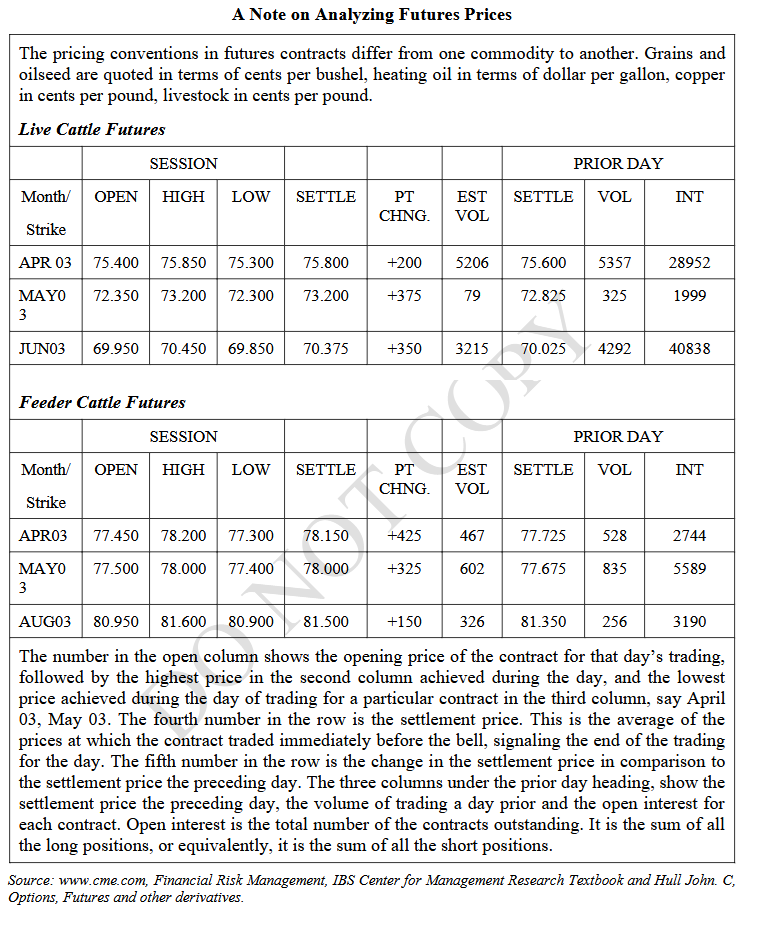
In referring to futures contracts, there are number of other terms that are commonly used. Spot price is the price at which an asset trades in the spot market3. The price at which the futures contract trades in the futures market is called the futures price (Refer Exhibit II). A contract cycle is the period over which a contract trades. An investor can take two positions in a futures contract, a ‘long futures position’ or a ‘short futures position.’ The investor is said to have taken a long position when he/she is buying, and is said to have taken a short position when he/she is selling, a futures contract. Expiry date is the last day on which the contract is traded at the end of which it will cease to exist. The amount of the asset that has to be delivered under a contract is known as the contract size. The difference between two futures prices is known as spread. The difference between two futures prices for the same underlying commodity on two different expiration dates is known as ‘intra commodity’ spread. The difference between two futures prices for two different but related commodities is known as ‘inter commodity’ spread. The price difference between the two markets for the same commodity is known as ‘inter market’ spread.
In the context of financial asset futures, basis is defined as the futures price minus the spot price. In a normal market4, the basis is positive, reflecting the fact that futures prices normally exceed spot prices. However, in case, the futures prices are less than the spot prices, the difference is known as backwardation. Another definition of basis is the difference between spot price of the asset to be hedged and the futures price of the contract of that asset. Cost of carry shows the relationship between future prices and spot prices. It measures the storage cost plus the interest paid minus the income earned.
The members who execute the trades on the exchange floor are floor brokers and floor traders. The brokers who execute the order on others’ account are known as floor brokers. They act according to the wishes of their customers and are basically agents for public investors. Floor traders execute trades exclusively on their own account. Those floor traders who also execute trades on others account are known as dual traders, and the mechanism is known as dual trading. In the market, some of the floor traders are known as scalpers. They are the individuals who trade on their own account and stand ready either to buy or sell. They are also called as locals and by their active participation provide liquidity to the futures market.
The participants in the market are classified as hedgers, speculators and arbitrageurs. Hedgers use futures market to reduce or eliminate the risk associated with price fluctuations of an asset. For example, an exporter whose receivables are denominated in another currency (say, Euro) runs a significant foreign exchange risk, because of the possible adverse movement in the price of the other currency vis-a-vis the home currency. The exporter can hedge the above risk by selling futures in Euro. Speculators are those who are willing to take the risk that the hedgers are seeking to avoid. They use futures contracts to benefit from betting on future movements in the price of an asset. They seek to make gains by taking long and short positions in futures based on their own views and forecasts about the market. Arbitrageurs look for profit from the discrepancy between prices in two different markets.
CLEARING HOUSE
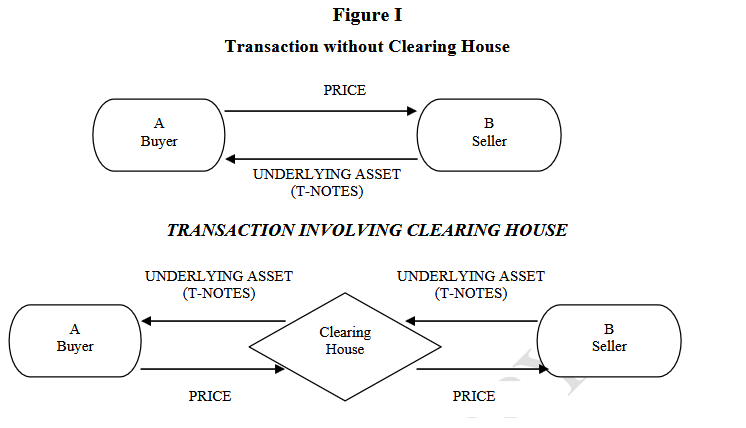
A clearing house is a part of the futures exchange and acts as an intermediary in futures transactions. All futures contracts are routed through a clearing house which is a ‘de facto’ guarantor for all futures transactions. A clearing house works closely with the exchange but is an entity distinct from the exchange. Since all transactions are routed through it, the clearing house becomes the buyer to every seller and seller to every buyer. Let us understand the process with the help of following illustration:
There are two parties, A and B, who want to enter into a futures contract. A typical transaction with, and without, the involvement of a clearing house would be as follows: In the first case, where the transaction takes place without the clearing house both A and B assume the counterparty risk5 because on the date of the contract, B may fail to deliver the underlying asset or A may fail to pay the price. In the second case, the clearing house replaces B as a seller to A, and A as a buyer to B, and thus the credit risk taken by both A and B becomes insignificant.
 |
The clearing house assumes many important functions like ensuring smooth trading by maintaining delivery schedules, minimizing credit risk by becoming counterparty to every transaction, monitoring speculation margins and more. Since the clearing house undertakes counterparty risk for all transactions, the total risk assumed by it is high. Thus, it becomes important for the clearing house to minimize this risk, which is done by collecting margins. Margins are levied for all transactions depending on the volatility of the underlying asset, and adjustment is done everyday depending upon the prices, a process known as marking to market.
TYPES OF MARGIN
The clearing house stipulates the margin to manage the credit risk assumed by it. These margins are of two types – Initial margin, and Maintenance margin. An example will help us to understand the different kinds of margin.
Example:
On February 3, 2003, an investor buys two March 2003 gold futures contracts on the New York Commodity Exchange (COMEX). The current futures price is $500 per ounce and the investor buys 200 ounces at this price. The minimum contract size is 100 ounces. The investor has to deposit the money in an account which is termed as the margin account. The amount to be deposited initially is called the initial margin and varies from one contract to another depending on the volatility of the underlying asset.
Let us assume that the initial margin is $5000. The investor also has to maintain at least 75% of the initial margin, also known as maintenance margin, to ensure that the balance in the margin account does not become negative. The margin account is adjusted at the end of each trading day reflecting the investor’s gain or loss. The maintenance of these margins ensures that the exchange is safeguarded against any default risks.
Let us assume that by the end of the first trading day, the futures price of gold has fallen from $500 to $495 resulting in a loss of $1000 (200 X $5) to the investor. The margin account will be adjusted and the account balance will be reduced by $1000 to $4000 at the end of the first trading day. Assume that from February 3rd to 10th, the future prices of gold are as follows:
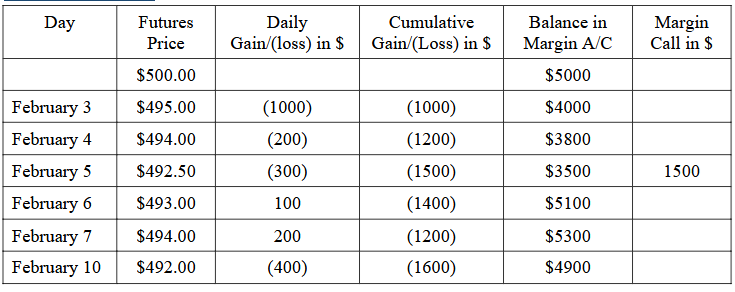 |
The investor can withdraw any balance in the margin account in excess of the initial margin. When the balance in the margin account falls below the maintenance margin (75% of the initial margin), the investor will receive a margin call and will be required to reset the balance to the initial margin level. The additional money deposited to bring the margin account to the level of initial margin is known as the variation margin.
SETTLEMENT PROCEDURES
The three common ways in which a futures contract can be settled are by physically exchanging the assets, cash settlement, and offsetting or closing out position.
Physical delivery
This manner of settlement involves physical delivery of the underlying asset. In case of commodity futures, if a trader holds the underlying asset, say wheat, the delivery is to be made at a specified place and time. However, this way of settlement can be a bit cumbersome, in case the trader does not actually hold the underlying assets, since it would be difficult for him to buy assets of the exact specifications in terms of quality.
Cash settlement
Index futures are usually settled in cash; this is because the delivery of the underlying asset of any index (say S&P 500) would involve delivering a portfolio of a number of stocks. In a cash settlement, the futures contract has to be marked to market at the end of the last trading day and all outstanding positions are squared. The resulting profit/loss is settled in cash. The settlement price is set equal to the closing spot price to ensure that the futures price converges with the spot price.
Offsetting
This procedure involves entering into a trade just opposite to the original one. For example, if an investor is holding a long position on a wheat futures, he/she can sell an identical futures contract to reverse the initial position. Identical here means contract of the same underlying asset and same month. The vast majority of the futures contracts that are initiated are closed out in this way.
APPLICATIONS OF FUTURES
Hedging
Futures markets were initially developed to hedge risk. Holding an asset involves some risks. Hedging is a way of insuring an asset against those risks. An example would help to understand how futures market can be used for hedging.
Example:
A wheat trader anticipates that he will need to buy additional wheat from his supplier in six months. During the period, however, he fears the price of wheat may increase. That could result in losses for him because he has already advertised his price for the six-month period. To lock in the price level at which wheat is presently being quoted for delivery in six months, he buys a futures contract at a price of, say, $30 per bushel.
If, six months later, the cash market price of wheat has risen to $37, he will have to pay his supplier that amount to purchase wheat. However, the extra $7 per bushel cost will be offset by a $7 per bushel profit when the futures contract bought at $30 is sold for $37. In effect, hedging through futures provided insurance to the trader against an increase in the price of wheat.
However, if the price of wheat had declined, he would have incurred a loss on his futures position but this would have been offset by the lower cost of acquiring wheat in the cash market.
Speculation
Speculators have no interest in locking in a price to hedge risk. They buy and sell futures contracts in order to make profits from price volatility. They bet on their anticipation of the price movement, that is, either upwards or downwards. An example will explain how the futures market is used for the purpose of speculation.
Example:
In March 2003, an investor ‘A’ expects the price of corn to rise over the next three months. The price in March is $17 per bushel. Instead of physically purchasing the corn (35,000 bushels) and taking the risk of storing it for three months and incurring the impact cost (storage, transportation and protection from pests), A can enter into a three months futures contract.
He will enter into a contract to purchase the corn after three months at a price fixed today, say, $20 per bushel. Three months hence, the price has reached the level of $24 per bushel. A can now make a profit of $4 per bushel by selling an identical futures contract to reverse his initial position.
Profit if A had bought corn in March from the spot market
Purchase price = $17 + $2 (Storage cost) + $1 (protection from pests) + $1 (transportation cost) = $21 per bushel
Selling price = $24 per bushel
Profit = 35,000 X ($24 – $21) = $105,000
Profit from a futures contract
= 35,000 X ($24 – $20) = $140,000
Arbitraging
Arbitrageurs profit by taking the advantage of a variance between prices in two different markets. They primarily look for opportunities to achieve riskless profits by entering into different transactions in two or more markets simultaneously.
Example:
Consider a GE stock traded on the NYSE and on Toronto Stock exchange with the stock price being $138 in New York and Can $210 in Toronto. The exchange rate is Can $1.55 per US$. An arbitrageur would simultaneously buy 100 shares in Toronto stock exchange and sell in NYSE and thus make a risk-free profit of
100 X [(1.55*138 - 210)] = Can $390
However, this arbitrage opportunity will not last for long because an increase in demand for the GE stock in Toronto will push up the prices. Similarly, the prices will fall at NYSE when shares are offloaded by arbitrageurs over there, thus reducing arbitraging opportunities.
TYPES OF FUTURES
On the basis of the underlying asset, the different types of futures contracts traded can be grouped into the following four categories:
- Currency Futures (where the underlying asset is a currency such as euro, yen, dollar, etc.).
- Index Futures (where the underlying asset is a stock index).
- Commodity futures (wheat, corn and so on).
- Interest rate futures (underlying asset is an interest earning asset like a debenture or bond).
TRADING USING CURRENCY FUTURES
An investor can limit his/her incoming and outgoing cash flows in one currency with respect to another currency by purchasing (long hedge) or selling (short hedge) foreign exchange futures. A person dealing in foreign exchange is exposed to exchange risk, since the cash flow in terms of domestic currency will be known only at the time of conversion. To hedge, a person who has taken a long position or is expected to do so in a foreign currency, should sell futures in the foreign currency against the domestic currency. Similarly, a person who has taken a short position or is expected to do so in a foreign currency, can create a hedge by buying futures in the foreign
currency against the domestic currency instead of buying the currency later in the spot market.
Example:
A US exporter is exporting goods to his German client. On January 27, 2003, the exporter got the confirmation from the German importer that the payment of Euro 800,000 will be made on March 1, 2003.
In this case, the US exporter is exposed to currency fluctuations. If the Euro depreciates there will be loss on his dollar receivables7. To cover this risk the exporter can sell a Euro futures contract.
On January 27, 2003
Spot Market
Importer notifies the exporter that receivables equal to Euro 800,000 will be delivered on March 1, 2003. Spot rate on January 27, 2003 is $/Euro 0.8208; Expected cash inflows are $656,640 (Euro 800,000 X 0.8208) if converted. But the conversion is not possible since the exporter will be receiving the Euros, only on March 01. However, he can sell the futures contract in Euros.
Futures Market
The March futures rate is $/Euro 0.8243. The exporter sells four March Euro futures contracts (the size of each contract is Euro 200,000). The equivalent notional amount in US dollars will be $659,440 (0.8243 X Euro 800,000)
On March 1, 2003
Spot Market
The dollar has appreciated and the spot exchange rate is 0.81919. Therefore, the dollar value of Euro 800,000 is $655,352. Hence, the loss to the exporter compared to the spot market position is
= $656,640 – $655,352 = $1288
Futures market
To offset the position, exporter will be required to go long on four March Euro futures contract. Let the futures rate be 0.82269. This gives the exporter the notional right to buy Euro 800,000 by paying $658,152 (Euro 800,000 X 0.82269). Profit on the futures contract is
= $659,440 – $658,152 = $1288
The loss resulting in the spot market from the appreciation of dollar is offset by the profit in the futures market. In the above illustration, the exporter received the same amount of US$ as if he had sold Euro in the market on January 27, 2003. This is because the change in the spot rate of Euro during the period and the change in the price of futures during the same period are equal.
Spot Price (t0) – Spot Price (t1)
= 0.8208 – 0.81919 = 0.00161
Futures Price (t0) – Future Price (t1)
= 0.8243 – 0.82269 = 0.00161
Also, in the above illustration, the basis (the difference between the spot price and futures price) at time t0 and at time t1 is the same i.e. 0.0035.
Thus, when the basis remains unchanged, the gain/loss in both markets, that is, spot and futures, is equal and, hence the amounts are exactly offset. However, it is unlikely that the basis will remain the same throughout the period. This is what gives rise to basis risk. To understand basis risk, let: St0 be the spot price at time t0
St1 be the spot price at time t1
Ft0 be the futures price at time to
Ft1 be the futures price at time t1
St0 – Ft0 = Basis at time t0
St1 – Ft1 = Basis at time t1
In the above example, the US exporter hedged Euro receivables by taking a short position on Euro futures. Assume that the hedge was created at time t0 and the position closed out at time t1. Profits made in the future markets by closing out position at time t1 = Ft0 – Ft1 (loss if Ft0 < Ft1). Consider a situation where a hedger knows that the asset will be sold at time t1 and takes a short future position at time t0. The price realized for the asset while selling in the spot market = St1, which implies the effective price at which the US exporter sold the Euro, is
= St1 + (Ft0 – Ft1)
= Ft0 + (St1 – Ft1)
= Ft0 + b1
Where b1 represents basis at time t1.
Since b1 is unknown, the futures transaction is exposed to basis risk. If b1 = b0, then the effective price at which Euro is sold will be Ft0 + St0 – Ft0 = St0.
Optimal Hedge Ratio
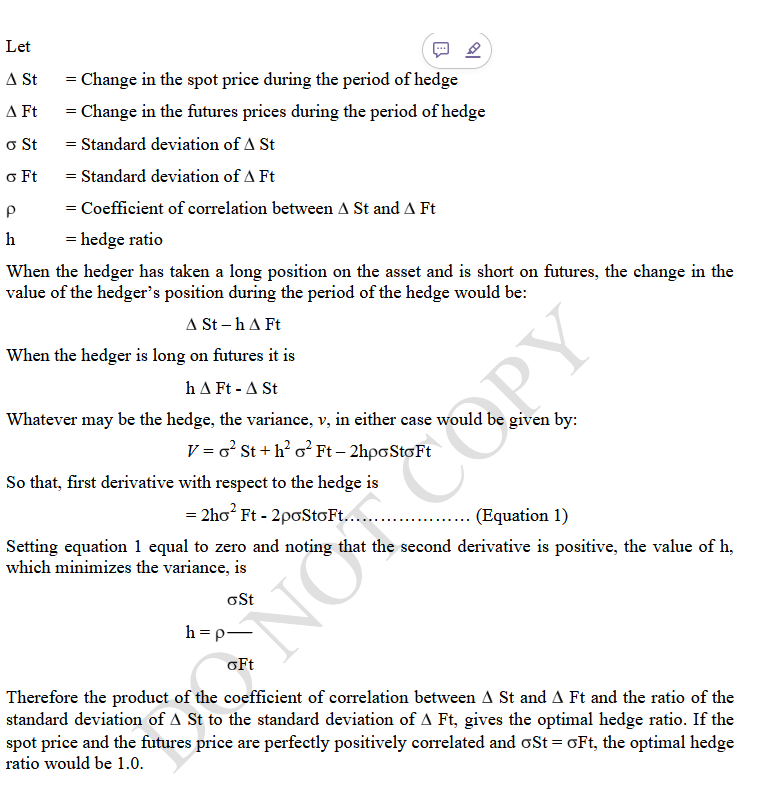
A hedger has to determine the number of futures contracts to buy in order for the best hedge for his/her return profile. A hedge ratio is the ratio of the size of the future position to the size of the underlying asset position. In terms of futures, it is be defined as the number of futures contracts to hold for a given position in an underlying asset.
A hedge ratio of 1.0 is not always optimal and will give a perfect hedge only when there is no change in the basis. An illustration will explain the concept better:
 |
Example:
A company anticipates that it will be requiring 2 million gallons of heating oil in six months. The standard deviation of the change in the price per gallon of heating oil over six months period is calculated as 0.045. The company decides to buy a six months futures contract on unleaded gasoline to hedge the risk. The standard deviation of the change in the future price over a six-month period is 0.054 and the coefficient of correlation between the two is 0.12. The optimal hedge ratio is therefore
0.12 X (0.045/0.054) = 0.10
One unleaded gasoline futures contract is on 42,000 gallons. The number of contracts the company should therefore buy is
0.10 X 20,00,000/42,000 = 4.76 contracts
Rounding off the decimal places to the nearest whole number, 5 contracts have to be purchased.
Example:
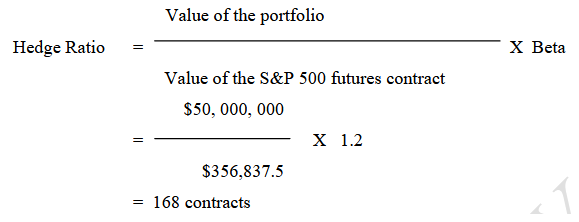
An investor has a long position on a portfolio of stocks worth $50 million with a beta of 1.2. To hedge this long position, the investor needs to take a short position on the futures contract (say S&P 500). The size of an S&P 500 futures contract is 250 times the value of S&P 500 index. The June 03, 2000, S&P 500 futures contract, was settled at 1427.35 on the last trading day. Therefore, the value of futures contract is 250 X 1427.35 = $356,837.5
 |
TRADING USING INDEX FUTURES
The following are the fundamental modes of trading on the index futures market:
Hedging
Long on Security, Going short on Index Futures (say Nifty)
When investors’ trade, they may be inclined to purchase a security, which they believe is undervalued. The investors may feel that the profits and the quality of management of a particular company make it seem worth more than the present market value. However, while purchasing the security the investor faces two kinds of risks:
a) His understanding of the company is wrong and the stock price goes down.
b) The market moves in the direction opposite to his expectations even though his understanding of the company was correct.
The probability of the second outcome is high. This is because assuming all other factors constant, a security constituting the market index gains if the market index rises and vice versa. To overcome this problem, every time an investor takes a long position on a particular security, he should sell some amount of index futures. This strategy offsets the index exposure when an investor takes purchases a security say Infosys. Thus a position Long Infosys + Short Index = Performance of Infosys.
To follow the above strategy, an investor needs to know the ‘beta of security’ and the market lot on the futures market. An example to explain the concept is given below
Example:
The stock of Carrier Aircon has a beta of 1.3 and an investor has taken a long position of Rs. 200,000 on the share. The size of the position to be taken on Index (Nifty) futures to hedge the index exposure is 1.3 X 200000 = Rs. 260,000.
The market lot on the futures market is 200 and Nifty is quoting at 1270 with the nearest futures contract trading at 1300. Hence, one market lot of Nifty is worth Rs. 260,000 (200 X 1300). So investor can take the following position.
Long Carrier Rs. 200,000
Short Nifty Rs. 260,000.
Assume that 10 days later, Nifty drops by 10% and the investor unwinds his position. His long position on Carrier led to a loss of Rs. 26000 (200,000 X 0.10 X 1.3). However, his short position earned him Rs. 31400. Overall he gained Rs. 5,400.
- Short on Security, Going Long on Index Futures
When trading, investors may be inclined to sell a security, which they believe is overvalued. But while doing so, they face two kinds of risks:
a) The understanding of the company may be wrong.
b) The market moves in the direction opposite to their expectations and generates losses even though their understanding of the company was correct.
The probability of the second outcome as explained before is high, because every short position taken on a security is simultaneously a short position on the index. For example, an investor may sell Infosys at Rs. 4000 expecting that during the period of economic slowdown in the US, Infosys would not be able to maintain its profits. However, a few days later the index may rise, resulting in losses for the investor even if his understanding of the company was correct. Hence, in this case, every time an investor takes a short position on a security, he should buy index futures.
Example:
The stock of Zee Telefilms has a beta of 1.2. An investor on March 03, 2003 takes a short position of Rs. 500,000 on the Zee’s stock. The size of the position an investor is required to take on Nifty futures to hedge the index exposure is 1.2 X 500000 = Rs. 6,00,000.
The Nifty market lot is 200. On March 03, the Nifty is quoting at 960 and the nearest futures contract is trading at 1000. Thus to buy Nifty worth 6,00,000 three lots will be bought since each market lot is worth Rs. 200,000 (200 X 1000). Now the positions are:
Short Zee Telefilms = Rs. 500000
Long Nifty = Rs. 600000
On March 24, 2003, Nifty rises by 15%. The investor unwinds his position with the following payoffs:
His short position on Zee lost him Rs. (500000 X 0.15 X 1.2) = Rs. 90000
His long position on Nifty earned him Rs. [(200 X 3 X 960 X 1.15) – (200 X 3 X 1000)] = Rs. 62400
- Long on portfolio of securities, Short on Index Futures
Investors who own a portfolio of securities often face the risk of adverse market movements.
An investor having a portfolio of securities has the following alternatives:
a) Sell the portfolio of shares immediately.
b) Do nothing i.e. suffer the risk of adverse movement in the stock prices.
c) Use Index futures to overcome the risk related to the exposure of market index fluctuations.
Every portfolio created by an investor is exposed to the index volatility whether the portfolio consists of index securities or not. In a portfolio, index fluctuations account for most of the risk. Hence, a position LONG portfolio + SHORT Nifty is less risky than just the long position on portfolio of securities.
Example:
On February 25, 2003, Ketan has a portfolio comprising five securities. The securities include Grasim (100 shares, Market Price on Feb. 25, 2003 = Rs. 110), Andhra Bank (200 shares, Market Price Rs. 48.25), Pfizer (100 share, Market Price Rs. 875.50), Infosys (200 shares, Market Price Rs. 150.5), and BPL (200 shares, Market Price Rs. 245). The total portfolio value is Rs. 187,300. Ketan wants to remove the budget-related (Budget to be announced on February 28) volatility from February 25 to March 10, 2003.
The beta of the portfolio is 0.90. For a complete hedge, Ketan will need to sell futures worth 0.90 X 187,300 = Rs. 168,570. On Feb 25, 2003, Nifty is at 1124.00. So he decides to sell 200 (market lot) Nifties. Hence, Ketan takes a short position on one March Nifty Futures.
On March 10, 2003, the securities of the portfolio and Nifty traded are as follows:
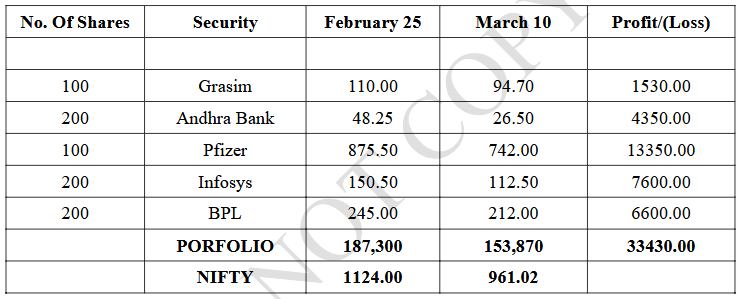 |
Gain on Nifty = 162.98 X 200 = Rs. 32596
On March 10 Ketan offsets his position by buying back futures. His profit on the futures contract is Rs. 32,596 and his loss on the portfolio was Rs. 33,430. Thus the net loss is Rs. 834. If he had not hedged he would have lost Rs. 33,430.
- Have Funds, Buy Index Futures
It is a common belief that index futures are used for hedging against a fall in the market index. However, it is equally important to use index futures to hedge against a rise in the index. Holding money in hand, when it is to be invested in securities may result in a lost opportunity for profit if the index rises. An investor having funds may not invest in equities for the following reasons:
a) It takes time to research and select securities to invest. During this time, the investor is exposed to the risk of losing out on the opportunity if the index rises.
b) Even if a person has selected a portfolio of securities, and placing purchase orders in the market involves large ‘impact costs’.
The alternatives the investor has are:
a) To buy liquid securities.
b) To hold money and suffer the notional risk of lost opportunity.
c) To buy index futures and obtain the desired equity exposure immediately.
An investor who expects to realize Rs. 3 million from the sale of a house would take a long position on index futures worth Rs. 3 million. The market for index futures is more liquid than individual securities; hence it involves lower impact cost, at the same time allowing large positions.
Later, the investor can select securities after detailed research, and as and when the shares are purchased, the long position on index futures can be scaled down correspondingly. This strategy provides the investor with the time to pick the securities carefully after research and analysis.
Speculation
- Expecting Bull Phase, Go Long on Index Future
At times investors feel that market is expected to rise (in a bull phase). To benefit from such a scenario, investors have two alternatives:
a) To buy securities which move in tandem with the index and offload at a time when investor feels he has realized the profit.
b) To buy the index portfolio and sell at a later date.
The first alternative uses certain securities as a proxy for the index. However, it is subject to company specific risks and may generate losses, as it is only a proxy for the index and not the index itself. The second alternative involves large transaction costs and is therefore expensive. A way out to this is to take a position on the index. It is effortless and is not costly as the entire index can be bought or sold as a single security. If a person is long on the index, he gains if the index rises, and vice versa.
To adopt this strategy, an investor can take a long position on the index by buying market lots. Suppose, the market lot is 200 Nifties and Nifty is trading at 1860, it will involve an outlay of Rs. 372,000. But he is only taking a position and will therefore be required to pay only the initial margin, say, Rs. 25000.
Example:
On January 01, 2003, an investor feels that the budget to be presented on February 28, 2003, will be investor-friendly and expects the index to rise thereafter. He therefore buys a three-month index futures contract expiring on March 27, 2003, currently trading at Rs. 1020. So his initial position is long Index futures worth Rs. 204000 (200 X 1020). On March 12, 2003, the index rises to 1335 and the March futures contract rises to Rs. 1352. The investor unwinds his position by selling at Rs. 1352. His total profit = 66400 (200 X (1352 – 1020)).
- Expecting Bearish Phase, Go Short on Index Futures
At times, investors feel that market is in for a bear phase for several reasons such as a series of bad corporate results, a minority government and a forecast of a bad weather. To benefit from such a scenario, investors have the following alternatives:
a) To sell securities which move in tandem with the index and buy at a time when investor feels he has realized the profit.
b) To sell the index portfolio and buy at a later date.
c) To take a short position on index futures. The third alternative is effortless and involves initial outlay only in terms of margin money.
Example:
On April 01, 2002, an investor feels that the year’s monsoon will be bad and expects the index to fall thereafter. He therefore sells a three-month index futures contract expiring on June 27, 2002, currently trading at Rs. 920. So his initial position is short in index futures worth Rs. 1,84,000 (200 X 920). On June 09, 2002, the index falls to Rs.835 and the June futures contract falls to Rs. 852. Investor unwinds his position by buying at Rs. 852. His total profit = 13600 (200 X (920 – 852)).
ARBITRAGE
- Arbitraging when lending money to the market
Index futures market provides an opportunity to investors to lend money into the market without being exposed to the (a) price risk and (b) default risk of the counter party. The investor creates a portfolio, which buys all the securities that comprise an index (say Nifty). The proportion of securities should be a representation of their market capitalization. A moment later, the investor sells the contracts in the futures market. Now the investor is completely hedged against fluctuations in the index and the credit risk is also eliminated since the counterparty is the clearing house. The investor loans the money to the market at the point of delivery of securities. A few days later the investor will unwind the position; the investor will send sell orders to sell off all the securities of the portfolio, and a moment later will reverse the future position. The point when the investor makes the delivery of the shares is when he receives his money back.
The return that investor earns when he unwinds the transaction at the expiration date of the futures is equal to the futures price minus cash market price of the Index. There are two other intricacies, which affect the return earned (1) dividends earned on shares during the period of holding and, (2) brokerage and other transaction costs. Suppose on 1 January 2003, the spot price of the index is Rs. 954.52, and the index January futures are at Rs. 965.3, then the return earned by the lender is [(965.3 – 954.52)/954.52 X 100] 1.13% for 30 days.
Example:
On April 01, 2002, the spot price of Nifty is 1020 and a futures contract for April is trading at Rs. 1055. To earn this return of (35/1020 X 100) for 25 days, the investor buys Rs. 3.5 million of Nifty on the spot market. In order to do so he had to place 50 market orders and thus ends up paying 0.2% higher i.e. he obtains the Nifty at Rs. 1022. A moment later he sells Rs. 3.5 million of the futures at Rs. 1055, because of liquidity in the futures market the transaction takes place at zero impact cost. Few days later he takes delivery and it at this point he lends money to the market. He holds the securities for few days before unwinding the position and receives dividends during that period that work out to be Rs. 5650.
On April 25, 2002, investor unwinds the entire transaction by putting 50 market orders to sell off his Nifty portfolio at the price of Rs. 1034. The transaction goes through at Rs. 1032, the futures position simultaneously expires at Rs. 1034 (the futures price converges with the spot price on the expiration day). Thus the investor ends up gaining Rs. 12 (0.98%) in the cash market and Rs. 21 (1.99%) on the futures. In addition, investor also earned dividends of Rs. 5650 that works out to be return of (0.16%), thus culminating into a total risk free return of 3.13% for 25 days.
However, this strategy does not make sense when the return works out to be something really not worth putting in this much of money for, like 0.45 or 0.5%. Also it is essential to make a portfolio of Rs. 3 million or more as portfolios of less than Rs. 3 million do not replicate the Nifty Index.
- Lend to the market the securities you own
The index futures market provides an excellent opportunity for the owners of shares to earn positive returns by loaning out the shares. This trading method on index futures also does not involve any price risk and default risk. The investor sells off all the securities that comprise an index (say Nifty), on the cash market. (The proportion of securities should be a representation of their market capitalization) A moment later, he buys a contract in the futures market. The investor receives the money after selling the securities and can invest that money at the risk-free rate of interest. A few days later the investor will unwind the position; the investor will send orders to buy all the securities of the portfolio and a moment later, will reverse the future position. The point the investor takes the delivery of the shares is when he pays the money back.
However, this method of trading is worth the effort only when the spot minus future basis is smaller than the risk-free interest rate available in the economy. For example, if the difference between the spot Nifty (1020) and the two-month futures nifty (1035) is 1.47% (15/1020) and the transaction cost is 0.4% (assumed). Further the cash can be invested at no risk at a rate of 1.3% per month. Over a two-month period, the yield works out to be 2.62% [(100 X 1.013 X 1.013) – 100]. The approximate return over a two-month period is 2.62 – 1.47 - 0.4 = 0.75%. On the other hand, if the difference between the spot and futures is say 2.2% over a period of two months and the riskless yield over the same period is 1.9%, then it is not profitable to loan out the money.
Example:
Suppose an investor holds Nifty worth Rs. 4.5 million, he puts in sell order for all the securities in Nifty at the spot price of Rs. 1200. The seller suffers the impact cost and thus ends up getting only 1197. A moment later he buys two-month Nifty futures worth Rs. 4.5 million at 1220. At the point of delivery of shares, the investor receives money 4.48 million from the sale (after taking into account the impact cost). The investor lends the money received at risk less rate, say 1.3% per month, so at the end of two months he gets back Rs. 45,97,237, in terms of Nifty it is 1197 X 1.0132 = 1228. On the date of expiration of the futures contract the investor unwinds his position, he puts in orders to buy back his Nifty portfolio at the spot price which has moved upto 1245 by this time. This makes the share buy-back costlier but the difference is offset by profits on the futures market.
The buy order placed by the investor goes through at Rs. 1248, because of the impact cost. The funds available with the investor is 1228, plus the profit made on the futures, that is, 25 (1245 – 1220). Thus, the investor ends up with a profit of Rs. 5 on the whole transaction (1228 + 25 – 1248).
CONCLUSION
Futures can result in serious losses, if used without proper knowledge. Hence, the prerequisite for trading in futures is a thorough knowledge of the futures market. This concept note is an attempt to make the readers understand the futures market better and how it can be used to benefit market participants. If used properly, futures can help to reduce price risk significantly.
EXHIBITS
Exhibit I
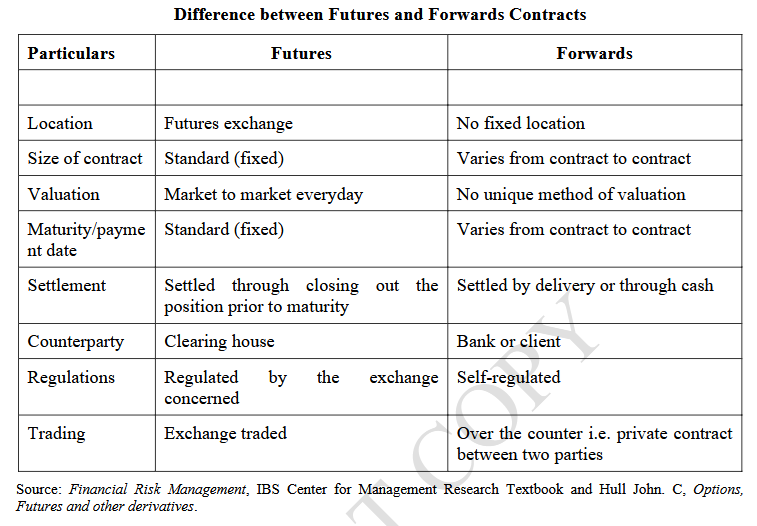 |
Exhibit II
 |
Keywords
Definitions, futures contracts, application, futures, derivative instrument, market participants, hedgers, speculators, arbitrageurs, futures, clearing house, settlement procedures, futures contracts, currency, index , futures
Related Case Studies
| Case Title | Details |
|---|---|
|
Case Title A Note on Interest Rate FuturesCase Code: MISC011 |
Details |
|
Case Title Allied Irish Banks - The Currency Derivatives FiascoCase Code: FINC032 |
Details |
|
Case Title Derivatives Trading in IndiaCase Code: FINC026 |
Details |
|
Case Title The Fall of Barings BankCase Code: FINC025 |
Details |
|
Case Title A Note on Investment Strategies Involving OptionsCase Code: MISC003 |
Details |