
A Note on Mobile CRM
🌐 International Buyers — Pay via PayPal
Details
BREP031
24
2006
NO
1000
Oracle Corporation
Technology & Communications
US; Europe; Asia Pacific
Abstract
Customer Relationship Management (CRM) is fast emerging as a critical part of an enterprise's competitive strategy. Over the years, CRM has transformed itself from being a mere web-based contact management and information tool, into a customer-oriented solution that enhances customer experience and automates processes. There has been a rapid change in the CRM industry with the emergence of the mobile phone and the Internet as new tools with which to communicate, share, and use information. Over time, CRM solutions have evolved to become more advanced, thus enabling better information flow between different divisions and leading to increased customer value and satisfaction. The CRM Industry is expected to grow consistently in the coming years with analysts expecting the industry to be worth US$ 43.3 billion by the year 2009. The increase in the complexity of business processes, the increase in product range, the diverse distribution channels, and the increasing worldwide customer base have all contributed to the need for advanced CRM solutions from which organizations can benefit. In addition to assessing the CRM Industry in terms of its growth and the parameters affecting them, this report focuses on the concept of Mobile CRM. Mobile CRM is an extension of the traditional CRM wherein a mobile remote access or wireless component application has been incorporated into the standard CRM system. Implementing Mobile CRM offers faster and more accurate information flow to and among the sales force of an organization. Mobile CRM itself offers a competitive advantage to organizations that want to differentiate themselves from their competitors. The emergence of enhanced applications and new service model offerings from vendors along with an increase in the accessibility of high-speed wireless technology and mobile devices is prompting organizations to put mobility in the forefront of their CRM initiatives. This report also covers the benefits that Mobile CRM offers to organizations, the factors contributing to its growth, and some likely challenges to it.
Learning Objectives
The case is structured to achieve the following Learning Objectives:
- 0
Contents
Contents
 |
Customer Relationship Management (CRM) is fast emerging as a critical part of an enterprise's competitive strategy. Over the years, CRM has transformed itself from being a mere web-based contact management and information tool, into a customer-oriented solution that enhances customer experience and automates processes. There has been a rapid change in the CRM industry with the emergence of the mobile phone and the Internet as new tools with which to communicate, share, and use information. Over time, CRM solutions have evolved to become more advanced, thus enabling better information flow between different divisions and leading to increased customer value and satisfaction.
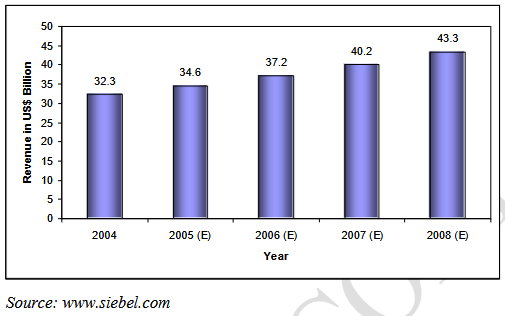
The CRM Industry is expected to grow consistently in the coming years with analysts expecting the industry to be worth US$ 43.3 billion by the year 2009. The increase in the complexity of business processes, the increase in product range, the diverse distribution channels, and the increasing worldwide customer base have all contributed to the need for advanced CRM solutions from which organizations can benefit.
In addition to assessing the CRM Industry in terms of its growth and the parameters affecting them, this report focuses on the concept of Mobile CRM. Mobile CRM is an extension of the traditional CRM wherein a mobile remote access or wireless component application has been incorporated into the standard CRM system.
Implementing Mobile CRM offers faster and more accurate information flow to and among the sales force of an organization. Mobile CRM itself offers a competitive advantage to organizations that want to differentiate themselves from their competitors. The emergence of enhanced applications and new service model offerings from vendors along with an increase in the accessibility of high-speed wireless technology and mobile devices is prompting organizations to put mobility in the forefront of their CRM initiatives. This report also covers the benefits that Mobile CRM offers to organizations, the factors contributing to its growth, and some likely challenges to it.
Customer Relationship Management (CRM) involves the various aspects of interaction – sales or service related – that a company has with its customer. It includes all methodologies, strategies, and software that help an enterprise organize and manage customer relationships. It enables organizations to maximize the value of every customer interaction and leads to superior corporate performance.
The increased global competition has made it necessary for companies to differentiate their products from those of competitors. Many companies have therefore moved away from a product- centric view of their business to a customer-centric one. They have realized that building relationships with customers is vital to profitability. They have also realized that it takes more effort and cost to attract a new customer than to retain an existing one. The advances in information and communications technology have enabled enterprises to put all their customer information into a single system and provided them with the ability to effectively manage complex information.
Some of the main benefits of implementing CRM are:
- It enables faster and prompter response to customer enquiries.
- It increases business efficiency through automation.
- It provides better understanding of customers.
- It helps to identify the most profitable customers.
- It helps in utilizing customer feedback, which results in improved products and services.
As organizations these days have multiple lines of businesses and overlapping customer segments, it is crucial that their customers find it easy to do business with them. CRM focuses on automating processes, gathering and processing information, and self-service.
CRM offers solutions for the diverse business functions of an organization. CRM Architecture primarily consists of three components:
- Functional CRM – Offers automation of the business processes involved in marketing, sales, and services (Marketing Automation, Sales Force Automation, Field Service Management, Partner Relationship Management).
- Analytical CRM – Provides analysis and reporting of customer data/information gathered from various sources.
- Interactive CRM – Facilitates interaction with the customers through different channels of communication like the Internet, mobile client, and interaction center.
The CRM Industry saw a decline in 2002. This was attributed to the economic slowdown, which led to lower IT spending by companies. Smaller deal sizes and intense competition among CRM players caused a lot of hardship to CRM vendors. After this slump in growth, in the year 2003, the CRM software market stabilized and 2004 marked a turning point for it.
According to a report published by Siebel Systems, the CRM Software Market is expected to reach US$43.3 billion by 2008 (Refer to Figure I for CRM Industry Revenues 2004-2008). Organizations these days are investing more in Customer Facing Solutions and want to get the maximum value from their investments. To meet the diverse needs of organizations, vendors are changing their CRM solutions in terms of pricing, features, and delivery models.
Figure I: CRM Industry Revenues in US $ Billion (2004-2008)
 |
Factors Expected to Facilitate Growth of CRM Industry
The growth of the CRM software industry is expected to be the result of small and medium size businesses adopting CRM solutions for the first time, and large enterprises adding to their initial CRM implementations. Analysts expect the growth in financial services and telecommunications sectors to boost the growth of CRM software solutions. Other industries which are likely to adopt CRM in the future are consumer goods manufacturers, retailers, and technology firms.
Some of the key factors that are expected to affect the growth of CRM are:
1) Projected Growth in IT Spending Worldwide
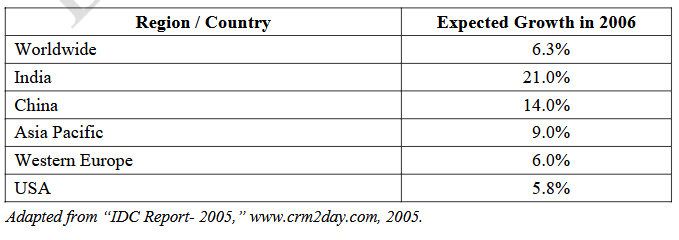
According to research firm IDC,1 the worldwide spending on information technology (IT) by companies would see an increase of 6.3% in 2006. The economic growth and stability witnessed in the US, Europe, China, and Japan in 2005, were expected to encourage IT spending by companies based in these regions in 2006. (Refer to Table I for Growth Expected in IT Spending in 2006) IDC also predicted that growth would be strongest in the software market, where spending would grow by 7 per cent in 2006.
Table I: Growth Expected in IT Spending in 2006
 |
2) Increase in IT Spending on Customer Facing Systems
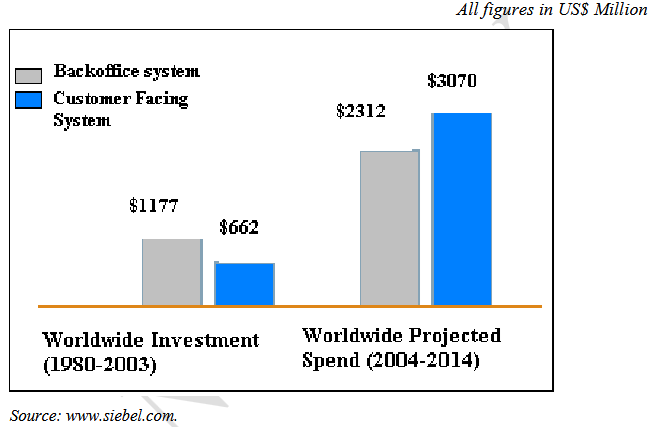
The ability of a company to effectively acquire and retain profitable customers is critical for it to deliver consistent top-line growth. Front-end customer-facing systems support an organization's interactions with its customers and enable it to understand its customers better. There are a broad range of customer-facing systems which includes technologies such as CRM applications that support sales, marketing, and customer service. A report in 2004 by Siebel Systems based on data from research firms like Gartner, AMR Research, and IDC, estimated that the worldwide IT spending on Customer Facing Solutions would reach US$ 3070 Million by 2014 (Refer to Figure II: Increase in IT spending on Customer Facing Systems).
Figure II: Increase in IT Spending on Customer Facing Systems
 |
3) Increase in On-demand CRM Implementations among SMB Segment
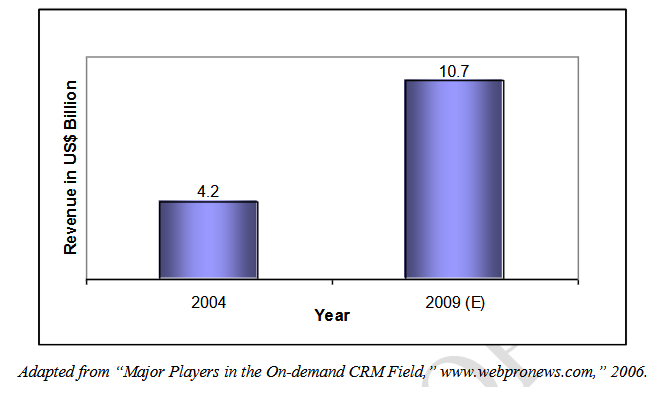
The market for on-demand CRM is expected to increase among the small and medium-sized companies in the coming years (Refer to Figure III for Expected Growth in On-Demand CRM solutions). This is largely because large-scale on-site CRM implementations will mean huge expenditure besides being extremely complex. On-demand CRM is ideal for companies that require standard CRM, but do not require complex or real-time integration with back office systems. Small and midsize businesses and departments within larger companies have been drawn to these software-as-a-service solutions (payable on a monthly basis) because they are much cheaper than licensed on-site software.
Figure III: Expected Growth in On-demand CRM Solutions
 |
CRM is a solution that caters to the diverse needs of employees across different departments who are required to continuously interact with customers. Among these employees are a range of mobile workers including sales representatives or account managers, field service personnel, and customer support staff.
Technology advancements in mobile communications have provided organizations with new ways of doing business and reaching out to their customers. One of the most widely known solutions in this aspect is Mobile CRM, which can be defined as an extension of the traditional CRM wherein a mobile, remote access or wireless component application has been incorporated into the standard CRM system. Mobile CRM makes it more convenient and efficient for mobile field forces such as sales, service, and technicians to interact with the customers. Typical examples in this regard would be Mobile Sales Force Automation (Mobile SFA) and Mobile Field Services.
Mobile Field Sales Force Automation (SFA) (H2): Mobile SFA is an extension of corporate CRM/SFA systems to mobile devices. This solution enables field sales personnel to access product information, pricing, and inventory status and customer information on their mobile devices and enables them to perform contact management, calendar entry, opportunity analysis, and order management functions while away from their office. Mobile SFA is comprised of three market segments, namely Wireless SFA, Off-line SFA, and Laptop & Tablet SFA.
Mobile Field Service Management (FSM) (H2): Mobile FSM involves extending the relevant components of FSM to a mobile device used by the service technician to deliver field service to the customer. This facilitates bi-directional interaction with customer support, scheduling & dispatch, service order and contracts management, service parts management, and possibly other components of the FSM application such as knowledge management.
Analysts believe that Mobile CRM will see a tremendous growth by 2010, with an increase in the number of business functions enhanced by mobile devices. Organizations have a continuous need to access critical information in real time – anytime, anywhere. Enhanced applications, more dispersed sales organizations, and the increasing accessibility of high-speed wireless (3G) and networking (Wi-Fi) would result in more organizations putting mobility at the forefront of their CRM initiatives.
Mobile CRM is moving toward being a solution for the masses rather than being used just by the top executives of the company. Some of the driving factors for companies to integrate CRM solutions in the mobile devices of their sales force would be shortening of order processing and product delivery times, improving field service personnel productivity, and speeding up the flow of information, both internally and externally.
Wireless/Mobile CRM will allow a company to maximize its relationships with customers especially in the area of faster response times to customer inquiries and the ability to close sales faster. The key benefit that is being foreseen is greatly improved productivity. By equipping their sales teams with handheld hardware providing wireless links to CRM systems, companies will be able to maintain or even increase customer satisfaction and reduce the sales team?s downtime. Another factor that is boosting the mobile CRM market is the growing convergence of mobile devices and wireless technologies, which is easing the integration of CRM with these devices. The rapid increase of wireless technologies such as the Wireless Access Protocol (WAP) communications format as well as devices such as smart cell phones, personal digital assistants (PDAs), and pagers would contribute toward changing the face of CRM. Within a few years, salespeople and mobile service personnel will be able to access relevant customer data with web-enabled handheld devices wherever they may be. This will increase their efficiency and help their companies to cut expenses.
Since its emergence in 2004, the market for mobile CRM solutions has grown and is expected to account for 10% of the total revenues generated from CRM in 2006. Having invested in the necessary technology and in equipping their field personnel with mobile devices, organizations are now looking to invest in mobile CRM solutions that can add further value to their business processes. Industry experts expect mobile CRM to emerge strongly in the coming years, as issues surrounding security, costs, and usability problems are resolved. According to a report published by Visiongain,5 Mobile CRM growth rates will exceed traditional CRM growth rates and will account for 20% of total CRM revenues by 2010.
Factors Driving the Growth of Mobile CRM Worldwide
1) Increase in size of mobile workforce:
The mobility requirements of a business vary according to its own specific needs, but we can generalize a few functions across businesses, which require being mobile. These include the Management executives, Sales staff and Service Personnel. The past few years have witnessed a growth in the number of mobile workers employed across organizations (Refer to Figure IV for Expected Increase in Mobile Workers)
Figure IV: Expected Increase in Mobile Workers
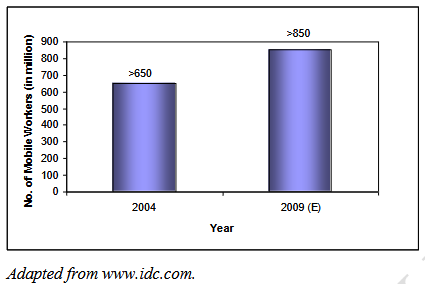 |
Note: Figures are based on a study conducted by IDC in 2004, which provides a worldwide five-year mobile
worker population forecast through 2009 and analysis across 3 major worker categories and 13 subcategories
in 5 regions: the United States, Western Europe, Asia/Pacific (excluding Japan), Japan, and the rest of the
world (ROW).
2) Proliferation of Wireless Services
Enterprises with highly mobile workforces require different degrees of access to critical, accurate business information using a variety of access methods. The rapid growth in wireless technology has given a tremendous boost to growth of Mobile CRM. As per the mobility requirements of an organization, there are three major technology options available.
- Wireless communications over GPRS.
- Wireless hotspots (WiFi).
- Wired/Bluetooth connectivity via docking station or to a local PC.
- Wireless Application Protocol (WAP).
Wireless communication over GPRS (Global Packet Radio Service)6 that supports fully mobile, 'always-on' solutions is one the most important solutions available. Data can be transferred from the main systems to the remote device at any time. For example, if a customer requests for an urgent service, the system can identify the most appropriate engineer and re-direct him/her to take the customer's call. The system will transfer the details to the mobile device allowing the engineer to prepare for the call.
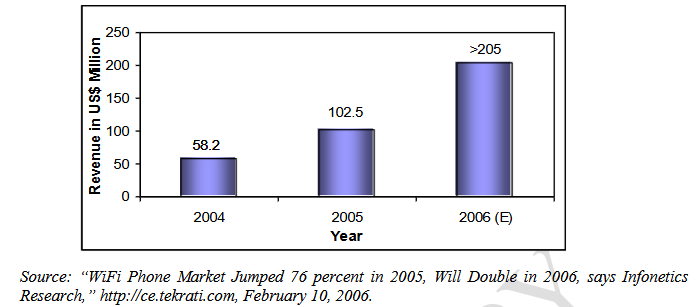
Wireless hotspots7 (based on WiFi technology) are gaining popularity of late. WiFi is a wireless Local Area Network that uses high frequency radio signals to transmit and receive data over distances of a few hundred feet. WiFi is ideally suited where there is no real time requirement for connectivity but occasional access is required (for example to pick up e-mails). WiFi, which is available in laptop PCs and some PDAs, allows access to the Internet and through Virtual Private Networks (VPNs) to the office network. (Refer to Figure V – Worldwide WiFi Phone Market Growth)
Figure V: Worldwide WIFI Phone Market Growth
 |
Wired/ Bluetooth connectivity is another technology driving Mobile CRM, which works on the principle of an open standard for wireless transmission of voice and data between mobile devices (PCs, handheld computers, telephones, and printers)
Wireless Application Protocol (WAP) is a specification for a set of communication protocols to standardize the way that wireless devices, such as cellular telephones and radio transceivers can be used for Internet access, including e-mail, and newsgroups. A WAP-enabled device means that these devices contain a microbrowser that has a wireless connection to the Internet using a gateway server, the WAP server, or WAP proxy. It does not use HTML but a special language WML to cope with issues such as low bandwidth or small screen sizes.
3) Growth in use of mobile devices (PDAs and cellular phones) among mobile workers and consumers.
Businesses are just beginning to take advantage of the increasing popularity of these wireless devices to improve CRM. Major changes are likely to occur in the customer relationship landscape as a direct result of new applications that are finally catching up with mobile customers and the sales force.
Some of the benefits that accrue to an organization which implements/integrates mobile CRM in its business processes are given here:
- Mobile CRM helps add value to the sales process by providing the sales force with accurate and timely information about the customer.
- It brings more transparency to the organization and structures team work via better and efficient transmission of information.
- Organizations are able to achieve a high degree of customer satisfaction as the customer handling processes becomes faster and automated.
- It results in an increase in Return On Investment.
- It helps differentiate the organization?s product/service offering from that of its competitors.
Siebel Systems:
Siebel is one of the world's leading providers of CRM solutions. As in 2005, the company offered more than 100 industry-specific solutions. Siebel's product portfolio included customer relationship management, business intelligence, and customer data integration solutions. The company had a huge clientele of around 4,000 customers, ranging from small and medium-sized businesses to large enterprises worldwide. Its business applications included the Siebel Application Suite and Siebel CRM On Demand (Hosted Solutions).
After having acquired PeopleSoft Inc., a leading CRM solutions vendor, in 2004, Oracle Corporation (Oracle) announced its acquisition of Siebel in September 2005. Industry analysts opined that Siebel's expertise in industry-specific customer-facing applications combined with its growing analytics business would help Oracle become a global leader in CRM solutions.
Products offered
Siebel Mobile Sales: Siebel Mobile Sales, which is a component of Siebel sales applications (Sales Force Automation), enables companies to improve sales productivity, respond immediately to customer inquiries, and free their sales professionals to focus on revenue generation. Siebel Mobile Sales supports a wide variety of mobile platforms, including handheld and wireless devices, interactive voice technology over any phone and remote laptop computers.
Siebel Field Service: Siebel Field Service enables service organizations to dramatically enhance customer service, productivity, and revenue. The solution offers support for multi-channel customer service, mobile and wireless connectivity, and schedule optimization for field resources, logistics, inventory management, and invoicing functionality.
Siebel Field Service is fully integrated with all Siebel applications and can be seamlessly integrated with existing third-party applications and legacy systems. It also supports a wide range of mobile devices in both connected and disconnected modes.
Annual Income Statement of Siebel
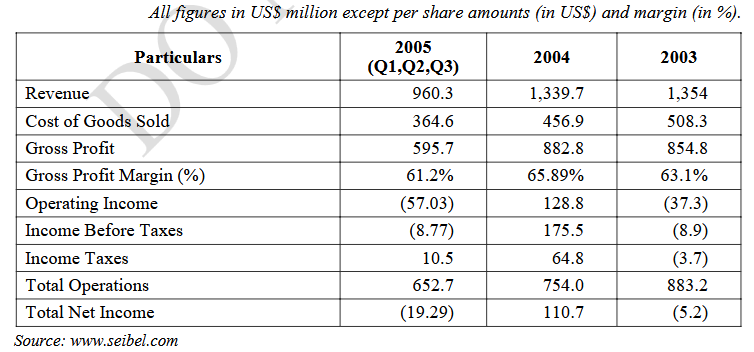 |
Note: Figures for 2005 are for the period from January 2005 to September 2005. In January 2006, Siebel
announced that its revenues for the year ended December 31, 2005 were US$ 1.43 billion, operating income
was US$ 59 million and net income was US$ 70 million.
SAP AG
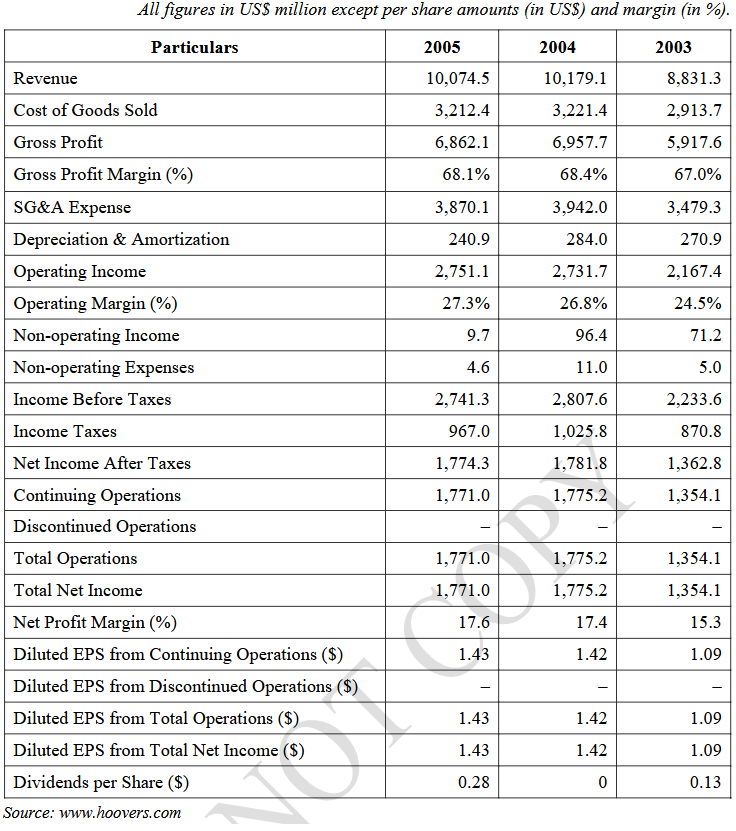
SAP, the third largest independent software provider in the world, has a core business of developing and licensing enterprise business software solutions. It has a clientele of around 32,000 customers spread across more than 120 countries (as on 2005). SAP provides a comprehensive range of applications and solutions catering to every aspect of client business operations, which includes the 'my SAP' Business Suite applications, the 'my SAP' All-in-One partner solutions, SAP Business One applications, and other customer specific solutions. SAP's service offerings include consulting and education support services, ramp-up services, hosting, support for business process outsourcing (BPO), and financial services.
Products offered
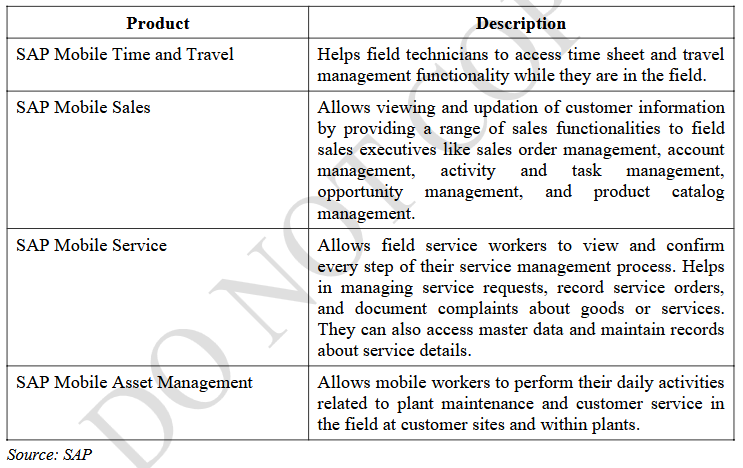
The products offered by SAP for the mobile business are available in different versions depending on which device (handheld computers, laptop computers, smart phone) they are integrated with. SAP offers its mobile CRM solutions through SAP Mobile Infrastructure (SAP MI).9 SAP MI supports multiple devices and enables synchronization of data. It also supports technologies like GSM, GPRS, Bluetooth, and WLAN. (Refer to Table II for Mobile CRM Products from SAP)
Table II: Mobile CRM Products from SAP
 |
Annual Income Statement of SAP AG
 |
Salesforce.com Inc.
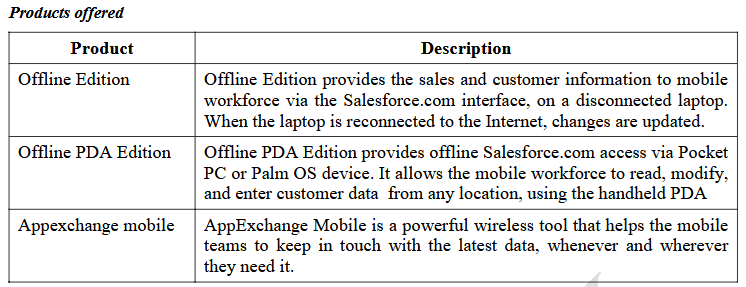
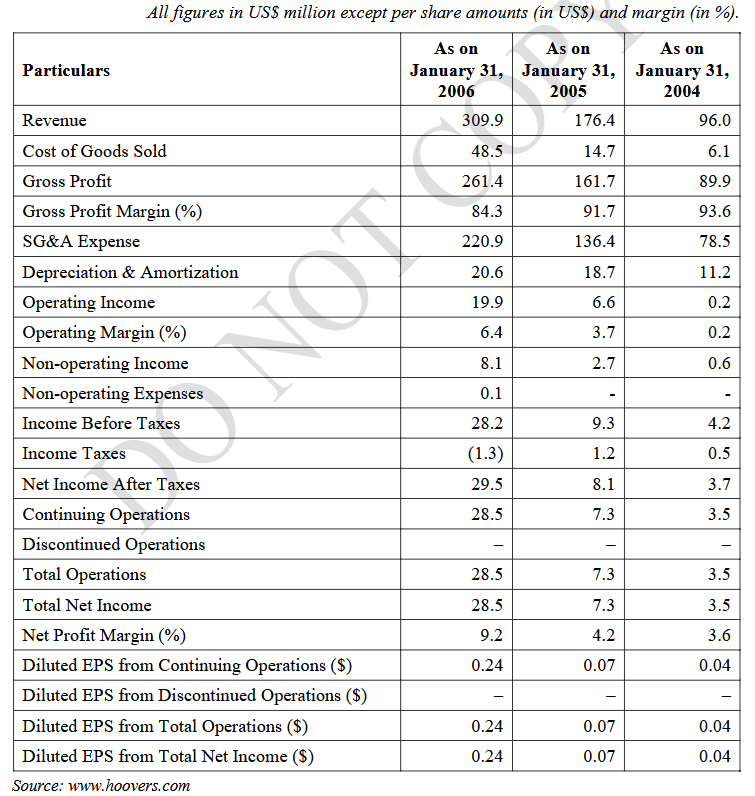
Salesforce.com Inc. (Salesforce.com) is a leading player in on-demand customer relationship management services. The company had over 399,000 subscribers in 20,500 companies worldwide in 2005. These companies depended on Salesforce.com to manage their sales, marketing, and customer support services. The company's product range includes CRM solutions, Custom Applications, on-demand solutions, and desktop and mobile solutions. The company also offers professional services for data management and data integration. Other services offered include educational and support services.
Mobile solutions:
The mobile customer relationship management (CRM) solution offered by Salesforce.com enables the mobile sales force to be connected while they are away from office. It offers support for devices like disconnected laptops, wireless e-mail devices (such as the Blackberry),10 and wireless PDAs.
 |
Annual Income Statement of Salesforce.com Inc.:
 |
Case 1: Deployment of Mobile CRM at ADTRAN Inc.
ADTRAN Inc. (ADTRAN) a supplier of advanced transmission products for expansive telecommunications networks, commenced operations in 1986. The company offered around 500 products, which enabled high-speed digital communication over the Local Loop. Some of the company's key customers were Incumbent Local Exchange carriers, inter exchange carriers, Internet Service Providers (ISPs), Competitive Local Exchange Carriers, international service providers, public and private enterprises, and original equipment manufacturers (OEMs).
The Challenge: ADTRAN had a large product range with a diverse set of customers and it felt the need to streamline its sales processes. The company wanted to replace the traditional paper reporting mechanism with automated processes that effectively managed business leads and opportunities. It was looking for faster, more accurate, and up-to-date information flow among its sales force (mobile workers).
The Solution: To address the above challenges, ADTRAN implemented a Mobile CRM solution that was offered by Salesforce.com. The company integrated the CRM solution of Salesforce.com with its existing backend ERP system that was offered by BAAN. ADTRAN's mobile workforce used Blackberry devices to access this CRM solution while on the field.
The Benefits: ADTRAN reported that the implementation of this Mobile CRM solution resulted in faster, accurate, and more efficient flow of communication within the organization and among its partners as well. It also enabled the organization to reduce order processing and delivery times and improved the efficiency of its employees.
Case 2: Implementation of Mobile CRM at Thomson Learning
Thomson Learning (Thomson), a division of the Thomson Corporation, offers learning solutions for diverse training and education needs. It had annual revenue of US$ 2.32 billion in 2005, operated in 39 countries with an employee strength of 9,500. Its solutions are tailored for individuals, businesses, and institutions around the world. In the academic marketplace, it serves secondary, post-secondary, and graduate-level students, teachers, and learning institutions. It offers adult education and certification materials for corporations, training centers, and individuals as a part of its corporate offering.
Thomson's products and services are sold through direct channels and a worldwide network of distributors. The company relied heavily on its mobile sales force to sell its products.
Challenges Faced by Thomson
To meet the diverse needs of its customers, the Thomson sales team had to be equipped to present a wide range of products to customers. They also had to organize their customer contact information, and sales related data like quotations, past orders, agreement terms, etc. The mobile workforce needed to have access to up-to-date product and price information to be able to provide accurate information during business discussions and meetings with customers.
Solution Adopted by Thomson
Thomson Learning first implemented Siebel CRM to address these challenges. The CRM solution was integrated into the laptops of the company's field executives, who used the offline CRM data to access customer and product information while on the field. When the executives returned to office, they updated the data in the CRM system.
Further, the company decided to upgrade its Mobile CRM solution and integrated the Mobile CRM functionality with the Fujitsu Life Book T3000 Tablet PC, a convertible notebook. This enabled the sales representatives to use the PC to note down points and navigate the „point and click' mobile CRM solution.
Benefits to the Business: This solution had a positive impact on the efficiency and effectiveness of employees at Thomson. Sales reps were better prepared and more confident at meetings and were able to present detailed product information and product demos. It improved opportunity tracking for Thomson sales executives and resulted in faster order processing and increased revenues. The company also estimated that it had saved US$ 100,000 in catalog printing and mailing costs due to the elimination of printed product catalogs.
1. Expensive Mobile Devices: Although significant improvements have been made, truly mobile devices that are able to adopt CRM and SFA capabilities continue to be expensive. For example, full-scale PDAs that are able to handle Mobile CRM capabilities are still considered by companies and mobile workers as being too expensive.
2. Network: Enterprise applications have been designed and built around the notion of a relatively high-speed persistent network connection where there is uptime reliability. Most of the applications in place were not designed for a network beyond the control of the enterprise. Enterprise mobility is all about connectivity outside the office, where companies have no control over networks and no right to interfere with frequencies.
3. Bandwidth Limitations: Bandwidth limitation is a critical issue that needs to be addressed to make a successful wireless CRM solution. To keep up the productivity of mobile workers, IT managers must have the ability to manage and control which applications can use the available network bandwidth. Mission-critical enterprise applications such as CRM must be accessible, even in bandwidth-constrained environments. Creating rule-driven network access lets the enterprise manage costs, since the cost of transferring data over wide area wireless networks is higher than it is for local area networks.
4. Use of Open Standards: Selecting a platform based on open standards that can be integrated with a variety of back-end systems ERP, the intranet, legacy, database and e-mail is imperative for the success of Mobile CRM. In addition, support for open standards also ensures that the application can support a wide variety of platforms and is flexible enough to keep up with the rapidly changing device landscape.
5. Security of Data: Security of data transferred through mobile devices is another crucial factor that needs to be given ample priority as CRM applications typically have crucial customer information and the security of such information is critical for an organization.
Increasing competition is forcing organizations to focus on measures to improve customer satisfaction and to retain customers. Organizations have increased their IT spending on solutions that can bridge the gap between customers and organizations. Mobile CRM is an ideal solution to the problem of keeping field salespeople or field service agents connected and up to date with the company and customer records by offering wireless connections. It provides access to real-time customer data, order information, and sales activity, along with a multitude of other important statistics. This is a solution that would certainly add value to the business process of an organization and offer them competitive advantage.
Proliferation in wireless technology and mobile devices are believed to be factors contributing to the growth of Mobile CRM. Due to advances in information and communications technologies, it is becoming easier to connect back-end CRM systems with wireless messaging platforms and devices. However, a successful large-scale adoption of Mobile CRM would depend on factors like bandwidth limitation, cost issues, and security issues.
Keywords
Mobile CRM, Customer Relationship Management, CRM, Siebel, SAP, Oracle, Salesforce.com, Blackberry, Mobile Field Sales Force Automation, Mobile Field Service Management, Wireless Services, Thomson Learning, ADTRAN Inc., Enterprise applications