
Financial Risk Management at UBS
🌐 International Buyers — Pay via PayPal
Details
FINA015
12
2003
NO
300
Union Bank of Switzerland
Banking
Switzerland
Financial strategy ,Enterprise Risk
Abstract
Union Bank of Switzerland (UBS) is one of the largest investment managers in the world. UBS serves institutional investors and high net-worth individuals by offering a range of products and services including mutual funds, asset management, corporate finance, and estate planning. UBS also provides securities underwriting services, mergers and acquisitions advice and trades in fixed-income products, and foreign exchange. The com-pany faces many risks. These include interest rate risks, currency risks, equity risks, credit risks, liquidity risks and capital adequacy risks. The case outlines the risks and the mechanisms UBS employs to mitigate them.
Learning Objectives
The case is structured to achieve the following Learning Objectives:
- 0
Contents
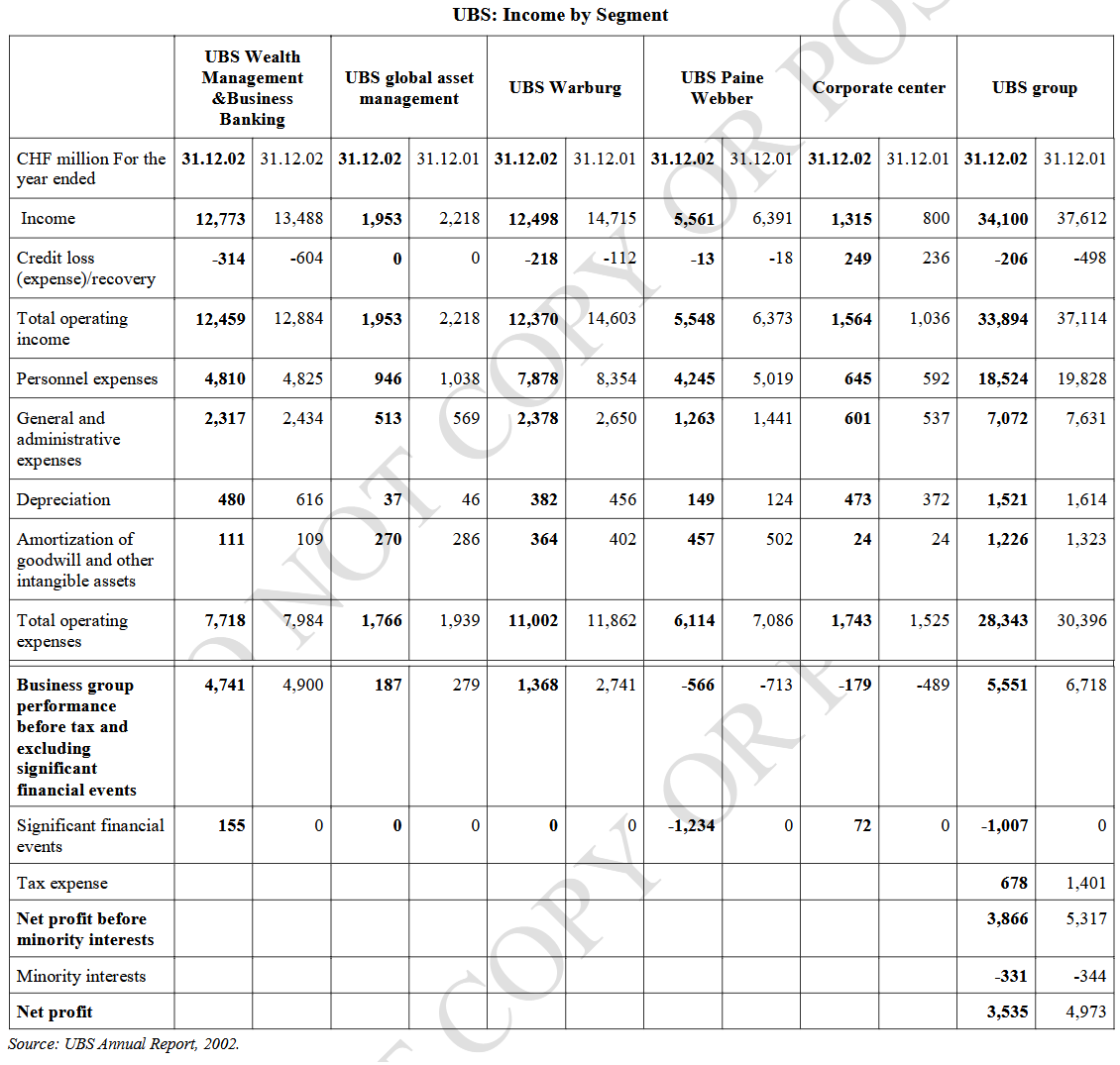
One of the largest investment managers in the world, UBS had four major segments. UBS Wealth Management & Business Banking, UBS Global Asset Management, UBS Warburg (Investment Banking) and UBS Paine Webber (wealth management for private clients. UBS served institutional investors and high-net-worth individuals by offering a range of products and services including mutual funds, asset management, corporate finance, and estate planning. UBS also provided securities underwriting services, mergers & acquisitions advice and traded in fixed-income products, and foreign exchange. The company also provided traditional banking services. To strengthen its asset management capabilities, UBS had bought RT Capital Management (renamed Brinson Canada), the institutional asset management business of RBC Financial Group, Canada. UBS also had plans to expand its private banking services in Europe. UBS had more than 69,000 employees operating in more than 50 countries.
Businessmen in Winterthur, Switzerland, formed the Bank of Winterthur in 1862 for trading, financing railroads, and operating a warehouse. In 1912, the bank merged with the Bank of Toggenburg (formed in 1863) to create Schweizerische Bankgesellschaft -- Union Bank of Switzerland (UBS). UBS expanded in Switzerland, buying smaller banks and adding branches. Though it was hit hard by the Depression, the bank benefited from Switzerland's neutrality in WWII, collecting deposits from both Jews and Nazis. Expansion in Switzerland continued after the war with the purchase of Eidgenossische Bank of Zurich. In 1946, the bank opened an office in New York.
UBS continued to grow by acquisitions in the 1950s. By 1962, it had 81 branches. In 1967 it opened a full-service office in London. During the 1970s, UBS established several securities underwriting subsidiaries abroad. But the firm's UK brokerage business was hit hard by the 1987 US stock market crash. Over the next two years, losses continued, prompting an overhaul of the London operations. Then the bank’s US operations were badly affected by the collapse of the junk bond market in 1990. Notwithstanding these setbacks, UBS set up offices in Paris, Singapore, and Hong Kong and took over Chase Manhattan's (now J.P. Morgan Chase) New York money management unit in 1991. The firm also continued to expand within Switzerland, buying five more banks to boost market share and strengthen its branch network. But these acquisitions left UBS with overlapping operations and a bloated infrastructure when recession hit. Falling real estate values left the bank with a heavy load of nonperforming loans. In 1994, as profits plummeted, stockholder Martin Ebner, tried to gain control of UBS. After failing in his attempt to have president Robert Studer charged with criminal fraud, he almost thwarted Studer's election to the chairmanship.
UBS launched a major reorganization in 1994 by consolidating its consumer credit operations. The next year it joined with Swiss Life/Rentenanstalt to offer insurance products through its bank network. In 1996, after rejecting Credit Suisse's merger bid, UBS began another major reorganization. The bank reduced the number of domestic branches and wrote off billions of francs in bad loans, leading to the bank’s first loss ever. In 1998 UBS merged with Swiss Bank Corp in one of the most celebrated mergers in banking history. The bank lost $1.6 billion after the Long-Term Capital Management hedge fund went bankrupt in October 1998. This prompted chairman Mathis Cabiallavetta to resign.
As difficulties in integration of the pre-merger entities continued in 1999, UBS retreated from riskier markets, selling some $2 billion in real estate, and its 25% stake in Swiss Life/Rentenanstalt. That year, UBS bought Bank of America's European and Asian private banking operations and Allegis Realty Investors, a US real estate investment management firm. In 2000, UBS reorganized yet again and bought US broker Paine Webber (now UBS Paine Webber).
Exhibit I
 |
UBS was exposed to market risk, primarily due to trading activities centered in the Corporate and Institutional Clients business of UBS Warburg. Market risk arose primarily from market making, client facilitation and proprietary positions in equities, fixed income and interest rate products, foreign exchange and, to a lesser extent, precious metals and energy. Such activities were mainly undertaken in OECD markets.
The principal market risk measures used were Value at Risk (VaR) and stress loss. Stress loss was assessed against a set of forward-looking scenarios, approved by the Board of Directors. Other controls included limits on exposure to individual market risk variables, such as individual interest or exchange rates, and limits on positions in the securities of individual issuers. These controls were set at levels, which reflected variations in price volatility and market depth and liquidity.
Exposure to interest rate movements was expressed for all interest rate sensitive positions, as the impact on their fair values of a one basis point (0.01%) change in interest rates.
Both trading and non-trading positions could vary significantly on a daily basis. So any representation of interest rate risk at a specific date offered only a snapshot of the risks taken by the Group. The presence in the portfolio of option products also meant that only limited inferences could be drawn about exposure to larger movements in interest rates.
The major part of trading interest rate risk arose in fixed income securities, currency forwards and other derivatives, and money market trading activities. Money market paper and debt instruments both contributed to interest rate sensitivity. Interest rate risk arose not only on interest rate contracts but also in case of forwards, swaps and options.
Non-trading interest rate risk was inherent in many of UBS’ businesses. Such risk arose from factors such as differences in timing between contractual maturity or re-pricing of assets, liabilities and derivative instruments, and the difference in re-pricing characteristics of floating rate indices, such as the savings rate and six-month LIBOR. Most non-trading interest rate risk was captured at the point of business origination and transferred to a risk management unit – primarily the Cash and Collateral Trading unit of UBS Warburg or Group Treasury – where it was managed within the market risk limits.
Exhibit II
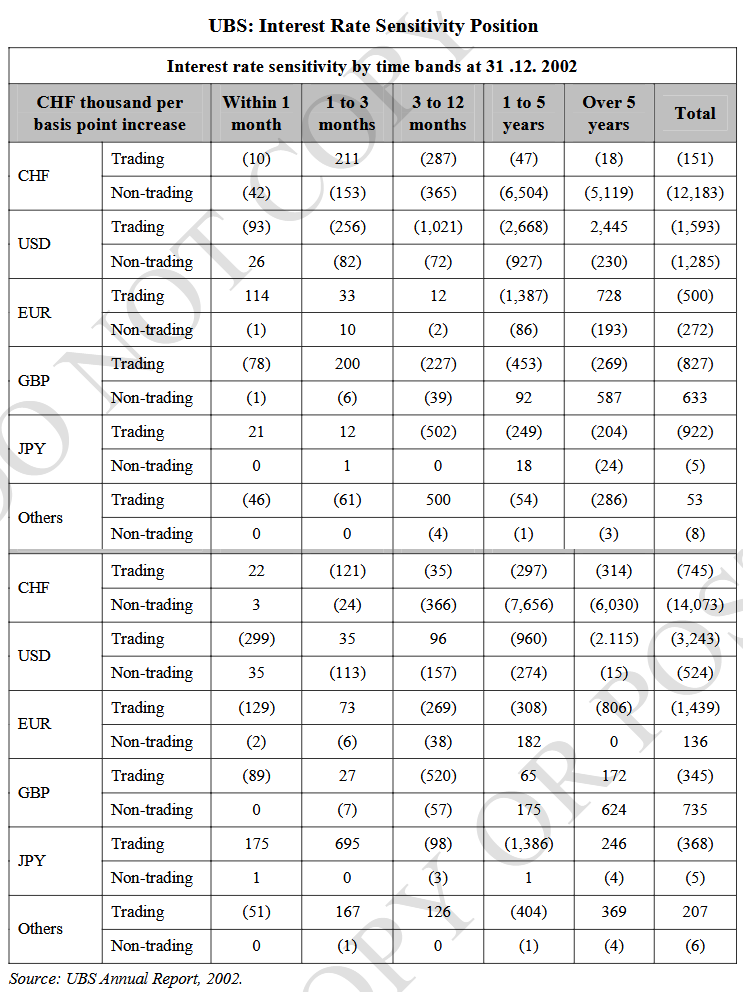 |
Note: The table sets out the extent to which the Group was exposed to interest rate risk at 31 December 2001 and 2002. It shows the net impact of a one basis point (0.01%) increase in market interest rates across all time bands on the fair values of interest rate sensitive positions, including balance sheet assets and liabilities and derivatives. The impact of such an increase in interest rates depended on the net asset or net liability position of the Group in each category, currency and time band in the table. A negative amount in the table reflected a potential reduction in fair value as a result of an increase in interest rates, while a positive amount reflected a potential increase in fair value.
Some products offered to clients, had no contractual maturity date or directly market-linked rate. Their interest rate risk was transferred on a pooled basis through “replication” portfolios. These portfolios of revolving transactions between the originating business unit and Group Treasury at market rates approximated their average cash flow and re-pricing behavior. The structure and parameters of the replication portfolios were set in accordance with long-term observations of market and client behavior, and were reviewed periodically. The extraordinarily low interest rate environment, especially in Swiss franc rates, led, at the end of 2002, to some temporary adjustment of the replication portfolios for variable rate liabilities.
Interest rate risk also arose from balance sheet items such as the Group’s real estate and equity investments in associated companies. These items were also transferred to Group Treasury, through replicating portfolios designed to approximate the investment or funding profile mandated by the Group Executive Board.
The investment of the Group’s equity accounted for CHF 14.2 million of the non-trading interest rate sensitivity, with CHF 11.9 million denominated in CHF and the remainder mainly in USD and a smaller amount in EUR. As on December 31, 2002, the Group’s equity was invested in a portfolio of fixed-rate assets with an average duration of three and a half years, in line with UBS’ corporate strategy. The interest rate sensitivity of these investments was directly related to the chosen investment duration. Although investing in significantly shorter maturities led to a reduction in apparent interest rate sensitivity, it also implied higher volatility in the Group’s
interest earnings.
For the Euro and pound sterling, the additional interest rate sensitivity arose mainly from subordinated note issues. These issues were intentionally unhedged as they were regarded as part of the Group’s equity for asset and liability management purposes. The additional interest rate sensitivity in USD resulted predominantly from the write-down of USD intangibles.
UBS was an active participant in currency trading activities. These trading exposures were subject to VaR, stress and concentration limits.
Exhibit III
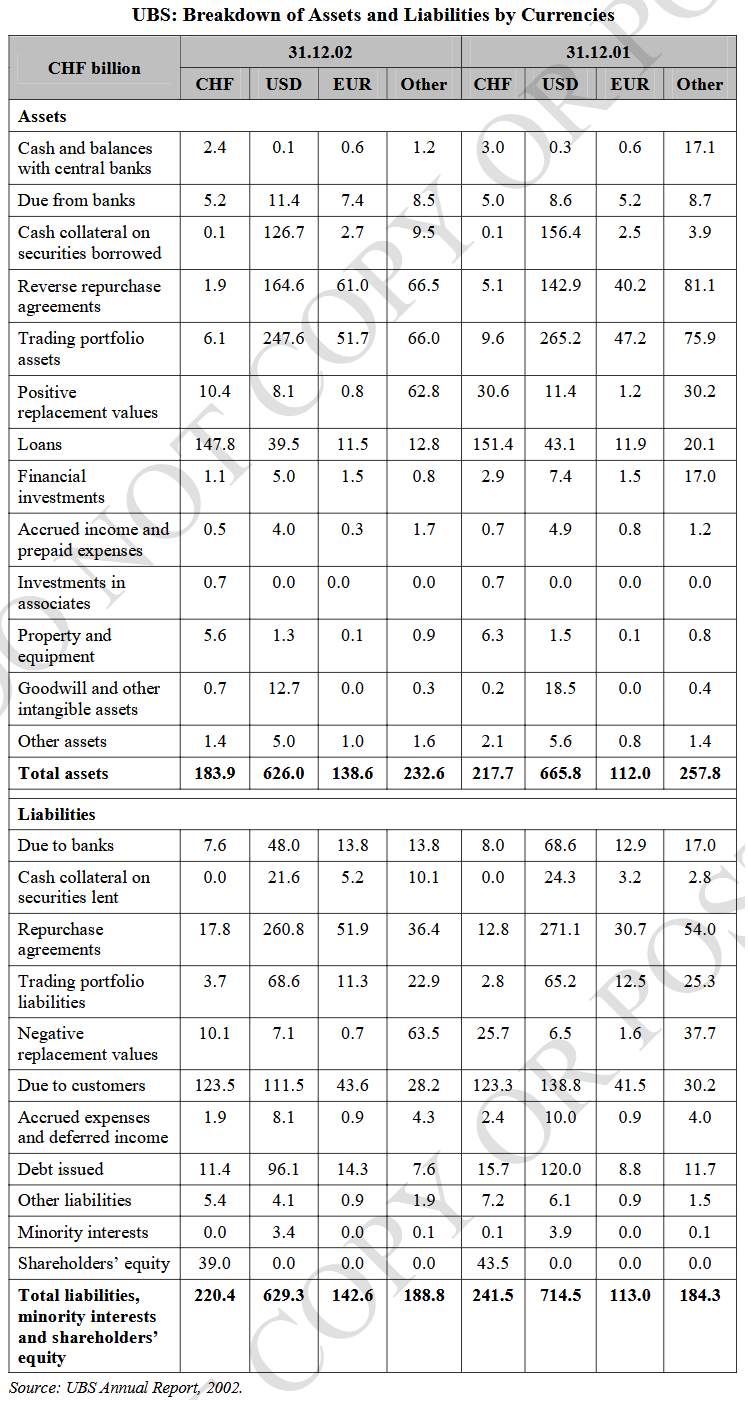 |
In Non-trading, the Group’s reporting currency was the Swiss franc but its assets, liabilities, income and expense were denominated in many currencies, with significant amounts in USD, EUR and GBP, as well as CHF. Reported profits or losses were exchanged monthly into CHF. Group Treasury proactively hedged significant expected foreign currency earnings/costs (mainly USD, EUR and GBP) within a time horizon of one year, in accordance with the instructions of the Group Executive Board and subject to its VaR limit. Hedging instruments employed, included options, which provided a safety net against unfavorable currency fluctuations while preserving the upside potential.
From 2002, UBS had begun to diversify the investment of its equity into CHF, USD and Euro in proportion to the currencies of its risk-weighted assets in order to protect its Tier 1 capital ratio against exchange rate movements. Other foreign currency assets and liabilities of the business units were required to be match-funded / invested in the relevant currency or otherwise hedged to avoid currency risk.
Equity risk was the risk of loss resulting from changes in the levels of equity indices and values of individual stocks. UBS was a significant player in major equity markets. Its exposures in these markets were subject to VAR, stress and concentration limits and in the case of individual stocks, to issuer risk controls.
The values of tradable assets – equities, bonds and other traded debt instruments – were affected by factors specific to individual issuers as well as general market moves. As an active trader and market maker in equities and bonds, UBS held positions in tradable assets, which were not only included in VAR, but were also subject to concentration limits on individual issuers, including positions arising from derivatives as well as physical holdings.
Credit risk represented the loss, which UBS would suffer if a client or counterparty failed to meet its contractual obligations. It was inherent not only in traditional banking products but also in foreign exchange and derivatives contracts, such as swaps and options.
To ensure a consistent and unified approach, with appropriate checks and balances, Business Groups had independent credit risk control (CRC) functions within which credit approval authority was exercised by authorized credit officers. CRC had authority over counterparty rating, credit risk assessment and approval, and the establishment of allowances and provisions.
UBS restricted its credit exposure to both individual counterparties and counterparty groups. The size of the credit limit depended on the assessment of their financial strength, particularly sustainable free cash flows and on the economic environment, industry position, and qualitative factors such as management strength. Exposure against limits was measured on a continuous basis and was subject to standard exception reporting.
Exposure against limits for banking products was measured at face value.
Exhibit IV
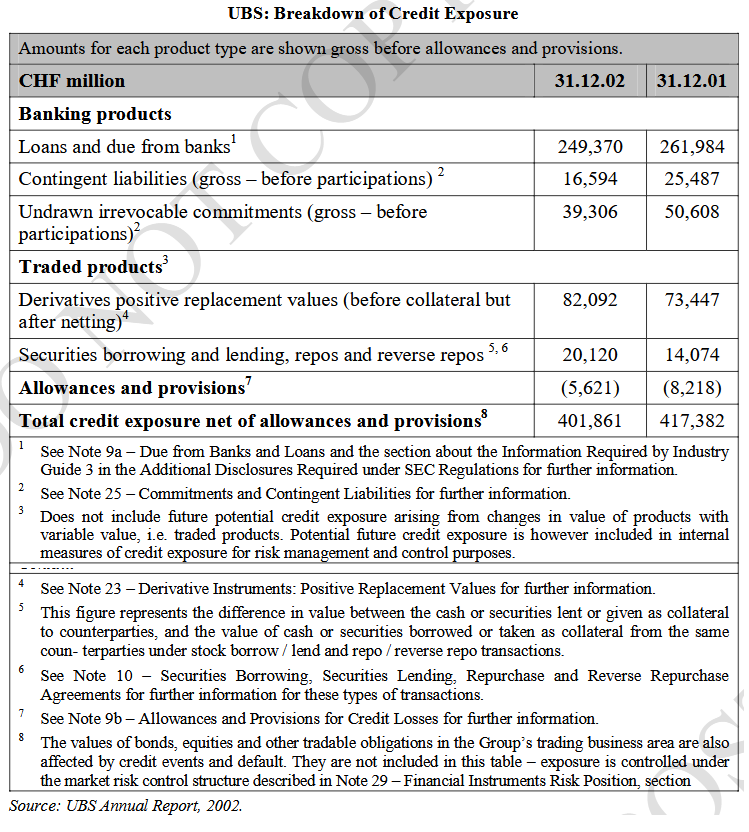 |
Note: The amounts shown in the table represent the mark to market values of these transactions, i.e. the difference in value between the cash or securities lent or given as collateral by UBS and the value of cash or securities borrowed or taken as collateral by UBS.
For all traded products, credit exposure was measured for internal risk control purposes on the basis of both current replacement value of contracts and potential future changes in replacement values. Securities borrowing and lending transactions were represented on the balance sheet by the values of cash collateral placed with or received from counterparties. Repo / reverse repo transactions were represented by the amounts of the forward commitments. The credit exposure was generally only a small percentage of the balance sheet amounts.
UBS was an active user of credit derivatives to hedge credit risk in banking and traded products. It also made use of master netting agreements where possible in its OTC derivatives trading, UBS also entered into bilateral collateral agreements with market participants.
Concentrations of credit risk arose if clients were engaged in similar activities, or were located in the same geographic region or had comparable economic characteristics. The Group applied stress measures to assess the impact of variations in bankruptcy rates and asset values, taking into account risk concentrations in each portfolio. Stress loss limits were applied where considered necessary, including limits on exposure, to all but the best-rated countries.
UBS classified a claim as impaired if the book value of the claim exceeded the present value of the cash flows actually expected in future periods. The carrying values of impaired claims were determined in accordance with the principles of IAS 39.
Exhibit V
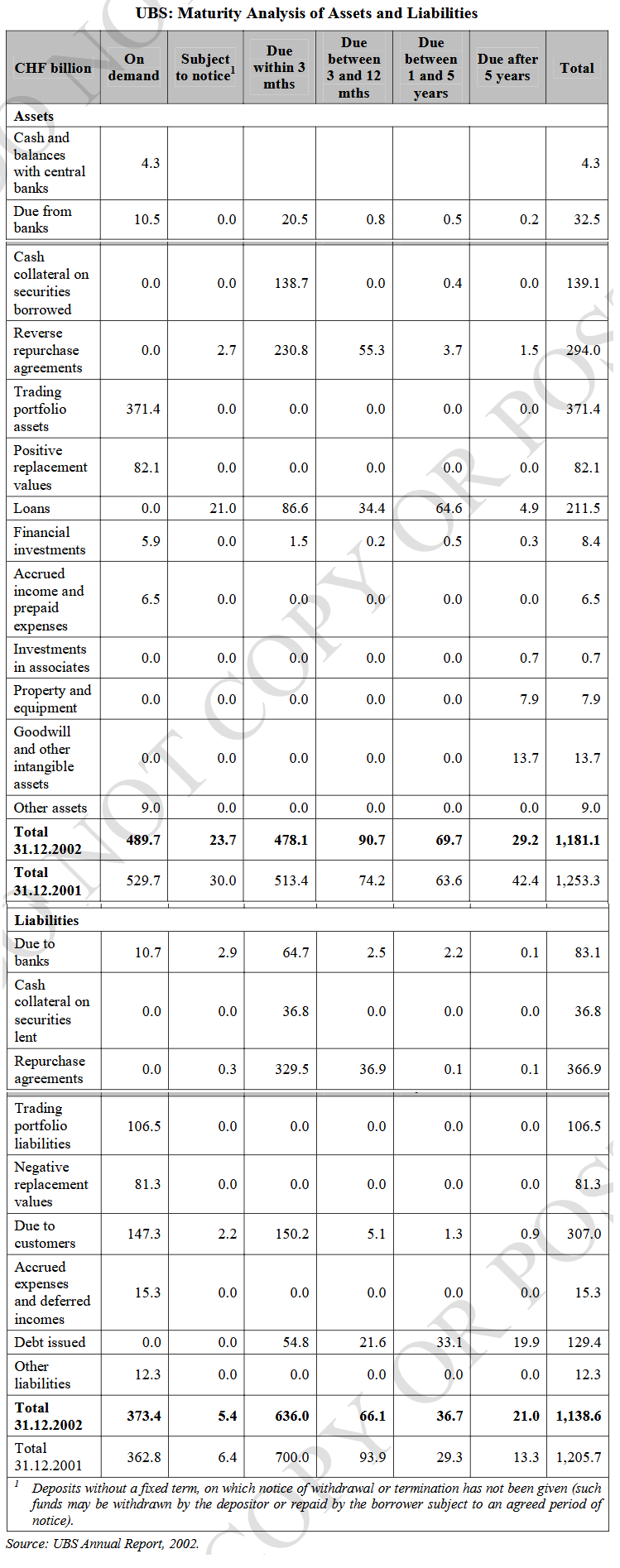 |
The occurrence of actual credit losses was erratic in both timing and amount. Losses that arose usually related to transactions entered into, in previous accounting periods. In order to make the business ultimately accountable for any credit losses they suffered but also to give them the incentive to align their credit risk decisions and risk adjusted pricing with the medium term risk profile of their credit transactions, the Group used the concept of “expected loss” for management purposes. Expected loss reflected the annual cost that would arise, on average, over time, from transactions that became impaired. Expected loss was a function of the probability of default (given by the rating), current and likely future exposure to the counterparty and the likely severity of the loss should default actually occur.
UBS aimed at ensuring sufficient liquidity to meet its liabilities when due, without compromising its ability to respond quickly to strategic opportunities. The Group’s centralized approach was based on an integrated framework incorporating the assessment of expected cash flows and the availability of high-grade collateral, which could be used to secure additional funding if required. The liquidity position was assessed and managed under a variety of scenarios, giving due consideration to stress factors. Scenarios encompassed both normal and extraordinary market conditions, including both company-specific and general market crises. The impact on both trading and client businesses was considered, taking into account the potential collateral with which funds might be raised, and the possibility that customers might seek to withdraw funds or draw down unutilized, committed credit lines.
UBS monitored the adequacy of its capital using, among other measures, the rules and ratios established by the Basel Committee on Banking Supervision. The BIS ratios compared the amount of the Group’s eligible capital (in total and Tier 1) with the total of its risk-weighted assets (RWAs).
While the Group monitored and reported its capital ratios under BIS rules, it was the rules established by the Swiss regulator, the EBK, which ultimately determined the capital required. These rules, typically, resulted in higher RWAs than the BIS rules. As a result, UBS’s ratios were lower when calculated under the EBK regulations than they would be if calculated under the BIS guidelines. The Group had complied with all BIS and EBK regulatory capital rules for all periods reported.
BIS eligible capital consisted of two parts. Tier 1 capital comprised share capital, share premium, retained earnings including current year profit, foreign currency translation and minority interests, less accrued dividends, net long positions in own shares and goodwill; Tier 2 capital included the Group’s subordinated long-term debt. Tier 1 capital was required to be at least 4% and Total eligible capital at least 8% of RWAs. Three elements made up total Risk-Weighted Assets (RWAs) – credit risk, other assets and market risk.
The credit risk component consisted of on and off-balance sheet claims, measured according to regulatory formulae and weighted according to the type of counterparty and collateral at 0%, 20%, 50% or 100%. The least risky claims, such as claims on OECD governments and claims collateralized by cash, were weighted at 0%, meaning that no capital support was required. The claims deemed most risky, including unsecured claims on corporates and private customers, were weighted at 100%, implying the need for 8% capital support.
Securities not held for trading were included as claims, based on the net long position in the securities of each issuer, including both physical holdings and positions derived from other transactions such as options. Claims arising from derivatives transactions included not only the current positive replacement value, but also an “add-on” to reflect their potential future exposure. Claims arising from contingent commitments and irrevocable facilities granted were converted to credit equivalent amounts based on specified percentages of nominal value.
Other assets, most notably property and equipment, investments and intangibles, were not subject to credit risk. But they represented a risk to the bank in respect of their potential for write-down and impairment. So they required capital backing. They were weighted at 100% of book value under BIS rules but EBK weightings were generally higher.
Exhibit VI
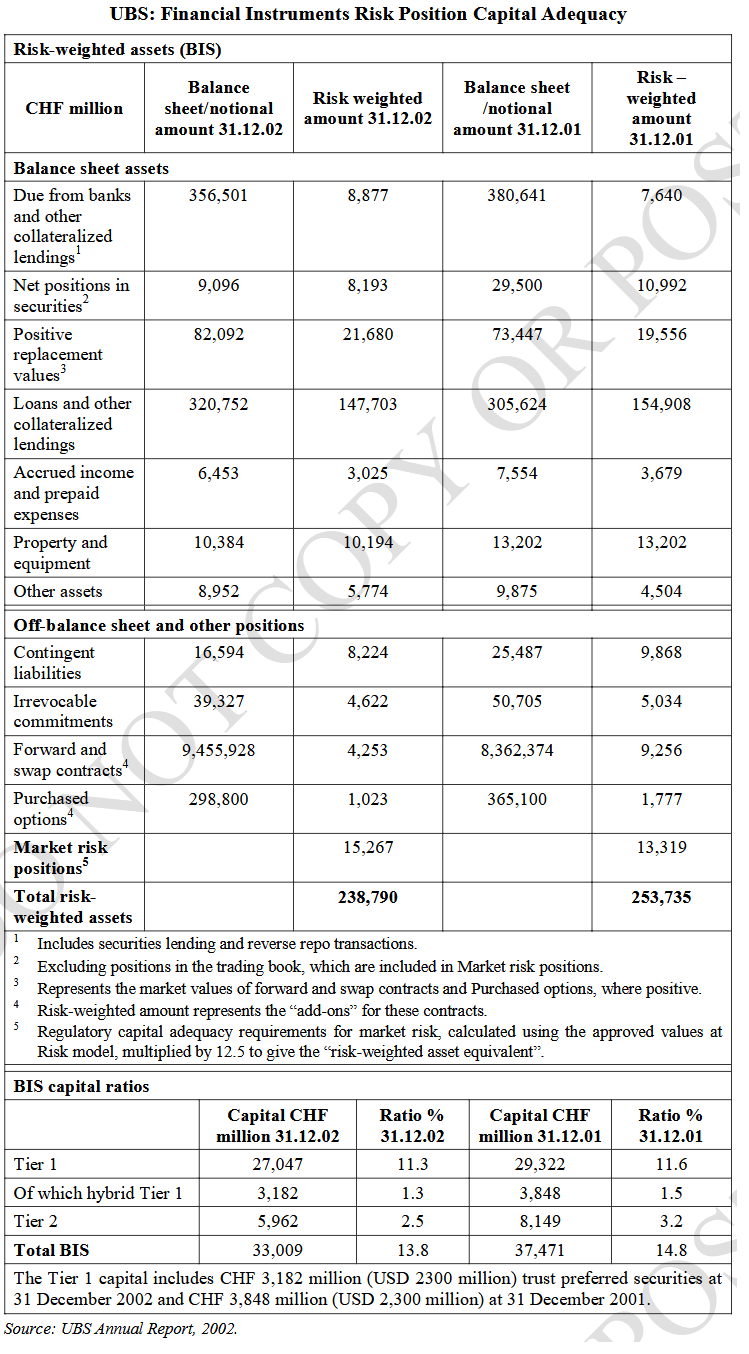 |
Capital was required to support market risk arising in all foreign exchange, precious metals and energy positions, and all positions held for trading in interest rate instruments, equities, and debt. UBS computed this risk using a VaR model approved in 1999 EBK. Unlike the calculations for credit risk and other assets, this produced the capital requirement itself rather than the RWA amount. In order to compute a total capital ratio, the market risk capital requirement was therefore converted to a “RWA equivalent” such that the capital requirement was 8% of this RWA equivalent, i.e., the market risk capital requirement was multiplied by 12.5.
Keywords
UBS, Union Bank of Switzerland, Currency risks, Equity risks, Credit risks, Capital adequacy risks, Interest rate risks, Liquidity risks, Market risk, ERM at Credit Suisse