
Financial Risk Management at ConAgra Foods
🌐 International Buyers — Pay via PayPal
Details
FINA019
16
2003
NO
500
Conagra Foods
Food & Beverage
US
Financial strategy ,Enterprise Risk
Abstract
ConAgra Foods (ConAgra) is the top US food producer. The company owns several famous brands like Banquet, Chef Boyardee, Healthy Choice, and Van Camp’s. ConAgra faces various financial risks: foreign exchange risk, commodity price risk and currency risk. This case outlines these risks and the mechanisms ConAgra employs to deal with them.
Learning Objectives
The case is structured to achieve the following Learning Objectives:
- 0
Contents
ConAgra Foods, a top US food producer, owned several famous brands like Banquet, Chef Boyardee, Healthy Choice, and Van Camp's. It was one of the country's largest food service suppliers and offered shelf-stable foods, seafood, and dairy products. The company offered agricultural products and food ingredients; mill flour and corn; and traded in food commodities. ConAgra offered cold cuts, and poultry under its Butterball, Decker, and Eckrich brands. The company also produced seafood and dairy products such as cheese, desert toppings and margarine. ConAgra had shifted away from its beginnings as a commodity producer and tried to recast itself as "America's favorite food company." It had divested non food-related businesses to focus on newly acquired brands, including Chef Boyardee, Louis Kemp, and PAM, among others. In 2003, ConAgra recorded revenues of $19,839.2 million and a net income of $774.8 million.
Alva Kinney founded Nebraska Consolidated Mills in 1919 by combining the operations of four Nebraska grain mills. The firm did not expand outside Nebraska until it opened a mill and feed processing plant in Alabama in 1942.
Consolidated Mills developed Duncan Hines cake mix in the 1950s. But Duncan Hines failed to capture a large enough market share, and the company sold it to Procter & Gamble in 1956. Consolidated Mills used the proceeds to expand, opening a flour and feed mill in Puerto Rico the next year. In the 1960s, while competitors were moving into prepared foods, the firm expanded into animal feeds and poultry processing. By 1970 it had poultry processing plants in Alabama, Georgia, and Louisiana. In 1971 the company changed its name to ConAgra (Latin for "in partnership with the land"). During the 1970s, it expanded into the fertilizer, catfish, and pet accessory businesses.
Poorly performing subsidiaries and commodity speculation caused ConAgra severe financial problems until 1974, when Mike Harper, a former Pillsbury executive, took over. Harper slashed debt and had the company back on its feet by 1976. But, ConAgra’s focus on the commodities side of the business, resulted in vulnerability to volatile price cycles.
ConAgra moved into consumer food products in the 1980s. It bought Banquet (frozen food, 1980) and within six years had introduced almost 90 new products under that label. Other purchases included Singleton Seafood (1981), Armour Food Company (meats, dairy products, frozen food; 1983), and RJR Nabisco's frozen food business (1986). ConAgra became a major player in the red meat market with the 1987 purchases of E.A. Miller (boxed beef), Monfort (beef and lamb), and Swift Independent Packing.
ConAgra continued with acquisitions of consumer food makers, including Beatrice Foods in 1991. In 1997, the company agreed to pay $8.3 million to settle federal charges of wire fraud and watering down grain. That year ConAgra named VC and president Bruce Rohde as CEO. Rohde became chairman in 1998. The company bought GoodMark Foods, maker of Slim Jim, and Nabisco's Egg Beaters and tablespreads units (Parkay). ConAgra bought Holly Ridge Foods (pastries) in 1999 and announced a major restructuring.
ConAgra bought Emerge, an agricultural and land-use information software provider, from Litton Industries in 2000. It also acquired Seaboard's poultry division and refrigerated meat alternatives maker Lightlife (Tofu pups, Smart Dogs), before buying major brand holder International Home Foods from Hicks, Muse, Tate & Furst for about $2.9 billion. The company then became ConAgra Foods.
During 2001, ConAgra drew SEC attention and was forced to restate earnings for the previous three years due to accounting problems in its United Agri Products division.
Exhibit I
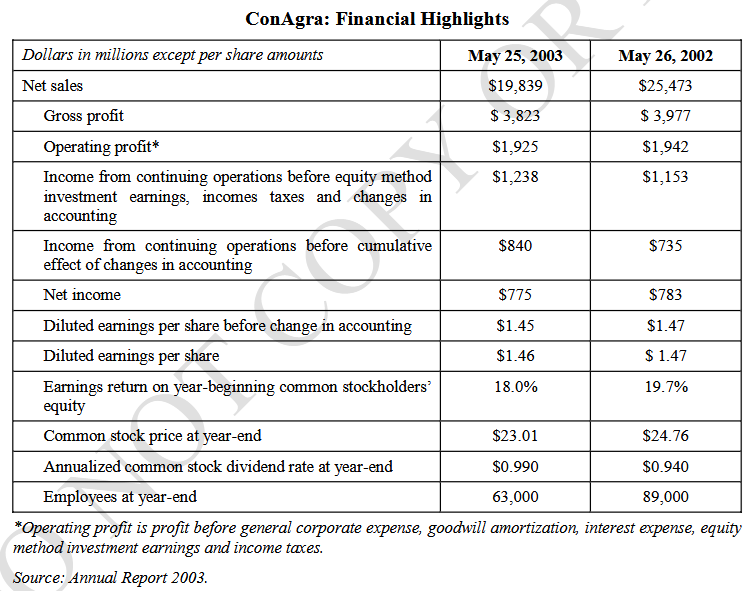 |
In 2002, ConAgra was forced to recall 19 million pounds of ground beef because of possible E. coli contamination, making it the second-largest food recall in US history. Later in 2002 ConAgra sold its fresh beef and pork processing business -- one of the largest in the US -- to Booth Creek Management and Hicks, Muse, Tate & Furst which renamed it Swift & Company.
In 2003, ConAgra sold its Bumble Bee canned seafood business to members of Bumble Bee management and private investment firm Centre Partners Management, and its blue cheese brands (Treasure Cave, Nauvoo) to Canada's Saputo, Inc. for undisclosed prices.
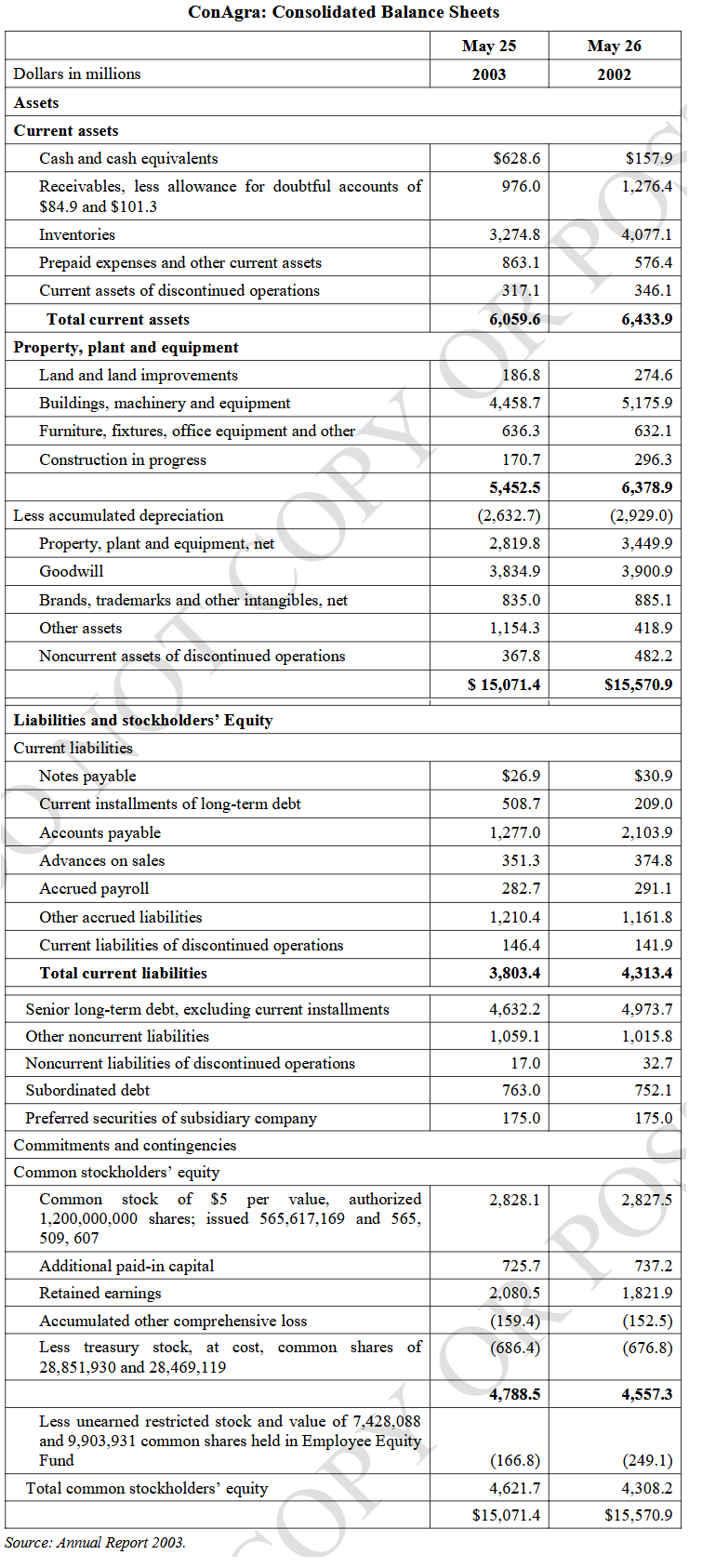
Exhibit II
 |
In 2003, ConAgra agreed to pay $1.5 million in cash and job offers to settle a lawsuit charging bias against disabled workers at the company's California-based Gilroy Foods plant. The agreement involved the largest disability settlement in the agriculture industry. The dispute dated back to 1999, when Gilroy Foods, then owned by Basic Vegetable Products (ConAgra bought the facility in 2000), after a strike failed to recall disabled workers who were on leave of absence due to illness or pregnancy or who had a history of illness or injury.
Packaged Foods
This segment included shelf-stable, frozen and refrigerated foods that were processed and packaged for sales through grocery and convenience stores, mass merchandisers, restaurants, institutions, sports and recreation venues and other retail, deli and foodservice customers. ConAgra offered shelf-stable canned and packaged foods, snacks, condiments and cooking products; processed prepared beef, pork, turkey, poultry, seafood and meat alternative products; tablespreads, egg alternative products and dessert toppings; frozen entreés and side dishes; potato and hand-held products; and pizza products. During fiscal year 2003, ConAgra divested its canned seafood business as well as its processed cheese operations.
Food Ingredients
This segment included Specialty Ingredients, such as dehydrated vegetables and processed garlic and onions; Milled Ingredients, such as flour and oats; and Basic Ingredients, the source of all prepared foods. Specialty Ingredients included dehydrated, controlled moisture and fresh vegetable ingredients as well as processed seasonings, seasoning blends and flavorings. Milled Ingredients included flour, corn and oat milling. Basic Ingredients included grain, oilseeds, feed ingredients, edible beans, livestock, natural gas, crude oil and refined products.
Figure (i)
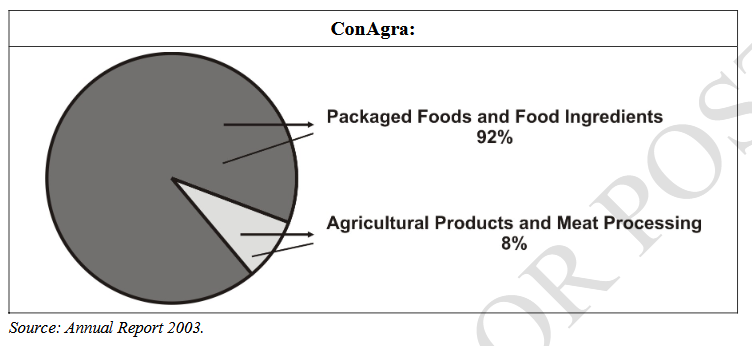 |
Agricultural Products
ConAgra’s Agricultural Products segment reflected the distribution business of United Agri Products, which supplied crop inputs to growers and retailers in nearly every major region across North America as well as overseas markets.
ConAgra distributed crop inputs, such as seeds, crop protection and nutrient products in the United States, Argentina, Bolivia, Canada, Chile, France, Mexico, South Africa and the United Kingdom. Major brands included ACA, Awaken, Biocover, Clean Crop, Dyna-GroTM, LI 700, Loveland, Saber, Savage, Shotgun, Starane, United Horticultural Supply Signature.
Exhibit III
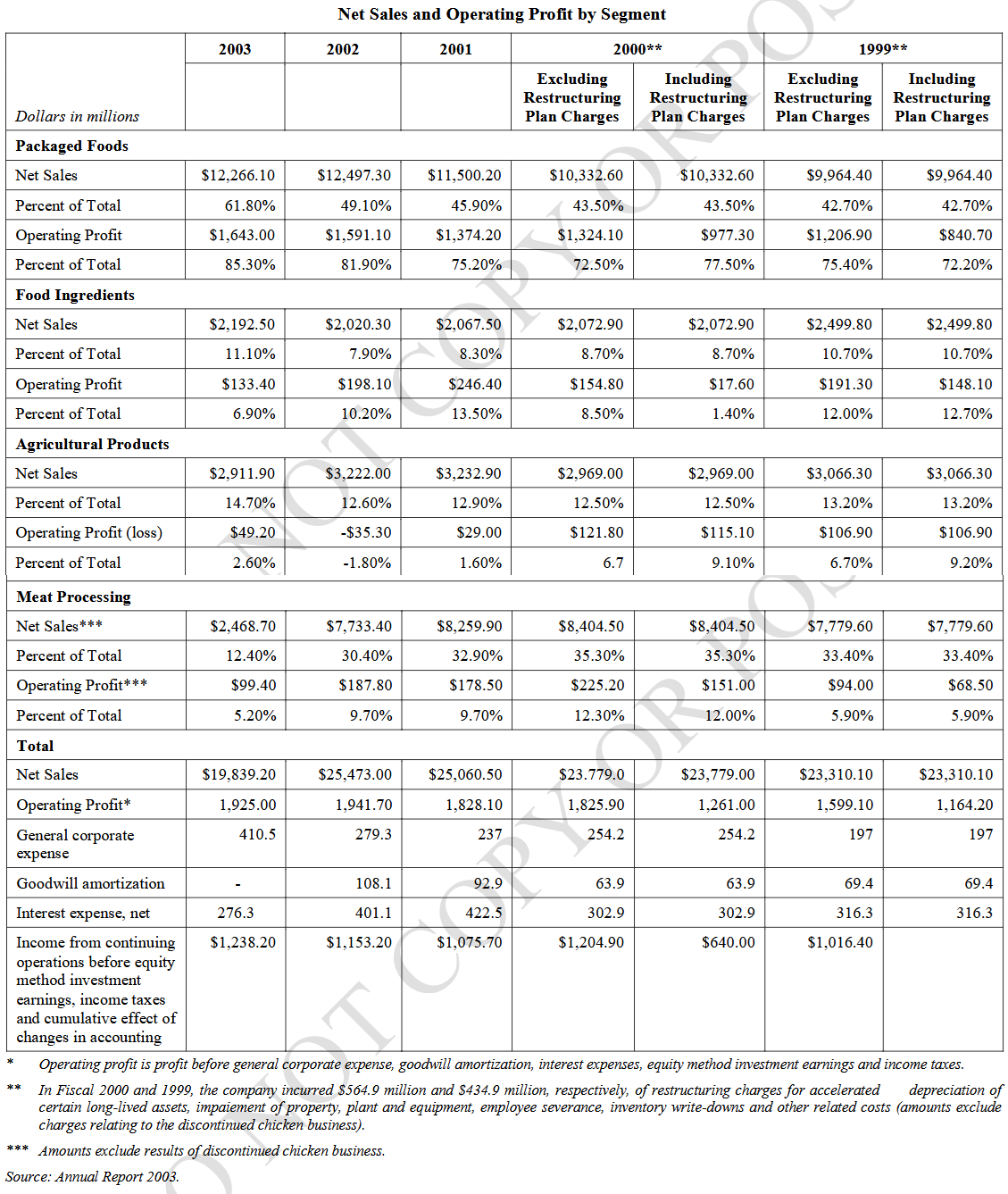 |
Meat Processing
ConAgra completed the sale of a controlling interest in its fresh beef and pork business in September 2002. In June 2003, the company announced the sale of its fresh chicken processing business. The transaction was expected to close in late summer 2003. For parts of fiscal year 2003, however, ConAgra Foods’ Meat Processing segment included the fresh beef and pork operations.
The principal market risks affecting ConAgra were exposures to price fluctuations of commodity and energy prices, interest rates and exchange rates.
Commodity Price Risk
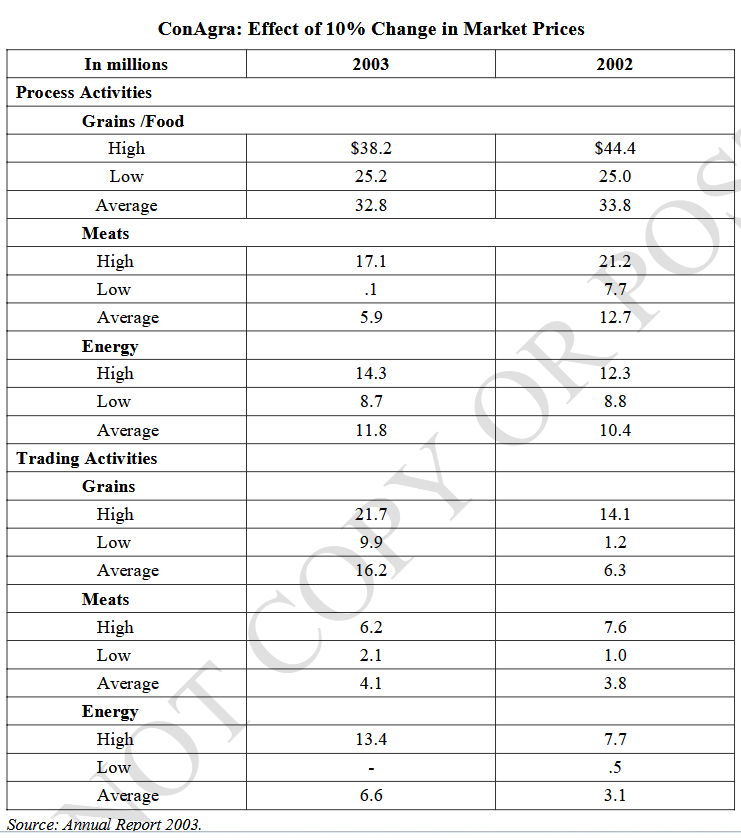
ConAgra purchased various commodities such as wheat, corn, oats, soybean meal, soybean oil, cattle and hogs, energy and packaging materials for use in its operations. These commodities were vulnerable to price fluctuations. The company managed this price risk using physical forward contracts or derivative instruments. Raw material price fluctuations were caused by supply conditions, weather, economic conditions and other factors. Generally, the company utilized commodity futures and options contracts to hedge against price volatility.
ConAgra had policies governing the hedging instruments its businesses might use. These policies included limiting the dollar risk exposure for each of its businesses. The company also monitored the amount of associated counter-party credit risk for all non-exchange-traded transactions. In addition, ConAgra purchased and sold certain commodities such as wheat, corn, soybeans, soybean meal, soybean oil, oats and energy in its trading operations. The company’s trading activities were limited in terms of maximum dollar exposure and monitored to ensure compliance. Fair value was determined using quoted market prices and was based on the company’s net derivative position by commodity at the end of each quarter during the fiscal year. The market risk exposure analysis excluded the underlying commodity positions that were being hedged. ConAgra believed the commodities hedged had a high inverse correlation to price changes of the derivative commodity instrument.
Futures and options contracts qualifying for hedge accounting and used to hedge anticipated transactions were designated as cash flow hedges with gains and losses deferred in accumulated other comprehensive income (OCI), to the extent the hedge was effective. These amounts were recognized within cost of goods sold in the period during which the hedged transaction affected earnings. Any hedge gains or losses deemed ineffective, as well as gains or losses on contracts which did not qualify for hedge accounting, were immediately recognized within sales or cost of goods sold.
Exhibit IV
 |
Interest Rate Risk
ConAgra primarily used interest rate swaps to manage the impact of interest rate changes The company entered into such interest rate swaps to take advantage of historically low short-term rates, while continuing to maintain long-term financing. For 2003, net interest expense was $276 million, 31% below 2002 amounts, primarily due to lower interest rates, increased interest income and reduced outstanding debt amounts. Through the use of interest rate swaps to effectively convert fixed-rate debt to floating rate debt, the company benefited from lower interest rates as compared to 2002. Also contributing to the reduced interest expense in 2003 was the company’s reduction of $222 million of debt with cash proceeds generated by divestitures completed during the year. The increased interest income resulted from the company holding debt securities issued by the fresh beef and pork joint venture in which the company held a minority interest As on May 25, 2003 and May 26, 2002, the fair values of the interest rate swap agreements recognized in prepaid expenses and other current assets were approximately $220 million and $29.4 million, respectively, while the fair values of interest rate swap agreements recognized in other accrued liabilities were approximately $52 million and $0, respectively. As on May 25, 2003, a one percentage point increase/decrease in interest rates would have decreased/increased the fair value of the interest rate swap agreements by approximately $37 million. For May 26, 2002 the corresponding figure was $89 million.
As on May 25, 2003 and May 26, 2002, the fair value of the company’s fixed rate debt was estimated at $6.3 billion and $5.7 billion, respectively, based on current market rates primarily provided by outside investment advisors. As on May 25, 2003 and May 26, 2002, a one percentage point increase in interest rates would have decreased the fair value of the company’s fixed rate debt by approximately $428 million and $383 million, respectively. A one percentage point decrease in interest rates would have increased the fair value by approximately $490 million and $437 million, respectively. With respect to floating rate debt, the impact of a one percentage point change in interest rates on net interest expense would have been approximately $11 million and $14 million in fiscal 2003 and 2002, respectively.
As on May 25, 2003 and May 26, 2002, the company had interest rate swap agreements outstanding with notional amounts totaling $2.5 billion and $2 billion, respectively. $2 billion of interest rate swaps were used to effectively convert some of the company’s fixed rate debt into floating rate debt. These interest rate swaps were accounted for as fair value hedges and resulted in no recognition of ineffectiveness in the income statement as the interest rate swaps’ provisions matched the applicable provisions of the hedged debt. As on May 25, 2003, $500 million of the company’s interest rate swaps were used to hedge some of the company’s forecasted interest payments for floating rate debt for the period of 2005 through 2011. These interest rate swaps were accounted for as cash flow hedges with gains and losses deferred in OCI, to the extent the hedge was effective. Any ineffectiveness associated with the interest rate swaps was immediately recognized in earnings within interest expense. The company did not have any interest rate swaps accounted for as cash flow hedges as on May 26, 2002.
Currency Risk
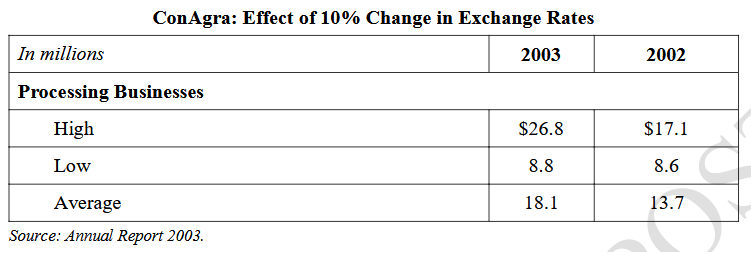
In order to reduce foreign currency exposures, ConAgra might enter into forward exchange or option contracts for transactions denominated in a currency other than the functional currency. This activity primarily related to hedging against foreign currency risk in purchasing inventory, capital equipment, sales of finished goods and future settlement of foreign denominated assets and liabilities.
Fair value was determined using quoted exchange rates and was based on the company’s net foreign currency position at end of each quarter during the fiscal year. The market risk exposure analysis excluded the underlying foreign denominated transactions that were being hedged. ConAgra believed the currencies hedged had a high inverse correlation to exchange rate changes of the foreign currency derivative instrument. The market risk exposure related to the company’s trading operations was not material to the company’s results of operations or financial position.
Exhibit V
 |
Hedges of anticipated foreign currency-denominated transactions were designated as cash flow hedges. The gains and losses associated with these hedges were deferred in OCI until the forecasted transaction had an impact on earnings. Forward exchange and option contracts were also used to hedge firm commitment transactions denominated in a currency other than the applicable functional currency. The firm commitments and foreign currency hedges were both recognized at fair value within prepaid expenses and other current assets or other accrued liabilities. Gains and losses associated with firm commitment and foreign currency hedges were recognized within net sales, cost of goods sold or selling, general and administrative expenses, depending on the nature of the transaction. Foreign currency derivatives that the company, believed did not qualify for hedge accounting were recorded immediately in earnings within sales, cost of goods sold or selling, general and administrative expenses, depending on the nature of the transaction.
The fair value of each derivative was recognized in the balance sheet within current assets or current liabilities. Changes in the fair value of derivatives were recognized immediately in the income statement for derivatives that did not qualify for hedge accounting. For derivatives designated as a hedge and used to hedge an existing asset or liability, both the derivative and hedged item were recognized at fair value within the balance sheet with the changes in both these fair values being recognized immediately in the income statement. For derivatives designated as a hedge and used to hedge an anticipated transaction (e.g., future purchase of inventory), changes in the fair value of the derivatives were deferred in the balance sheet within OCI to the extent the hedge was effective in mitigating the exposure to the related anticipated transaction. Any ineffectiveness associated with the hedge was recognized immediately in the income statement. Amounts deferred within OCI were recognized in the income statement in the same period during which the hedged transaction affected earnings (e.g., when hedged inventory is sold). Unless otherwise specified, the company believed the carrying value of financial instruments approximated their fair value.
The fair value of derivative assets was recognized within prepaid expenses and other current assets, while the fair value of derivative liabilities was recognized within other accrued liabilities. As on May 25, 2003 and May 26, 2002, the fair value of derivatives recognized within prepaid expenses and other current assets was $325.5 million and $106.8 million, respectively, while the amount recognized within other accrued liabilities was $84.5 million and $35.4 million, respectively. As on May 25, 2003 and May 26, 2002, the fair value of derivatives recognized in current assets of discontinued operations was $2.3 million and $1.9 million, respectively. For fiscal 2003 and 2002, the ineffectiveness associated with derivatives designated as cash flow and fair value hedges from continuing operations resulted in a loss of $1.6 million and $6.4 million, respectively. Hedge ineffectiveness was recognized within net sales, cost of goods sold or interest expense, depending on the nature of the hedge. For fiscal 2003 and 2002, the ineffectiveness associated with derivatives designated as cash flow and fair value hedges from discontinued operations led to a gain of $2.3 million and $0.5 million, respectively. The company did not exclude any component of the hedging instrument’s gain or loss when assessing effectiveness.
Generally, ConAgra hedged a portion of its anticipated consumption of commodity inputs for periods up to 12 months. The company might enter into longer-term hedges on particular commodities if deemed appropriate. As on May 25, 2003, the company had hedged certain portions of its anticipated consumption of commodity inputs through March 2005.
As on May 25, 2003 and May 26, 2002, the net deferred loss recognized in OCI was $23.5 million and $19.5 million, net of tax, respectively. Fiscal 2002 included the impact of the cumulative effect of change in accounting principle. The company anticipated that a gain of $9.9 million, net of tax, would be transferred out of OCI and recognized within earnings over the next 12 months and a loss of $33.4 million, subsequent to the next 12 months. A $3.7 million gain on loss and $24.5 million loss, net of tax, was transferred from OCI into income from continuing operations in fiscal 2003 and fiscal 2002, respectively. The corresponding figures for discontinued operations were, a $4.0 million gain and $4.3 million loss respectively.
For fiscal 2003, the company recognized a total of $5.1 million gain within sales and cost of goods sold and a $3.2 million loss within selling, general and administrative expenses related to discontinued cash flow hedges. These hedges were no longer probable as a result of the fresh beef and pork divestiture and the canned seafood divestiture. The company did not discontinue any cash flow hedges or firm commitments during fiscal 2002.
Trading Activities
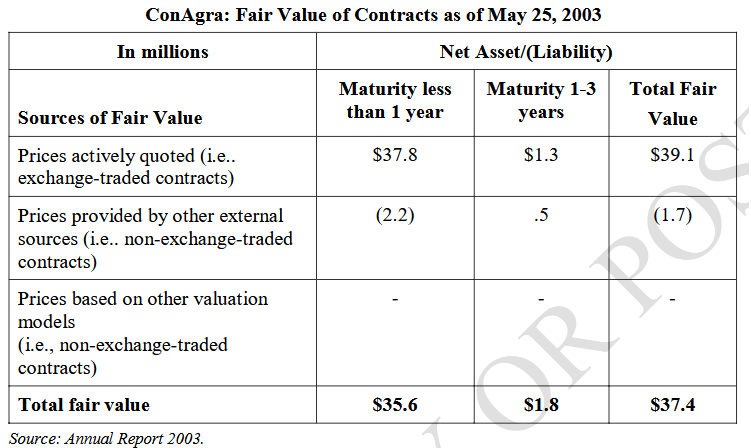
ConAgra accounted for certain contracts (e.g., “physical” commodity purchase/sale contracts and derivative contracts) at fair value. The company considered a portion of these contracts to be its “trading” activities; specifically, those contracts that did not qualify for hedge accounting under FAS No. 133.
Exhibit VI
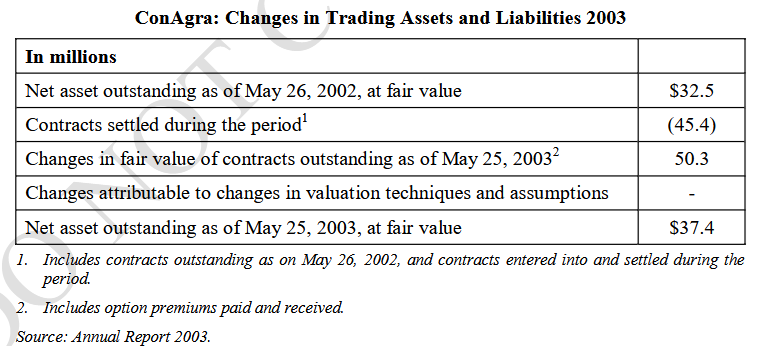 |
Exhibit VII
 |
Accounting for Financial Instruments under US GAAP
FAS-133
With the development of new and sophisticated financial instruments, relevant accounting standards had also evolved. In case of derivative instruments, accounting was more complicated as significant periods often elapsed between execution and performance of contracts. FAS-133, the accounting standard for derivative instruments and hedging activities was issued in 1998. The effective date for the rollout of FAS-133 was delayed till June 15, 2000 by FAS-137. FAS-133 was subsequently amended by FAS-138.
FAS-133 had been formulated on the basis of a few fundamental principles. Derivative instruments essentially resulted in assets and liabilities. All derivatives needed to be shown at fair value on the balance sheet as either asset or liability. The differences in fair values had to be adjusted periodically. The method of adjustment would vary depending on whether the derivative instrument was hedging an underlying exposure or not. To be considered a hedging transaction, certain criteria had to be fulfilled. There had to be an effective hedging relationship between the item to be hedged and the accounting instrument at the initiation of the hedge and throughout the life of the hedge. A company had to define hedge effectiveness and stick to the criteria.
Derivative instruments were classified into four categories under FAS-133. No hedge, fair value hedge, cashflow hedge and foreign currency hedge. For each of these categories, FAS-133 prescribed different ways of accounting. If an instrument did not qualify as a hedge, the change in fair value had to be recognized in net income.
Fair value hedges aimed at reducing the risk of changes in value of a recognized asset or liability or an unrecognized firm commitment. In case of a fair value hedge, both at the inception and on an ongoing basis, the hedging relationship had to be effective in achieving offsetting changes in fair value attributed to the hedged risk. Such an assessment was required whenever financial statements or earnings were reported and at least every three months. Changes in value of both the derivative used for hedging and the hedged item were recognized in current earnings.
Cashflow hedges aimed at reducing the variability of cash inflows & outflows. They were applied to both contractual cashflows related to an existing asset or liability and forecasted transactions. In case of a cashflow hedge, the hedging relationship aimed at offsetting cashflows attributable to the hedged risk. An assessment was required on the effectiveness of hedging when financial statements or earnings were reported and at least every three months. If a hedging instrument was used to modify cashflows on account of interest, the instrument had to establish a clear link between the underlying assets and liabilities. The effective portion of the gain or loss on a derivative designated as cashflow hedge was reported in Other Comprehensive Income (OCI). The ineffective portion was reported in earnings. Amounts in accumulated OCI were reclassified into earnings in the same period in which the hedged forecasted transaction affected earnings.
In case of a hedged item being denominated in a foreign currency, there could be three types of hedges – fair value (as explained earlier), cashflow (as explained earlier) and hedge of a net investment in a foreign operation. The change in fair value of a derivative instrument that qualified as a hedge of a net investment in a foreign operation was reported in OCI and remained as part of Accumulated OCI.
FAS-115
FAS-115 dealt with the accounting and disclosure standards for debt and equity securities. A debt security represented a creditor relationship with an enterprise. An equity security represented an ownership interest in an enterprise. FAS-115 covered investments in equity securities that had readily determinable fair values and all investments in debt securities.
FAS-115 required enterprises to classify securities into three categories: held-to maturity, trading and available-for-sale. A security qualified for held-to maturity category only if the enterprise had a clear intent and ability to hold it to maturity. Trading securities (both debt and equities) were those, held for a short period of time with the hope of gaining from the investment. Available-for- sale securities (both debt and equity) fell somewhere between these extremes.
Investments in securities classified as trading or available-for-sale had to be carried at fair value in the balance sheet. Unrealised holding gains or losses represented the net change in the fair value of a security, excluding dividend or interest income recognized but not received and any write-downs for permanent impairment. Unrealised holding gains and losses were included in earnings in case of trading securities; d reported in shareholders’ equity as OCI in case of available-for-sale securities. In case of held-to maturity securities, (which applied only to debt), the cost was amortized.
FAS-107
This standard established specific disclosure requirements and procedures to be followed while estimating the fair value of financial instruments. Fair value was defined as the amount at which the instrument could be exchanged in a current transaction between willing parties, not in a forced or liquidation sale.
In general, fair value could be computed if:
- there was a published price quotation for it in an active public securities market.
- it was a debt instrument rated by an independent rating agency, and its cashflows could be reasonably estimated.
- there existed an appropriate valuation model, and the data inputs required could be measured reliably because they came from active markets.
Quoted market prices, if available, were considered to represent the best value of financial instruments. Otherwise, the fair value could be estimated on the basis of quoted price of a similar instrument or by using valuation techniques. For example, the fair value of a loan could be arrived at by calculating the present value of future cashflows, using a risk adjusted discount rate.
FAS-107 disclosures did not apply in case of financial instruments covered by other pronouncements. Thus, they did not include items such as minority interests in consolidated subsidiaries and an entity’s own equity instruments included in stockholders’ equity. They did not apply to leases and warranties. They also did not apply to trade receivables and payables unless their carrying values did not reflect fair values.
FAS-119
This standard encouraged companies to disclose quantitative data about foreign exchange, interest rate, commodity price or other market risks of derivatives, consistent with the company’s risk management strategies. Various approaches to make these disclosures had been suggested
- Information on current positions, such as time maturity profiles, contract rates, indexes and provisions of contract.
- Hypothetical changes in market prices and their impact on net income and equity.
- Gap analysis to measure interest rate risk associated with repricing of assets and liabilities at their maturity.
- Duration of financial instruments-Duration could be thought of as the life, in years, of a zero coupon bond whose fair value would change by the same amount as the real bond or portfolio in response to a change in market interest rates.
- Value at risk-This was a measure of the maximum loss a portfolio would suffer over a defined time horizon at a specified confidence level.
Keywords
ConAgra Foods, Financial risk, Financial risk management, Food producer, Meat processing, Packaged foods, Food ingredients, Market risk, Commodity price risk, Interest rate risk, Currency risk, Financial instruments, US GAAP, generally accepted accounting principles, Fair value hedges, Cashflow hedge