
Co-operative Bank Scams in India
🌐 International Buyers — Pay via PayPal
Details
FINC021
8
2003
YES
300
Not Applicable
Banking
India
Regulatory Environment,Enterprise Risk
Abstract
The case, “Cooperative Bank Scams in India” gives an insight into the various scams and malpractices in cooperative banks in India and their implications on the Indian financial sector. The case begins with a history of co-operative banking in India. It briefly describes the structure of cooperative banks and their characteristics. The case then discusses in brief the scams that surfaced in four co-opera-tive banks, viz., Madhavpura Mercantile Co-operative Bank (MMCB), Krushi Co-operative Urban Bank (KCUB), Charminar Cooperative Urban Bank (CCUB) and Nagpur District Central Cooperative Bank (NDCCB) in 2001-02. The case also discusses how to revive the functioning of cooperative banks in India.
Learning Objectives
The case is structured to achieve the following Learning Objectives:
- Scams in the cooperative banks in India
- Banking regulation.
Contents
“The objective of co-operative banking is to create enduring and sustainable financial institutions which remain responsive to the credit needs of weaker sections.”
-RBI Report on Trend and Progress of Banking in India, 2000-01.
“There has been a mushrooming of co-operative banks in the country. Low barriers to entry spurred individuals with vested interests to start such banking ventures with a view to milk the depositors funds.”
-Suresh Hemmady, chairman of the Shamrao Vithal Cooperative Bank.
“They are non cooperatives under the camouflage of cooperatives.”
-Rama Reddy, President of Hyderabad based Cooperative Development Foundation.
Cooperative banks were established in India to facilitate rural credit, and to cater to the needs of small farmers and businessmen. They were popular with middle and lower income groups because of the high interest rates they offered as compared to commercial banks. However, with the passage of time, most cooperative banks lost their purpose. Excessive state control and politicisation further led to their deterioration. By the 1990s, none of the public or private sector banks were willing to deal with cooperative banks and thus even otherwise healthy cooperative banks were facing a tough time.
In 2001-2002, many cooperative banks were rocked by scams that exposed the malpractices in these banks. Many of these banks did not adhere to the prudential norms prescribed by the Reserve bank of India (RBI). The Madhavapura Mercantile Cooperative Bank (MMCB) had invested a huge amount in the equity market which was almost equal to its deposit base, thus, violating the RBI norms relating to exposure to the equity market. Another bank, the Krushi Cooperative Urban Bank (KCUB) had issued loans and advances amounting to Rs. 530 million as against its deposit base of Rs. 350 million. Not only that, most of its loans had not been secured. Similarly, the Charminar Cooperative Urban Bank (CCUB) faced liquidity problems due to indiscriminate lending to big borrowers against worthless land. More recently the Nagpur District Central Cooperative Bank (NDCCB) was involved in fraudulent dealings in government securities through brokers.
In the early 20th century, the availability of credit in India, more particularly in rural areas was non existent. There was no organized institutional credit for agricultural and related activities. People in the rural areas largely depended on money lenders who lent money at very high rates of interest. Thus, there was need to create an institution which would cater to the needs of ordinary people and was based on the principles of cooperative organisation and management. In 1904, the first legislation on co-operatives was passed. In 1914, the Maclagen committee suggested a three tier structure for cooperative banking i.e Primary Agricultural Credit Societies at the grass root level, Central Cooperative Banks at the district level and State Cooperative Banks at the State or apex level. Cooperative banks were expected to serve as substitutes for money lenders, and provide both short-term and long-term institutional credit at reasonable rates of interest.
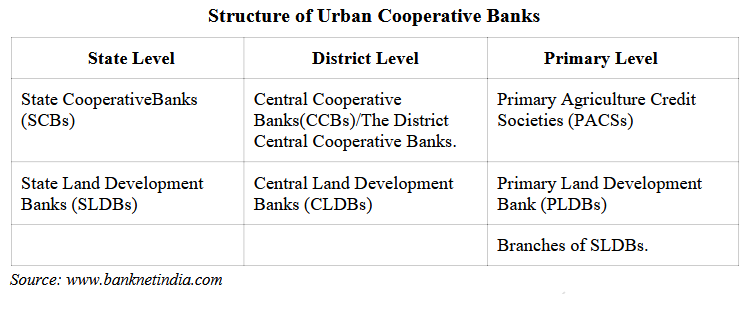
Cooperative banks operate both in urban and non-urban centers (Refer Table I for characteristics of Cooperative banks). The urban areas are served by the Primary (Urban) Cooperative Banks (PCBs/UCBs) whereas the rural areas are largely served by two sets of institutions, the PACSs and LDBs, dispensing short-term and long-term credit, respectively. UCBs have a three-tier structure with the State Cooperative Banks (SCBs) at the apex level, the District Central Cooperative Banks (CCBs) at the intermediate level and the Primary Agricultural Credit Societies (PACS) at the grass root level (Refer Table II). Under the long-term credit structure, State Cooperative Agriculture and Rural Development Banks (SCARDBs) are at the apex level and the Primary Cooperative Agriculture and Rural Development Banks (PCARDBs) are at the base level. UCBs are regulated by the RBI as well as the Registrar of Cooperative Societies of the state where they are located. District and state level cooperative banks also report to the National Bank for Agriculture and Rural Development (NABARD).
Table I
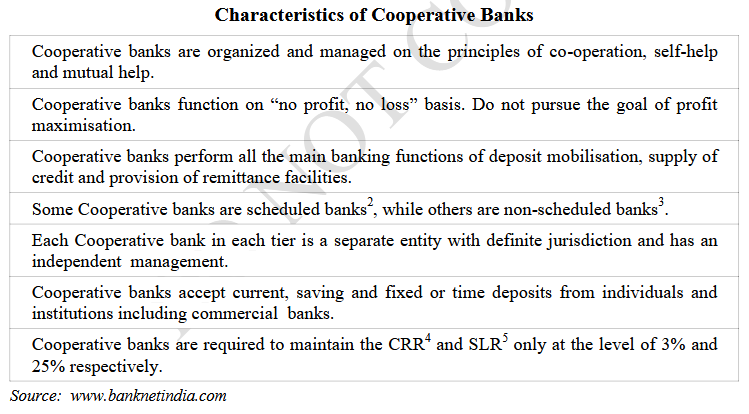 |
Table II
 |
PACS is an association of borrowers and non-borrowers residing in a particular locality. The sources of funds for PACS are share capital and deposits of members and loans from central cooperative banks. The members and the credit societies have fixed borrowing power. The loans are given to members for the purchase of cattle, fodder, fertilizers, pesticides, implements, etc.
CCBs are federations of primary credit societies in a district. They are of two types: those having a membership of primary societies only and those having a membership of societies as well as individuals. The sources of funds for CCBs are share capital, deposits, loans and overdrafts from state cooperative banks and joint stocks. Financing member societies depend on the borrowing capacity of societies.
SCB is a federation of central cooperative banks and is a regulator of the cooperative banking structure in the state. The sources of funds are share capital, deposits, loans and overdrafts from the RBI. SCBs lend money to CCBs and PACSs and not directly to farmers.
LDBs (Land Development Banks) are organized at the state, central and primary (district) level. They meet the long term credit requirements of farmers for developmental purposes. SLDBs are governed both by the state government and RBI. The sources of funds are debentures subscribed by both central and state governments. SLDBs do not accept deposits from the general public.
The number of UCBs increased from 1106 in the late 1960s to 2050 in March 2000. Almost 80% of UCBs were located in Gujarat, Maharashtra, Karnataka, Tamil Nadu and Andhra Pradesh and accounted for 75% of their deposit resources. In March 2000, the aggregate deposits and outstanding advances of UCBs were Rs. 285.45 billion and Rs. 172.85 billion respectively. Off late, cooperative banks have been subject to the influence of petty political scheming. Irregularity in financial activities and gross mismanagement have led to several problems. As borrowers and not depositors are members of cooperative banks, they can freely use the funds from these banks. Another problem associated with cooperative banks is that most of the members of these banks are from a single industrial sector. If the sector does not perform well, so do the banks. The dual control on cooperative banks also poses to be a hindrance in regular functioning. Moreover, penalties are abnormally low in cooperative banks. For any scam the maximum penalty is Rs. 200 a day. Another problem with cooperative banks is that they can't be liquidated. In May 1999, RBI appointed a High Power Committee under the Chairmanship of Shri K. Madhava Rao, Ex-Chief Secretary, Government of Andhra Pradesh to review the performance of cooperative banks. The Committee identified five broad objectives:
1. Preserving the cooperative character of UCBs.
2. Protecting depositors' interest, reducing systemic risks to the financial system.
3. Ensuring strong regulatory norms at the entry level to sustain the operational efficiency and evolving measures to strengthen the existing cooperative banking structure.
4. Aligning the cooperative banking sector with the other segments of banking sector.
5. Applying prudential norms and removing the problems associated with dual control regime.
RBI accepted most of the recommendations of the Committee but those requiring legislative action at the state level remained pending. Analysts feel that the regulation and supervision of cooperative banks is difficult as the administrative and management control is in the hands of the state government. Thus, to undertake corrective measures, the RBI and NABARD have to approach the state governments and any suggestion which does not go down well with politicians or bureaucrates is often ignored.
MMCB was established on October 10, 1968 in Ahmedabad, Gujarat, to cater to the varied financial needs of wholesale grocery traders in Ahmedabad's Madhavpura spice market. The bank was awarded the status of a scheduled bank in 1999, which permitted it to expand its banking activities outside Gujarat. MMCB had 22 branches and was undertaking regular banking activities. It had a deposit base of Rs. 10.56 billion in 1999-00, of which Rs. 6 billion was from other cooperative banks and organizations, while the rest was from the public. The bank received huge deposits after being awarded the status of a scheduled bank by RBI.
KCB, a Hyderabad based bank was registered on April 1, 1998. On March 31, 2000, the bank had a paid-up share capital of Rs. 10.2 million. Its deposits comprised 92.41% term deposits, 5.42 % current deposits and 2.17 % savings deposits. The bank reported a deposit base of Rs 350 million as on June 30, 2001. The bank had targeted a deposit base of over Rs. 1 billion for the year ended March 31, 2001.
CCUB was founded on September 7, 1985 in Hyderabad. One of the aims of the bank was to attract deposits from domiciles of Hyderabad working in Saudi Arabia and other Gulf countries. The bank had a deposit base of Rs. 3 billion in 2001.
In 2001, MMCB was rocked by a scam. The bank had lent Rs. 10.5 billion to the equity market. There was no security or collateral issued against the money taken as a loan. This exposure was almost equivalent to its deposit base of Rs. 10.56 billion in the fin ancial year 1999-2000. Its advances during the year were Rs. 7.78 billion. The bank violated the RBI norms which stated that a bank's exposure to the stock market cannot exceed 5 % of its outstanding loans. Panicky depositors began withdrawing money on hearing reports that the bank had lent heavily in capital markets and that these loans had turned difficult to deal with, due to a steep fall in share prices.
Only three entities accounted for the 10.5 billion. No security or collateral was deposited with the bank. While Rs. 8.3 billion was lent to stock broker Ketan Parekh and his companies, Rs. 2 billion and Rs. 20 million were lent to Bombay Stock Exchange (BSE) broker, Mukesh Babu, and the Maniar group respectively. Ketan and his associate companies had siphoned off funds through 10 accounts. Mukesh Babu maintained five accounts while the Maniar Group had three accounts.
TABLE III
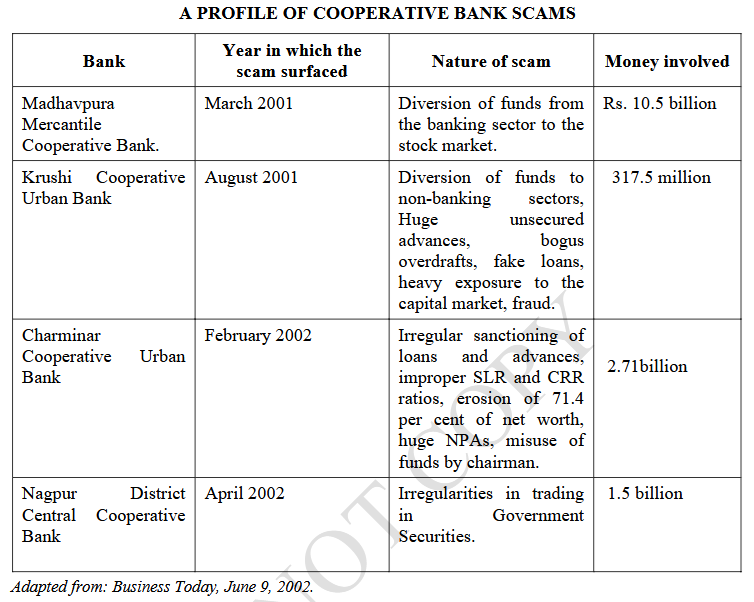 |
In 2001, the KCB was also involved in a major scam. The bank had extended loans and advances of over Rs. 530 million as against the deposit base of Rs. 350 million. The non-performing assets of the bank were estimated around Rs. 330 million, which amounted to over 60 per cent of its total loans and advances. KCB extended large amount of advances to four of its directors, including the Chairman and Vice-Chairman, without obtaining sufficient security against the loans. Its exposure to the capital market was to the tune of over Rs. 20 million.
There were also bogus overdrafts totaling to Rs.200 million, besides fake education and vehicle loans amounting to Rs. 60 million. Most of the overdraft accounts and loans were not adequately secured. Sixty seven per cent of loans and 53 per cent of net demand and time liabilities (NDTL) had not been secured, against RBI stipulated limits of 33.3 per cent of NDTL. Ironically, when RBI scrutinized the bank accounts in March 2001, it gave it a clean chit. The officials of Registrar of Cooperative Societies had categorized the bank as „A' among cooperative banks and a penalty of over Rs. 3-3.5 million was waived for non-compliance with statutory liquidity ratio (SLR) norms.
Noticing that the bank's advances were much more than the stipulated levels, RBI issued instructions to reduce its NPA levels and advances to its directors to less than 10% before September 30, 2001. The bank had not followed any of these directions. It diverted its funds to `non-banking' sectors such as real estate, cinema, and stock markets. The bank's directors especially the Chairman seemed to have used the bank as a convenient vehicle to amass wealth. CCUB was into a serious crisis after its Chairman, Almdar Hussain Sajjad Aga committed suicide in February 2002. The chairman and directors of the bank had committed several irregularities in sanctioning loans and advances. People were lured with an offer of 14.5% interest in contrast to the meagre 6 to 7 % interest being offered by public sector banks. The bank advanced a huge amount of Rs. 2.71 billion, nearly 1.85 billion of it without sufficient securities and guarantees.
The bank was not maintaining its CRR ans SLR requirments adequately. As per RBI guidelines, the bank should have had a CRR of Rs. 180 million, but it only had Rs. 10.4 million. It should have Rs. 842 million as SLR but it had only Rs. 47 million. The bank should have maintained Rs. 38.6 million as cash in hand but it had only Rs. 20 million. There were serious lapses and deficiencies in its functioning. The financial position of the bank was unstable since March 2001. Its net worth had depleted by 71.4 per cent. Its gross NPAs were estimated at Rs. 632 million which accounted for 23.2 per cent of its total loans and advances of Rs. 2.71 billion. The bank's loan policies and credit appraisal systems were also unsatisfactory. Most of the advances were extended against land and buildings for construction purposes to a limited number of borrowers. A large number of properties offered for mortgage were said to have been overvalued at the time of sanctioning loans.
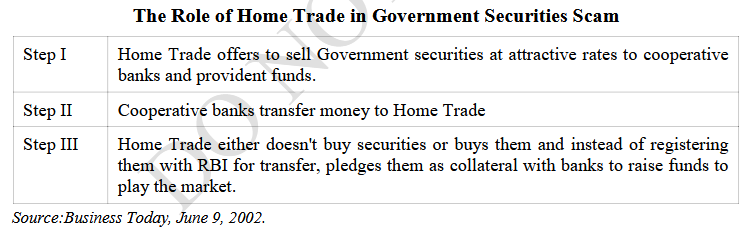
The NDCCB came into limelight in April 2002, with the Government securities scam which involved the stock trading portal, Home Trade.6 Home Trade, and a few cooperative banks entered into certain transactions on government securities. Home Trade and its affiliates lured a few cooperative banks including the NDCCB, by promising them 2 to 7% higher returns on investment in Government securities. According to RBI norms, the purchase of government securities through a single broker should be limited to 5 % of the total value of such purchases and no money should be credited to the broker's account. Having violated these norms, Home Trade claimed to have bought government securities for the bank which was never delivered. In April 2002, NDCCB lodged a complaint against Home Trade and four other brokers on charges of cheating. Home Trade was operating illegally and did not have wholesale debt market memberships as required under the law. The money was used in the stock market to trade in shares of companies in which Home Trade had a stake.
Table IV
 |
Cooperative banks have for long been the back bone of rural banking. Since their inception, they have been doing excellent work in the field of rural and cooperative banking. The recent scams in cooperative banks have been a jolt to cooperative banking system. Many analysts have suggested that cooperative banks should be brought under the complete control of RBI ending the dual control by the State governments and RBI-NABARD. According to N. Patel, Vice-Chairman of Gujarat Urban cooperative Banks Federation, control by a single authority will ensure smooth governance of cooperative banks. Some analysts also feel that interference from the registrar of cooperatives should be minimized.
Though various committees have conducted in-depth studies of different aspects of the co-operative credit structure (Madhavarao Committee on UCBs, 1999, Jagdish Capour Task force on Cooperative credit system, 2000, and U. S. Vyas Group on Rural Credit, 2001), none of these committees seemed to have addressed the basic issues ailing the cooperative banks.
A large number of cooperative institutions accept sizable deposits from non-members. In some states they use the word 'bank' as part of their name, to give the public an impression that keeping deposits with them was as safe as keeping deposits with other banks. Analysts feel that there should be an ammendment in the Banking Regulation Act to prohibit this practice. Analysts also feel that periodical review of interest rates offered by cooperative banks in comparision with the market trends should be taken up by the state governments. Cooperative institutions should be allowed to diversify their activities to cross supplement their lending activities.
According to the suggestions given by the RBI, the Government should set up a new apex supervisory body which would be under the control of a separate high-level supervisory board consisting of representatives of the Central Government, State Governments, RBI, as well as experts. It would ensure the cooperative banks' conformity with prudential norms, capital adequacy and risk-management norms laid down by RBI. Rehabilitation of sick and ailing cooperative banks would involve strategies like directing cooperative courts to undertake speedy recovery process, executing decrees, relocating or closing down unviable branches, exploring avenues for additional capital, or merging with a well managed bank.
The norms of capital adequacy, when applied to cooperative banks will make cooperative banking move closer to commercial banking with respect to the regulatory mechanisms. The various initiatives being adopted to strengthen the competitive edge of cooperative banks in the market include total quality control initiatives, management initiatives and cost reduction initiatives. The cooperative banking sector has come to occupy a formidable place in the Indian financial system. However, sustenance of its growth, depends on the professionalism of its management, inculcating good corporate governance, technology absorption and scrupulous adherence to regulatory framework. Elements of good corporate governance, sound investment policy, appropriate internal control systems, improved credit risk management, focus on areas like micro finance, efficient customer service and adequate mechanisation will help cooperative banks withstand these challenges.
1. Cooperative banks were established to contribute to the development of rural economy in India. However, these banks do not seem to have contributed much to the development of the rural economy. What according to you are the reasons for the failure of cooperative banks and their mismanagement?
2. In 2001-02, many scams surfaced in cooperative banks. What were the reasons for scams in different cooperative banks? What measures do you suggest to prevent such scams happening in the future?
3. Cooperative Banks are under the dual control of the RBI-NABARD and the Registrar of Cooperative Societies. Do you think the end of dual control would result in proper administration and management of cooperative banks? Explain with reasons.
Keywords
Cooperative Bank Scams in India, scams, malpractices, cooperative banks, India, Indian financial sector, structure, cooperative banks, four cooperative banks, Madhavpura Mercantile Cooperative Bank, MMCB, Krushi Cooperative Urban Bank, KCUB, Charminar Cooperative Urban Bank, CCUB, Nagpur District Central Cooperative Bank, NDCCB, 2001-02
Related Case Studies
| Case Title | Details | Price | Add to Cart |
|---|---|---|---|
|
Case Title Digital Vulnerabilities in the Global Supply Chain: The Jaguar Land Rover Cyber AttackCase Code: OPER170 |
Details | 500 | Add to Cart |
|
Case Title The IndiGo Crisis in 2025: Lessons in GovernanceCase Code: BECG201 |
Details | 300 | Add to Cart |
|
Case Title IndiGo Airlines: Business Model Efficiency or Operational Resilience?Case Code: CLBS176 |
Details | 300 | Add to Cart |
|
Case Title Can Kelly Ortberg help Boeing Navigate through its Troubles?Case Code: HROB292 |
Details | 500 | Add to Cart |
|
Case Title PepsiCo India Vs Gujarat Potato FarmersCase Code: ECON074 |
Details | 400 | Add to Cart |