
Allied Irish Banks - The Currency Derivatives Fiasco
🌐 International Buyers — Pay via PayPal
Details
FINC032
12
2004
NO
400
Allied Irish Bank
Financial Services
US; Ireland
Financial Options & Derivatives,Enterprise Risk
Abstract
The case discusses how John Rusnak (Rusnak), a trader at Allfirst Financial Inc. (Allfirst), the US subsidiary of Ireland’s leading bank - Allied Irish Banks (AIB), lost $750 mn in foreign exchange trading operations. It describes in detail how the fraudulent trading activities and manipulation of records by Rusnak resulted in major losses. The case brings out the complete sequence of events and also highlights the reasons for the loss, including inadequate supervision, control system deficiency and failure to review policy and procedures.
Learning Objectives
The case is structured to achieve the following Learning Objectives:
- Risk Management in Banks, Value at Risk (VAR) Model.
Contents
“It’s very clear now that this guy targeted every control point of the system and systematically found ways around them, and built a web of concealment that was very sophisticated.”
- Michael Buckley, CEO of Allied Irish Banks.
On February 06, 2002, Allied Irish Banks (AIB)2 revealed that its US subsidiary – Allfirst Financial Inc. (Allfirst)3 had incurred a loss of US $750 million (mn) in foreign exchange trading operations (Refer Exhibit I for information on the AIB Group). The losses incurred were the result of fraudulent trading activities of John Rusnak (Rusnak), a trader in foreign currency operations at Allfirst. Rusnak's job was to make arbitrage profits by taking advantage of discrepancies in the price of currencies in the cash, futures and options markets. During the period 1997 to 2001, Rusnak incurred heavy losses in foreign exchange transactions. However, he was able to successfully conceal these losses by constructing fictitious option trades that offseted those that were genuine.
He manipulated bank records and documents and reported false profits. Due to the senior management's carelessness, and lack of knowledge and experience in foreign exchange trading, Allfirst finally landed up in a financial mess.
Analysts said that though AIB would be able to bear this loss as it amounted to less than 10% of its equity capital, it could also make the bank more vulnerable to future takeover attempts. They commented that this scam had once again sent across a strong message that inadequate risk management control systems and improper supervision of traders' activities could lead to massive financial losses with a negative impact on even the most successful companies.
Allied Irish Banks (AIB) was formed in 1966 by merging three leading Irish banks – the Provincial Bank, the Royal Bank and the Munster & Leinster Bank. Founded in 1825, the Provincial Bank had pioneered the branch banking concept in Ireland, whereas the Royal Bank, established in 1836, was famous for its mercantile links. The Munster and Leinster Bank, formed in 1885, was the largest of the three banks with the most extensive branch network. In the mid-1960s, in their efforts to expand their operations and seize the emerging opportunities in global markets, the three banks agreed to merge and form AIB.
Over the decades, AIB became an increasingly global organization. It established a branch network in the UK in 1970s, followed by major investments in the US in 1980s. In 1983, AIB made an initial investment in the equity of the US-based First Maryland Bancorp (FMB). In 1989, AIB purchased 100 percent equity stake in FMB. In July 1997, AIB acquired another US-based company Dauphin Deposit Corporation which was later merged with FMB in 1999 to form Allfirst.
Allfirst's treasury operations were divided into three departments – Treasury Funds Management (TFM); Asset & Liability Management (ALM); and Risk Control & Treasury Operations (RC&TO). Each of these offices was headed by a Senior Vice-president who reported to the Allfirst treasurer.
In 1993, the TFM was headed by Bob Ray (Ray) and it acted as the front office for Allfirst's treasury operations. It had four major functions – treasury funding; interest rate risk management; investment portfolio management; and global trading. The global trading division had two managing directors – one responsible for interest rate derivatives and the second Rusnak, promoted as managing director in June 2001, responsible for foreign exchange trading. The ALM acted as a middle office of Allfirst's treasury operations. It had two Vice-presidents and an assistant Vice-president responsible for asset & liability management, a Vice-president in
charge of financial analysis for the treasury, and a risk control officer. The responsibility for reporting trader's compliance with Allfirst's limits on value-at-risk, trading losses and counterparty credit was entrusted to the risk control officer.
The RC&TO acted as a back office for processing, confirming, settling and booking the trades executed by the bank's foreign exchange and interest rate derivatives traders. This division also included portfolio operations function and a Vice-president in charge of systems and technology.
In 1989, Allfirst's currency trading activities were limited. It used to meet the foreign exchange needs of its commercial customers engaged in import/export activities, which was essentially a fee-based business and did not entail much risk. In 1990, proprietary trading5 was started and a new person was recruited for the job.
In early 1993, the trader left the job and Ray appointed Rusnak to the post. Rusnak introduced arbitrage trading in Allfirst. Previously, Allfirst was engaged in directional spot and forward trading – simple bets that a particular currency would rise or fall. Rusnak convinced his seniors that his trading style would enable Allfirst to take advantage of price discrepancies between currency options6 and currency forwards, thereby diversifying the revenue streams arising from simple directional trading.
Rusnak claimed that he had vast experience in foreign exchange option trading and could easily and consistently make money by taking a large option position, and hedging the position in the cash markets. The trading strategy would involve buying options when they were cheaper relative to cash (when the implied volatility of the option is lower than its normal range), and selling them when they were expensive (when the implied volatility is higher than normal). Rusnak was allowed to go ahead with his plans and was kept under the supervision of a trading manager who also supervised proprietary interest rate traders.
Rusnak, however, started trading contrary to his arbitrage trading style. He engaged in directional trading involving bets that the market would move in a particular direction. He took positions in currency forwards and foreign exchange options with high deltas (options that were 'deep in the money' and had large premiums). During 1997, Rusnak, while betting on the movement of Japanese yen, entered into currency forwards and bought large amount of yen for future delivery. Subsequently, the value of yen declined and he incurred huge losses on his forward positions. In order to hide his losses and the size of his positions, Rusnak engaged into fraudulent activities and created fictitious options.
The modus operandi used by Rusnak to exploit weaknesses in Allfirst's control system was a cleverly thought-out one. He simultaneously entered two bogus trades into Allfirst's trading system. The fictitious options were so designed as to give it the appearance of fully hedged positions. He claimed to have sold a 'deep-in-the-money' option on Yen to a counterparty in Tokyo or Singapore, and then purchased an offsetting option from the same purported counterparty.
The two options involved the same currency and the same strike price, and would offset each other from a cash standpoint. The first option involved the receipt of a large premium; and the second a payment of an identical premium. The only difference in the options was the expiry date. The option involving the receipt of a premium would expire on the same day it was purportedly written, but the other option would expire after a month or so.
Allfirst did not prepare any reports listing the expiring one-day options and hence these moves of Rusnak did not attract the attention of his supervisors. The surveillance system installed by Allfirst for options did not have the feature of an automatic alert to supervisors if such options were not exercised. The inadequate supervision on Rusnak meant that no one raised the question of how two options with two different expiration dates could have the same premium and why the 'deep-in-the-money' option would expire unexercised by the counterparty. The quitting of the immediate supervisor (the trading manager) of Rusnak in 1999 and the scrapping of that post due to financial constraints led Rusnak to report directly to Ray. While Ray had significant experience with interest rate products, he had limited knowledge about foreign exchange. Hence, he devoted less attention to Rusnak's trading activities.
In order to prevent the back office from detecting bogus trades, Rusnak created bogus broker confirmations to validate the trades undertaken by him. Post-1998, he was successful in persuading the back office staff not to seek confirmation for the purported pairs of options. Rusnak argued that since there was no net transfer of cash there was no need for confirmation.
With less back office interference, Rusnak ensured that the liability represented by one day bogus options would not appear on Allfirst's books, while the other purported unexpired deep-in-the-money option for which Allfirst had supposedly paid a large premium appeared in the books. Thus, Allfirst's balance sheet reflected that the bank was holding a valuable asset and concealed the losses Rusank had accumulated through his directional spot and forward trades. Rusnak continued to keep the nonexistent asset in the books by repeatedly rolling it over into new bogus options when the original ones purportedly became due.
While Rusnak made bogus options to cover up his losses, he also continued to lose money in real spot and forward transactions that he entered into. He entered into prime brokerage agreements with Bank of America and Citibank. According to the agreements, spot foreign exchange transactions between Allfirst and its counterparties were settled with the broker and 'rolled' into a forward transaction. At the end of each day, all spot foreign exchange trades were swapped into a forward foreign exchange trade between the prime broker and Allfirst. These forward trades were cash settled in dollars at a fixed date each month. While prime brokers typically charged full bid-offer pricing on the forward transaction rollovers, they were paid a fee for settlement of foreign exchange spot transactions. These accounts not only enabled Rusnak to significantly increase the size and scope of his real trading but also effectively permitted Allfirst to make trades in the prime
brokers' names. This in effect made the prime brokers the back office for those trades and Rusnak was able to convince his supervisors to allow this setup by arguing that it would eliminate the need for extensive back office operations.
The use of prime brokerage accounts helped Rusnak increase his trading activity significantly. Rusnak's use of Allfirst's balance sheet through bogus option positions also increased simultaneously. In 2000, Allfirst's treasurer found that while the overall trading income had increased from $6.6 mn to $13.6 mn, when adjusted for the cost of funds, it showed an increase of only $1.1mn. So he ordered that henceforth the charge for the cost of funds should be reflected in the trading income. By 2001, the finance department and the auditors started taking note of the fact that Rusnak's earnings were inadequate to justify his use of the balance sheet. An inquiry was launched by audit and internal finance department. Subsequently, the treasury funds manager directed Rusnak to reduce his balance sheet usage. The increasing supervision and control led Rusnak to change his strategy.
Starting from February 2001, Rusnak started to sell real one year, deep-in-the-money options. The funds raised through these options were used for the monthly settlement of foreign exchange forward transactions. The options (selling yen puts against the dollar) also reinforced Rusnak's long spot and forward positions in yen. These options were liabilities of Allfirst and were recorded as such in the books. Rusnak was able to get these liabilities out of the books by recording bogus option deals which gave the impression that the original options had been repurchased. This activity of Rusnak ensured that a large amount of liabilities remained unrecorded in Allfirst's books.
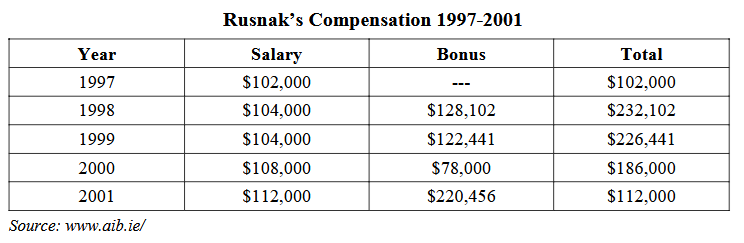
Rusnak's annual bonus was directly related to his net trading profits. He received a bonus equal to 30 percent of the net trading profits he generated in excess of five times his salary. By constantly manipulating his trading profit figures, Rusnak was able to generate a hefty bonus for himself during the five-year period from 1997 to 2001 (Refer Table I for details about Rusnak's compensation). In June 2001, Rusnak also got promoted to the post of managing director in charge of foreign exchange trading.
Table I
 |
In December 2001, during a checking, the back-office supervisor made an enquiry with an employee responsible for confirming foreign exchange options about two trade tickets that did not have confirmations attached to them. The back office employee said that offsetting trades with the same counterparty did not required confirmation. However, the supervisor insisted that all trades required confirmations, regardless of any offset and irrespective of the counterparty.
For the month of December 2001, the foreign exchange trading turnover was reported to be $25 bn. The high turnover drew the attention of Allfirst's treasurer and he became concerned about Rusnak's trading operations. In order to verify Rusnak's trading, he planned to square off all Rusnak's trading positions. On January 28, 2002, the treasurer ordered the settlement of all Rusnak's trading positions. The back office staff supervisor started verifying the confirmations of Rusnak's trading deals. It was found that there were 12 unconfirmed trades. Subsequent confirmations provided by Rusnak for these trades seemed bogus and the back office manager insisted on confirmations on the phone. Rusnak agreed to provide the phone numbers of brokers who arranged the trades by February 03, 2002. However, Rusnak neither called up nor reported to the office from February 4. The treasurer reported the matter to Allfirst's senior management who informed the AIB headquarters.
Table II
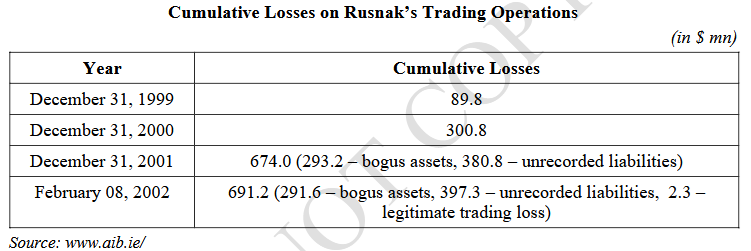 |
The discovery of bogus options immediately led to an intensive review of Rusnak's trading transactions by AIB and Allfirst. Transactions for each of the 71 counterparties were examined. Nineteen of them were Asian counterparties to whom all the transactions were found to be bogus. For 47 counterparties, no bogus transactions were found, and none of the transactions fitted the bogus-option pattern (that is, same-day transactions that netted out). Finally, AIB and Allfirst discovered that there were five counterparties with whom there were unrecorded real options that had been removed with bogus liquidating options. Out of $691.2 mn loss, a major portion of the loss occurred in 2001 and 2002 (Refer Table II).
Industry analysts felt that a combination of factors led to the loss at Allfirst. The bank had completely failed to implement a proper operational control system. Due to the lack of effective control and supervision, Rusnak got an opportunity to conduct fraud and also successfully hide them from being detected. The major reasons that led to the disaster were:
CONTROL SYSTEM DEFICIENCY
There were numerous deficiencies in the control system of Allfirst. The absence of any net cash payment from Rusnak's trading activity and the difficulty in confirming trades at midnight had resulted in the back office decision not to confirm offsetting pairs of options trades with Asian counterparties from early 2000. Confirmation of all trades was the basic standard practice, and failure to do so proved to be a disastrous for Allfirst.
Another major deficiency was the failure of the middle and back offices to obtain foreign exchange rates from an independent source. On the request of Rusnak, the treasury risk control analyst had developed a system wherein the rates would be downloaded from Rusnak's Reuters terminal to his personal computer's hard disk drive, and then fed into a database on the shared network, making it accessible to the front, back, and middle offices. Through this system, Rusnak could manipulate the prices – a key input into the bank's back office and risk control functions.
The lack of experience and inadequate staff resulted in the internal audit department paying less attention to foreign exchange trading as a possible risk area. The confusion between the middle office and the credit risk department regarding their scope of control ensured that neither of them investigated the instances where Rusnak had exceeded the counterparty credit limits
INADEQUATE SUPERVISION
Inadequate supervision ensured that Rusnak was able to carry on with his fraudulent activities without being detected. In spite of the huge size of Rusnak's positions, none of his supervisors – trading manager, treasury funds manager or treasurer – undertook a careful examination of Rusnak's trading positions. A little vigilance would have raised questions as to why the offsetting options for the two different expiration dates had the same premium and why the deep-in-the- money options expired unexercised by the counterparty. The basic requirement of examining Rusnak's daily profit-and-loss figures and their reconciliation with the general ledger was also not done properly.
The prime brokerage account used by Rusnak had a feature that allowed Rusnak to net trades at the end of each day. This prevented the treasury risk control from determining if there had been off-market trades with a particular counterparty in the course of that day. The back office also did not always confirm the end of the day settlement positions and considered the confirmation process as a mere formality.
FAILURE TO REVIEW POLICIES AND PROCEDURES
The risk control department at Allfirst never made an attempt to benchmark the policies and procedures against the best practices in the industry. They relied on the Value at Risk (VAR) model (Refer Exhibit II) and ignored other risk related information that was available to them. The VAR model developed by the AIB Group used the Monte Carlo simulation technique to generate 1,000 hypothetical foreign exchange spot and volatility rates and calculated the resulting profit or loss. The VAR is equated to the tenth-worst outcome produced by the simulation, which yields a 99 percent level of statistical certainty.
Rusnak manipulated the VAR in many ways. Firstly, the bogus options noted by Rusnak appeared to hedge his real positions thus reducing VAR. Secondly, he manipulated the figures of holdover transactions (transactions entered into after a certain hour towards the end of each day), which were critical inputs in the calculation of the VAR. As a result, the transactions created an illusion of reduction in Rusnak's open currency position, which in turn, resulted in a lower VAR (the larger the open position, the higher the calculated VAR). The employee responsible for checking the VAR relied on a spreadsheet that obtained information regarding the holdover transactions from Rusnak's personal computer.
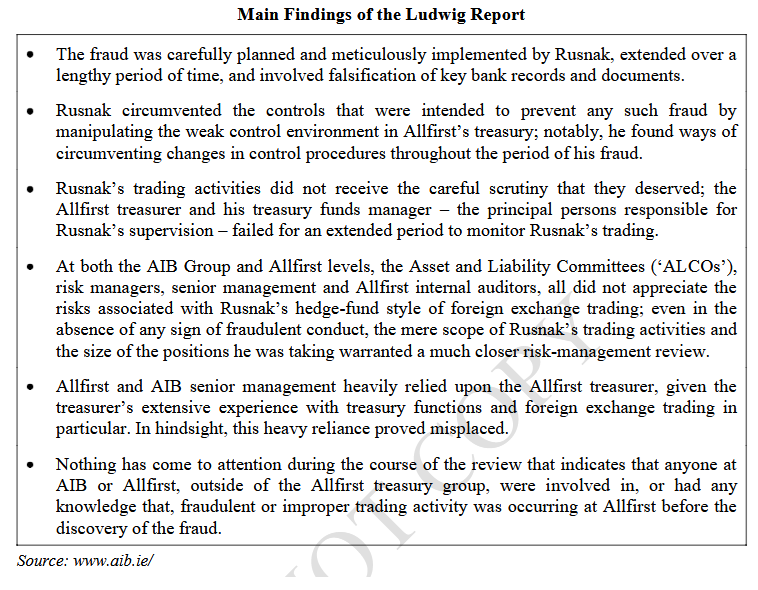
After the fraud was discovered, AIB undertook a thorough investigation into the foreign exchange trading operations at the Baltimore headquarters of Allfirst. The investigation was led by Eugene A. Ludwig, an eminent US banking figure. Ludwig disclosed his findings in a report (Refer Exhibit III), which blamed the weak control environment at Allfirst for the fraud. Alfred J.T. Byrne, the chairman of the financial institutions practice at LeClair Ryan, a Richmond-based law firm said, “The Ludwig report makes clear that some of those responsible for compliance with internal controls at Allfirst were asleep at the switch. One has to wonder whether the lights were out at Citi or Bank of America on these transactions as well.”
Following the report, AIB discontinued all foreign exchange trading operations in Allfirst with the exception of customer service obligations. The company decided to centralize the management and control of all its treasury activities throughout the AIB Group, bringing them under its subsidiary AIB capital markets, based in Dublin, Ireland. The fraud was reported to the US Federal Bureau of Investigation seeking its assistance in the investigation. AIB fired Rusnak and six other employees – the executive vice-president & treasurer, the senior vice-president of treasury funds management, the senior vice-president of investment operations, the head of the internal audit, an operation unit clerk and an internal audit staff. To reflect the fraud losses, AIB restated Allfirst's earnings from 1997 to 2000 and the first three quarters of 2001. The restatement reduced 1997-2001 earnings by $438.1 mn. The reduction for 2001 was $242.6 mn. Frank Bramble, the chairman of Allfirst, opted for retirement, in June 2002.
AIB appointed John G. Heimann as a special advisor to the Board on Risk Management across the AIB Group. In January 2003, Rusnak was sentenced to seven and a half years in prison and five years' probation. He was also ordered to compensate the losses incurred by Allfirst. The court ordered him to pay $1,000 a month during his probationary period. In May 2003, AIB sued Citibank and Bank of America seeking to recover about $500 mn in compensatory damages – the share of the losses it attributed to the banks' alleged wrongdoing.
Analysts stated that AIB being Ireland's largest bank had a strong financial position which would enable it to overcome the losses from the fraud. They further stated that in view of the numerous trading scams, it was time that commercial banks with trading operations gave due importance to risk management. Apart from creating strong risk management policies and procedures, banks should provide effective management supervision, examine all new trading strategies very carefully and avoid dual reporting relationships.
Exhibit I
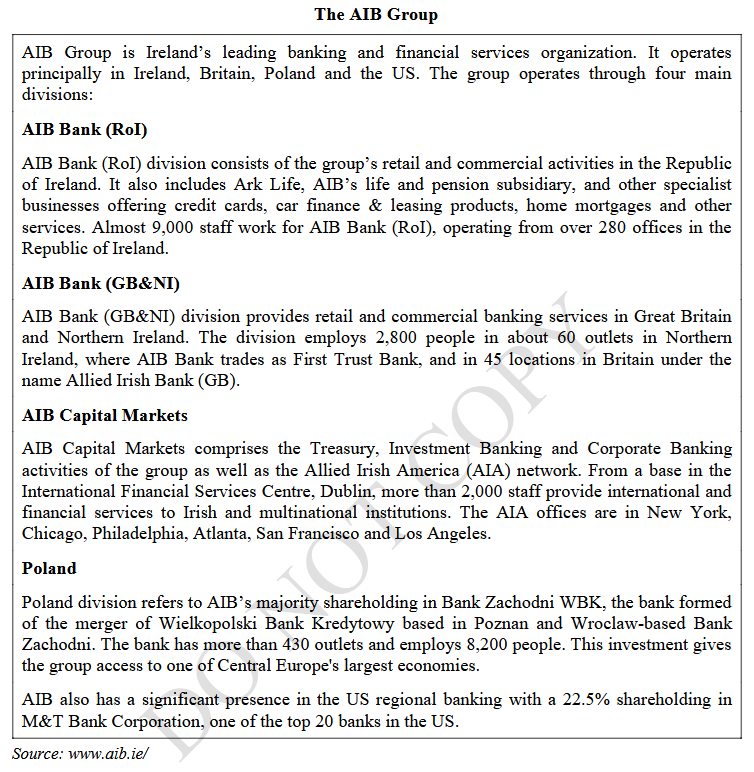 |
Exhibit II
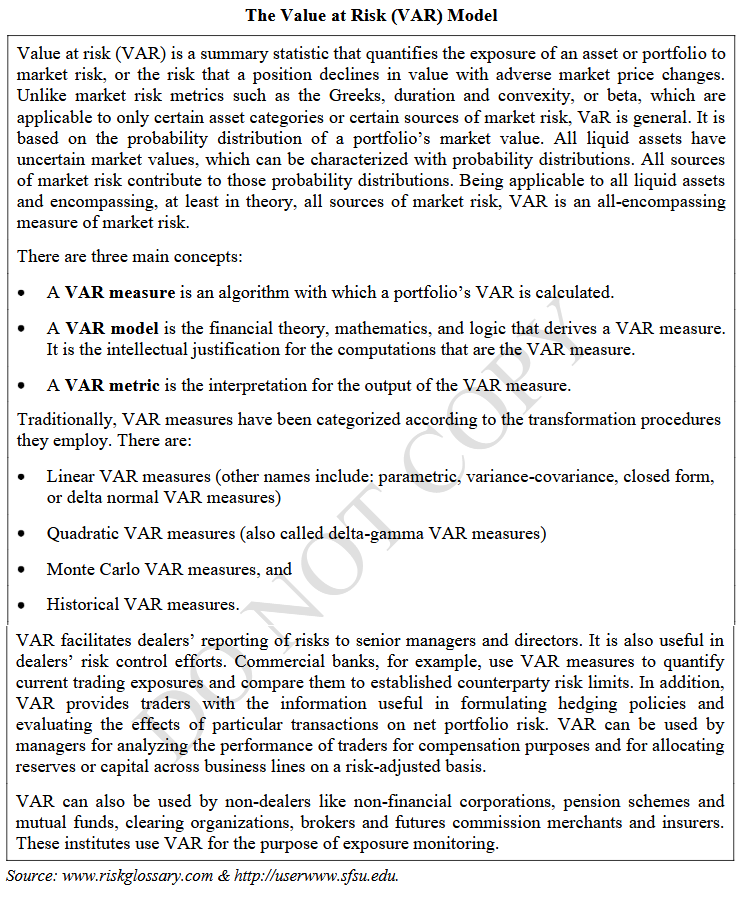 |
Exhibit III
 |
Keywords
Allied Irish Banks, Currency Derivatives, Corporate Disasters, Value at Risk, VAR Model, Management Controls, Risk Management in Banks, Asset and Liability Management, Ludwig Report, Arbitrage, Currency Options, Currency Forwards