
Wipro’s PCMM: Level 5 Certification
🌐 International Buyers — Pay via PayPal
Details
HROB010
10
2002
YES
0
Wipro Limited
Technology & Communications
India
Competitive Strategy ,HR Policy, Human Capital
Abstract
The case examines the HR measures taken by software major Wipro to get itself assessed on the PCMM standards. The case also discusses the evolution of CMM and PCMM standards besides examining the potential benefits for Wipro after the certification.
Learning Objectives
The case is structured to achieve the following Learning Objectives:
- The importance of quality standards such as PCMM for a software firm.
Contents
To us, PCMM Level 5 is not just another trophy, it is the way we run our business.”
- Pratik Kumar, V.P. - Talent Engagement & Development, Wipro, in December 2001.
Wipro, a part of the Indian software services major and Azim H Premji group of companies was established in 1945 and commenced operations in 1946. In 1947, the company set up an oil mill and hydrogenated cooking medium plant at Amalner in Maharashtra for manufacturing vegetable ghee, edible oil and laundry soap. In 1966, Azim Hasham Premji (Premji) took over Wipro and chartered an expansion plan for the company. This included diversification into manufacturing toiletries and baby care products.
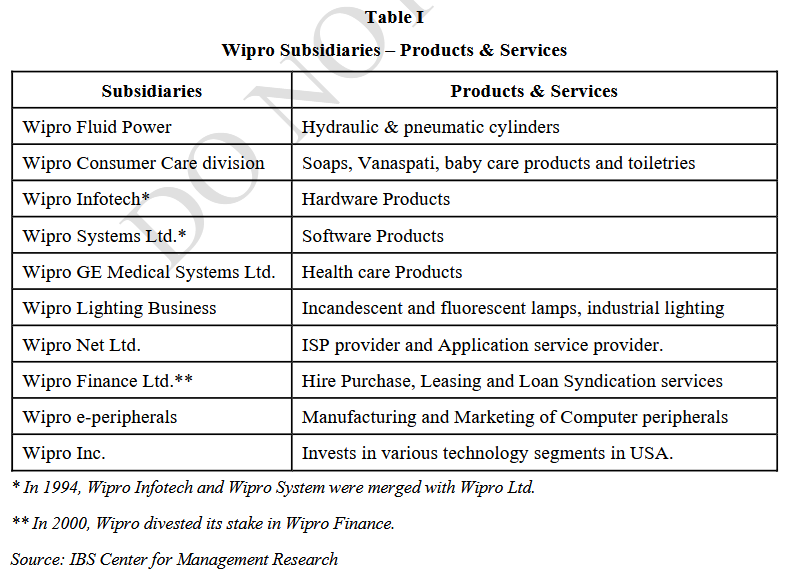
Wipro’s turnover increased from Rs 40.82 million in 1965-66 to Rs 104.09 million in 1970-71. In the late 1970s, the company realized the potential of information technology and set up its own information technology outfit in Bangalore in 1982, under Ashok Narasimham, with a small team of professional R&D and marketing managers. Over the years, company set up various subsidiaries involved in various businesses (Refer Table I for Wipro’s subsidiaries).
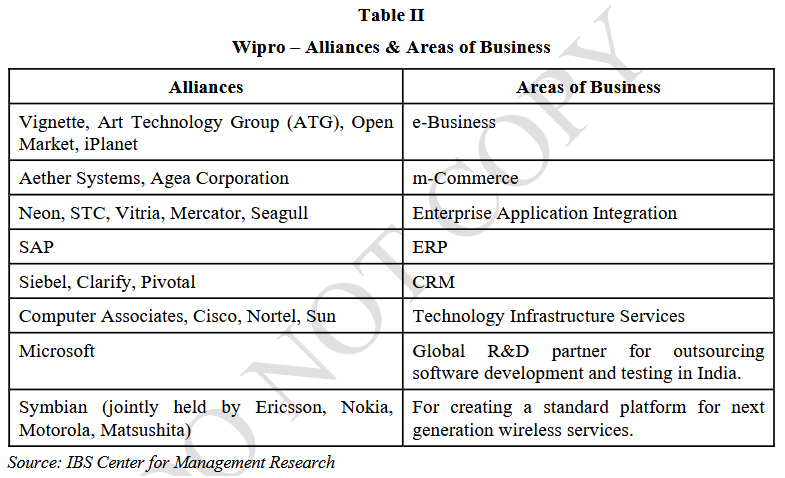
Till the early 1980s, Wipro was well known for its computer hardware products. After 1984, Wipro shifted its focus to software business and started offering offshore software solutions for global companies. The company’s expertise and cost advantages over other companies made it very popular globally. After Wipro Infotech and Wipro Systems were merged in 1994, Wipro became the largest software exporter from India after TCS and Infosys Technologies. Over the years, Wipro entered into various alliances with global IT majors (Refer Table II for Wipro’s alliances).
By the end of the financial year 2000-01, Wipro had emerged as a Rs 31 billion company, offering a complete suite of IT infrastructure solutions, professional services, communication services and business solutions. It provided services in various sectors like telecom, healthcare, retail and systems software. Wipro’s IT division had around 18,000 customers, 7,000 high-end systems across 190 locations and it also had a network of 180 business partners. The company had 14,000 employees, of which around 11,500 were employed in its IT division.
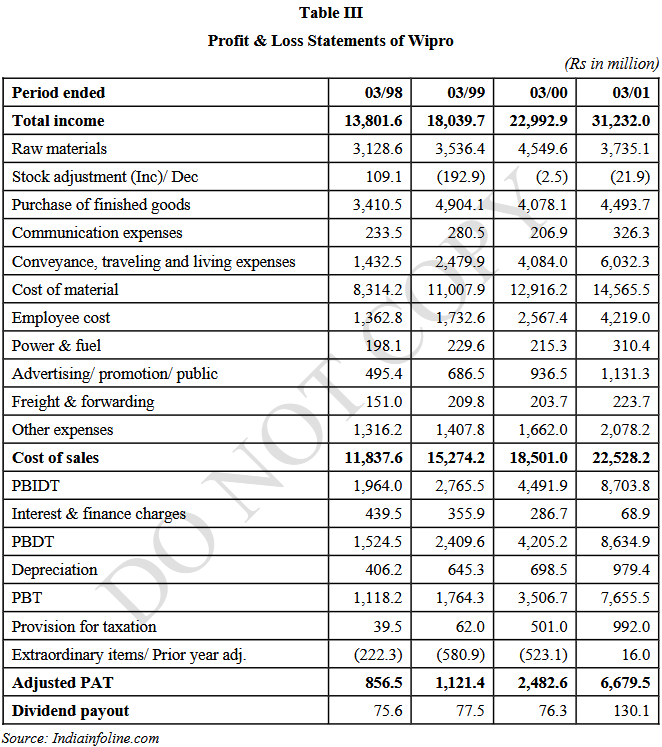
Wipro had 28 development centres spread across India, Europe and USA. It also had 21 offices in USA, Canada, Finland, Taiwan, France and UK. The company’s revenues grew at an annual average rate of 23% and PAT at an annual average of 50%. Global IT services accounted for 57% of the total revenue with a growth rate of about 70%. During 2001, Wipro acquired 114 new clients who contributed around 95% of the total global IT revenues. In comparison Indian IT sales grew by 21%. The company’s consumer care and lighting businesses accounted for 11% of the total revenue. While soaps and lighting grew by 14% and 17% respectively, the vanaspati/hydrogenated vegetable oils business declined by 41% (Refer Table III for Wipro’s financial performance).
Wipro had always paid attention to the quality of its products and services. In 2001, the company successfully acquired the Six Sigma1 certification and also became the first company to be affirmed for the SEI – CMM level 5 in the world. The same year, Wipro received the TL 9000 certification for the implementation of telecom projects and the Bluetooth qualification from the Bluetooth Qualification Body (BQB). The qualification from BQB helped the company provide a complete set of Bluetooth solution. The company’s decision to opt for Capability Maturity Model (CMM) and People Capability Maturity Model (PCMM) certifications was a part of the overall quality initiatives.
In the late 1980s, the global upsurge in the information technology business saw the demand for software soar. This growth also saw an increase in software development, which led to organizations sharpening their focus on the processes used in software development. The need for improved processes required strict process analysis and assessment methods to be put in place. This resulted in the development of the Capability Maturity Model (CMM) standards for software by the Software Engineering Institute (SEI) at Carnegie Mellon University (CMU).
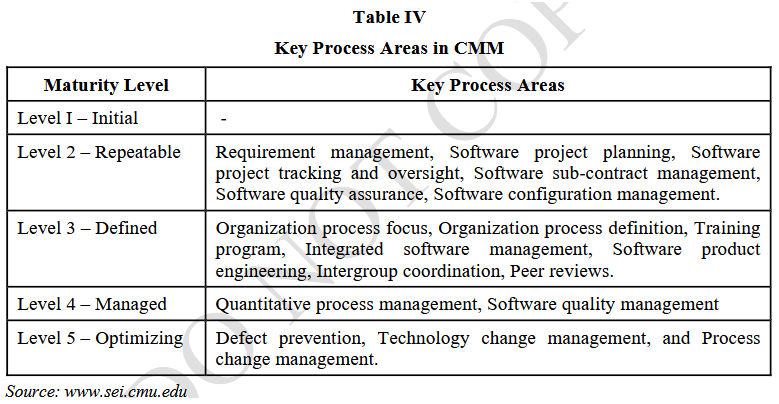
The CMM standards were established in the early 1990s and they quickly gained acceptance in the infotech industry. According to the CMM standards, there are five levels of maturity in an organization’s software processes. CMM specifies certain Key Process Areas (KPAs) for each level, which are associated with specified goals that represent the KPAs for an organization (Refer Table IV for KPAs at each level).
During the mid 1990s, many companies based in India, which were providing software services on a global scale, discovered the importance of getting themselves assessed on the CMM standards. By the late 1990s, of the 23 companies assessed at level 5 worldwide, 17 were based in India. These included Motorola, Wipro, Zensar, IBM, Infosys, CBSI, DCM ASIC, NIIT, CG Smith, Satyam, TCS, COSL, HCL Perot, I-Flex and NeST.
However, some analysts argued that CMM focused too much on the process or technology and it failed to take the people into consideration. Moreover, as organizations realized that implementation of CMM required important changes in the methods applied for managing people, they were forced to focus on issues related to people and HR management as an integral part of managing quality aspects in software development.
During the 1990s, organizations implemented practices such as 360° performance reviews, web enabled learning, knowledge management, team building, incentive based pay and employee empowerment. Though these practices helped in the improvement of workforce practices, many companies failed in implementing them due to the lack of commitment from the top management and an unintegrated approach towards adopting these practices.
Taking these drawbacks into consideration, SEI developed the People CMM (PCMM) standards by adopting those concepts of CMM, which were focused on HR development and were specifically targeted towards talent in software and information systems development. One of the major aims of PCMM was to help organizations integrate workforce practices into a system and facilitate management involvement in their deployment.
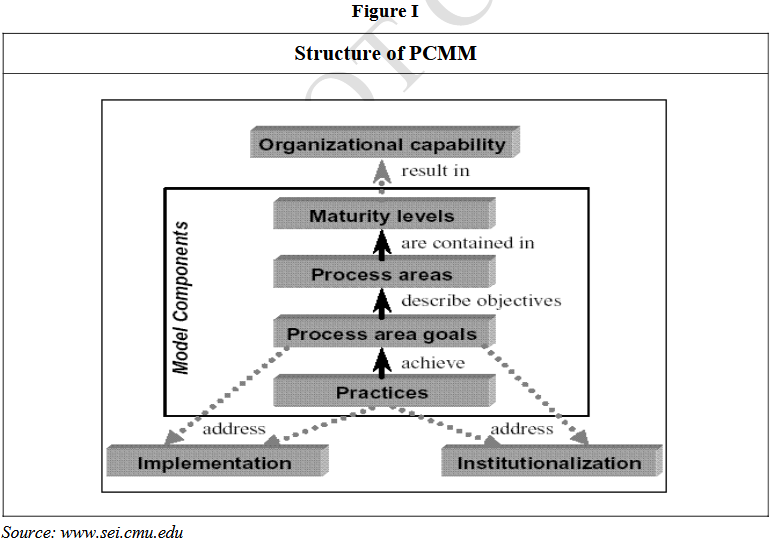
The People CMM concepts were first published in 1995, and companies such as Ericsson and Boeing soon adopted them to guide workforce improvement programs. PCMM was developed to help software organizations to attract, develop, motivate, organize and retain talented people for improving the software development capability of an organization. It was implemented in areas such as staffing, performance management, training, compensation policies, work culture, career development, team building and nurturing future leaders (Refer Figure I for PCMM’s structure).
The PCMM model is based on practices that contribute to the achievement of the process area goals. The workforce practices improve an organization’s capability and enable it to manage and develop its workforce. The practices also help the organization to look forward for the process area goals. The process area goals describe the objectives that have to be accomplished of the process areas, and these goals constitute the requirements for an organization for implementing the workforce practices in a process area. The process area is a set of interrelated practices, which at each maturity level transforms the capability of the organization in managing the workforce. The process areas result in the accomplishment of the maturity levels. Each maturity level can be defined as a cluster of several process areas that contains a set of goals that institutionalize the level of capability of workforce improvement within the organization.
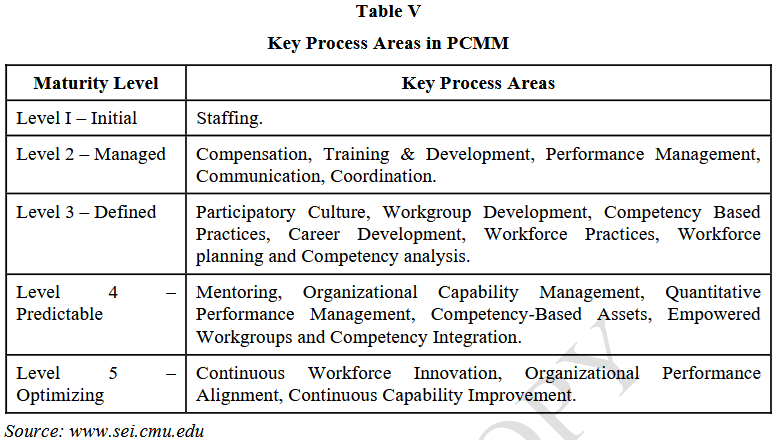
PCMM consists of five levels, with each level (except the initial level) consisting of 3-7 KPAs (Refer Table V). Each KPA is identified with a set of related practices, aimed at achieving workforce capability enhancing goals. At each level, process areas create an inter-linked system of processes, which transform the capability of managing workforce.
PCMM’s emergence in India was largely attributed to the high attrition rates in the software industry. Employee retention became a major concern for many IT companies during the late 1990s, and as a result the emphasis on PCMM increased. In December 2001, Wipro, became the world’s first company to be assessed on Level 5 of the People Capability Maturity Model (PCMM). The Quality Assurance Institute (QAI)6, India, an assessor accredited by the SEI completed the assessment, which covered all the strategic business units and divisions of Wipro, comprising over 6,000 employees.
Wipro decided to get PCMM certification after an internal HR meeting in 1996, where company officials discussed the possibility of becoming a ‘HR No 1’ company. In December 1996, Corporate, Executive VP, Human Resources, Dilip Ranjekar (Dilip), and Ranjan Acharya (Ranjan) VP – Corporate, Human Resources Development, went to the US to conduct an in-depth analysis on the best global HR practices. They studied HR policies of various companies such as AT&T, GE, Tandem and British Telecom for the purpose.
By 1999, Wipro developed a ‘competency dictionary,’ wherein it identified 24 competency areas spread across the five levels of PCMM. The behavioral issues for each level were identified and the procedures to address them were also clearly defined. In September 1999, Wipro took up a study to identify HR areas, where it was weak and conducted an initial gap analysis for level 2.7 Around 137 employees including managers and process owners were covered in groups of 10 and 20 for this purpose. The management realized that the organization already had excellent processes in place even before PCMM. For instance, Wipro was one of the first companies in India to implement practices such as 360° feedback and employee training and development programs for upgradation of skills.
During the next three years, Wipro officials spent a substantial amount of time and resources to understand the practices followed by global companies. In 1999, a team of five top management personnel attended a workshop in Mumbai on the introduction of PCMM, after which Wipro formally decided to implement PCMM. The company’s decision was influenced by the fact that the PCMM program, as designed by CMU, offered clearly measurable results. The company’s top management took personal interest in presenting the PCMM concepts to all employees in the organization. This helped in making the employees understand that PCMM was an expansion of opportunities and aimed at building ‘people leaders.’
All the training needs of employees (to help them fit the PCMM certification standards) were taken care of by the in-house training department at Wipro. Every new recruit in the company was put through a well-structured induction/training program, which covered all aspects of software development skills required. To meet the ever-changing training requirements of its employees, Wipro rolled out e-learning initiatives for all. The ‘training on demand’ service helped employees to take proactive decisions regarding their training needs. These steps enabled the company to meet the requirements of the PCMM level 2.
Having successfully implemented the process areas for level 2, Wipro began to integrate KPAs for level 3. The company focused on the career development path, which consisted of several levels (Refer Figure II). The first stage in the career path was ‘Team Member.’ Employees having less than one year of work experience were made team members for the first few projects. Their primary task was to gain experience with various tools and software development while developing programs. After this stage, employees moved on to become ‘Module Leaders,’ where they interacted with customers in addition to developing software and leading the team.
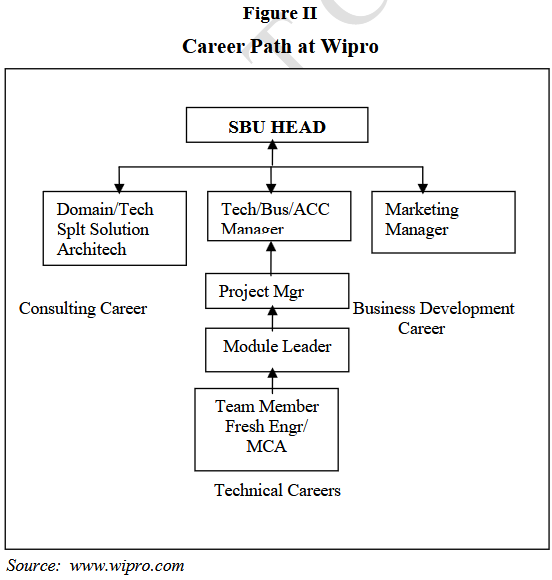
Wipro decided to offer its module leaders, careers in consulting or in business development. If an employee chose a technical career, he became the Project Manager, and was made responsible for setting standards for a project, building customer relationships and providing technical assistance for his team. He was also in charge of developing of a good work culture and environment for his team, besides interacting with other internal departments. Project managers became Technical Managers, managing multiple projects and relating to customers, people and business. Successful technical managers could become a Head for any of Wipro’s strategic business units (SBUs). Wipro employees were allowed to alter their career path midway to suit their core competencies. The opportunity to shift to either functional or technical specialization eventually was dependent on the employee’s interest and expertise.
Wipro also appointed an external agency to conduct the yearly ‘Employee Perception Survey’ to know employee perception and help management understand the requirements for high employee morale. The management ensured that the outcome of the survey was implemented to motivate, empower and recognize the employee’s performance.
After integrating the career development of employees with its strategic HR policies, Wipro concentrated on integrating key process areas of the PCMM level 4. One of the important features for achieving PCMM level 4 was the organization’s ability to mentor leadership qualities in employees and empower them to take decisions which would result in the capability management in the organization. Wipro recognized the need to groom employees and develop leadership qualities and started the Wipro Leaders Program. The program had various options such as Entry Leaders Program, Wipro Leaders Program, Business Leaders Program and Strategic Leaders
Program that were designed to enable employees face challenges in their career path. The Entry Leaders Program was for employees who were at entry level positions in the company, Wipro Leaders Program was for employees who were already team leaders, Business Leaders Program addressed the leadership qualities in business leaders and the Strategic leaders Program was for Strategic leaders.
According to Ranjan, at Wipro, leadership grooming was not a just matter of intention but it was a process of continuous support. The company followed an integrated approach towards selecting and grooming leadership qualities in employees. For all the above programs, the company sought to develop the competencies of the employees through training, coaching, exposure, delegation of authority, counseling and value clarification.
While selecting the employees for the programs, Wipro set certain parameters. The company tested not only the employees’ IQ and technical knowledge but also potential leadership competencies. The company delegated enough responsibilities to the employee to prove his leadership abilities and groom his people skills. These initiatives filled in the gaps for reaching the PCMM level 4.
To reach PCMM level 5, Wipro began putting in place measures to further streamline its manpower planning and HR policies. To meet the ‘Continuous Capability Improvement’ KPA, Wipro made a resource commitment of 5% of its overall manpower costs towards employee training.
The most critical aspect of the exercise was fixing the gaps identified by the gap analysis. The management formed taskforces for this purpose. That consisted of line managers as well as personnel from corporate HR. Wipro also had an assessment team consisting of 7 line managers, 3 HR staff and 2 quality staff. In December 2001, Wipro achieved the PCMM level 5 certification for which over 100 people had worked over 2 years.
According to sources at Wipro, the certification was expected to help the company implement change management effectively. The company also expected to achieve the goal of ‘business development integrated with people development.’ After the successful assessment, Wipro claimed to have achieved the ability to focus on its people processes and the learning abilities of its personnel. It expected to achieve increased productivity and skill sets for its employees. The company also believed that it was in a position to adapt better to the rapid changes in the Indian information technology industry.
The PCMM certification not only helped the company increase its internal energy levels, it was also being seen as an affirmation of Wipro’s focus on having the best ‘people and business processes.’ According to company sources, PCMM had enabled Wipro to provide its employees with better training and on-the-job experiences. Industry analysts felt that the certification would go a long way in helping Wipro integrate its human resources with its strategic objectives and organizational goals. They added that employees will feel more involved in the processes of the company and become more committed towards the company.
Many other companies followed Wipro and initiated PCMM implementation in their organizations. These included Hughes, Mastek, Intelligroup, Datamanics and the Indian subsidiaries of Oracle and Samsung. Both Intelligroup and Datamanics were awarded the PCMM level 2 certification. According to analysts, this was expected to help Indian software companies further establish their stronghold in the global IT business and become better equipped to withstand the global slowdown in the early 21st century.
1. Comment on the circumstances that led Wipro to opt for the PCMM certification. What were the basic objectives underlying the program?
2. Study the evolution of the PCMM standards as an integral part of the software quality initiatives of SEI. Also make a comparative analysis of the five level structure of the CMM and PCMM standards.
3. Explain the methodology employed by Wipro in implementing the PCMM model and integrating it with its operations. How far do you think the existing infrastructure facilitated speedy and successful introduction?
4. What is the nature of potential contribution that PCMM could make to companies like Wipro who are competing globally and dependent critically on export business?
Keywords
Wipro, SEI-CMM standards, PCMM standards, Human resource practices in IT companies, Career path, Training programmes
Related Case Studies
| Case Title | Details | Price | Add to Cart |
|---|---|---|---|
|
Case Title The Nirma StoryCase Code: MKTG008 |
Details | 300 | Add to Cart |
|
Case Title Xiaomi: Charging Ahead in China’s EV RaceCase Code: BSTR714 |
Details | 500 | Add to Cart |
|
Case Title Ulta Beauty under CEO Kecia Steelman: Unleashing Growth in a Slowdown?Case Code: BSTR713 |
Details | 500 | Add to Cart |
|
Case Title JPMorgan’s Return-to-Office Policy in 2025Case Code: CLHR101 |
Details | 300 | Add to Cart |
|
Case Title BYD VS. Tesla: The Electric Vehicle Race in ChinaCase Code: BSTR711 |
Details | 400 | Add to Cart |